Solo SaaS Reaching $10K MRR Without Paid Ads
Most solo SaaS founders fail at distribution, not product.

The distribution of outcomes and where most founders get stuck
Reaching $10,000 in monthly recurring revenue as a solo SaaS founder, without spending a dollar on ads, is a repeatable outcome. It is not a fluke story you hear once a year and file away. It happens for founders who treat getting customers as a system they design on purpose, built alongside the product, not something to figure out after the product ships.
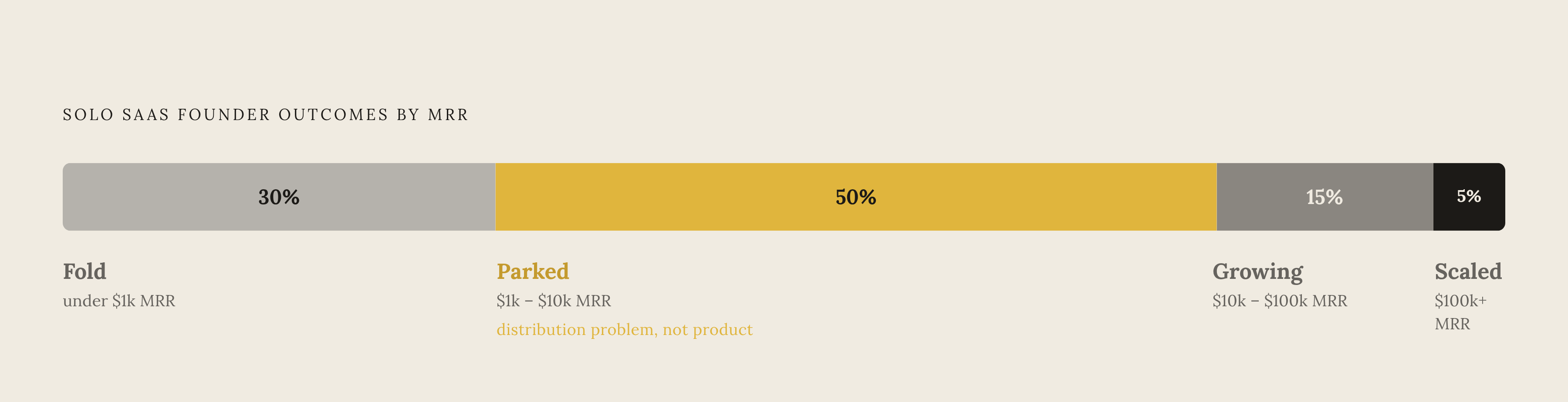
The pattern across enough micro-SaaS founders looks the same every time. Roughly 30% never clear $1,000 MRR and fold quietly. Half land somewhere between $1,000 and $10,000 and stay parked there, sometimes for years. About 15% break into the $10,000 to $100,000 range, and only 5% ever clear six figures a month.
That middle 50% is the group to study, because their product is rarely the issue. The app works. Customers who find it tend to stick. What's missing is a system for getting found in the first place, and most of them treated that system as an afterthought instead of a launch requirement.
Distribution trips up solo founders more than product quality, more than pricing, more than anything else on the list. That's a hard thing to sit with after six months spent polishing features nobody asked for yet.
Recent tracking on solo SaaS founders puts $1,000 MRR at two to four months in, $5,000 somewhere between six and twelve months, and $10,000 stretching to nine or eighteen months. Knowing that runway going in beats discovering it the hard way at month seven, staring at a flat graph and wondering what broke.
Burnout kills more of these companies than a bad roadmap decision ever will. A weekly split that keeps this in check dedicates the largest share of time to building and marketing, with sales conversations and the operational grind that keeps the lights on filling the rest. Distribution is a major part of the job, by design, starting week one, not week twelve.
B2B and B2C founders are not playing the same game. Founders building for businesses reach the top outcome tier far more often than those chasing consumers, and by month 24, median B2B revenue runs more than four times median B2C revenue for solo founders. Businesses with expensive, specific problems pay to make them disappear, and keep paying, which is why B2B median revenue runs so far ahead of B2C at the two-year mark.
Choosing the right problem: why boring, specific, and already-painful beats ambitious
"AI for small businesses" is a mood board. "Automated appointment scheduling for orthodontists" is a niche, with an exact person who needs it, an exact tool they're currently limping along with, and an exact moment in their day when that tool breaks. Vague targeting is the root cause behind most distribution efforts that go nowhere. Nobody can write a cold email, a landing page, or a piece of content aimed at "small businesses." Plenty of people can write all three aimed at orthodontists still booking appointments by phone.
Before any code gets written, the first week or two should go entirely to interviews. Twenty to thirty conversations, in a niche already familiar, using nothing more than LinkedIn messages, Reddit threads, and cold DMs. Free tools, real conversations, no shortcuts.
The best problems are usually already being solved badly, by a person, for money. Scan Upwork job postings and a pattern jumps out fast: repetitive tasks people already pay someone else to do by hand. That's a market with a price tag already attached to it.
The complaints sit in public view too. Negative reviews on G2 and Capterra, Reddit threads, one-star App Store reviews: together they form a free research database showing exactly where existing tools fail people. Confirm the pain appears at scale across multiple public feedback sources before building anything against it.
Pauline Clavelloux, who's solo-founded four companies including Refindie, grew a SaaS to €10,000 MRR with no ad spend by talking to users every day, building only what multiple customers asked for, and staying the best at one narrow niche instead of chasing the broadest audience in a big one.
Sell before building anything. A landing page with a deposit request, or a paid waitlist, tells the truth fast. One founder who burned $47,000 and eighteen months on an AI startup pointed to the real mistake afterward: asking people what they'd pay for, instead of asking them to actually pay. Asking someone to imagine paying costs nothing and proves nothing. Asking for the card number proves everything.
Skip the long sales cycles too. Healthcare, enterprise, government: these can work eventually, but not for a solo side project trying to prove itself by month three. Pick a segment where one person on one call can say yes.
The minimum lovable product
The bar for "good enough" moved, and it isn't coming back down. AI made it fast for nearly anyone to ship something that technically runs, so a barely-working product doesn't stand out anymore. It just blends into a pile of other barely-working products. An early user's reaction needs to land closer to "finally, someone gets it" than "okay, this works."
A tight feature set aimed at one pain point, built well: that's the target, and it should get tested against the interview cohort before any public launch, not after.
A useful scope check circulating in solo-founder circles: if the first build stretches past six weeks, that's a warning sign. Ship something real at six weeks and let actual user feedback run the roadmap from there, instead of guessing at features in a vacuum.
Charge from day one. Even $29 a month works. Free betas pull in people who vanish the second money enters the conversation, while early payment is the clearest signal available that a problem is urgent enough for someone to hand over a card. Price against the value delivered, not against what it cost to build: a tool that saves a small team ten hours a month at $50 an hour is a bargain at $99. Aim for a price point that reaches $10,000 MRR with a customer count one person can actually support without hiring anyone.
On the stack itself: boring, well-documented, AI-friendly technology beats anything clever. The real edge at this stage is taste, speed of iteration, and how fast the product gets in front of real people. For founders who don't write code, the build decision has split cleanly away from the coding decision, a split covered in full further down.
The organic channels that move founders from zero to $1K MRR
At zero MRR, distribution runs entirely through the founder. There's no team, no outsourcing, no delegation, not until somewhere around $5,000 MRR. The founder is the sales team, the support desk, and the marketing department, all at once.
Building in public works because it's honest. Posting on X, Indie Hackers, or Reddit communities like r/SaaS, with something like "Week 1: interviewed 20 users, here's what I learned," builds trust faster than a polished landing page ever will. People follow a real story. They scroll past a brand.
Cold outreach still works, at volume: something like 50 personalized messages a week on LinkedIn or by email, each one referencing a specific pain point ("referencing a specific pain point the recipient actually has"). Personal beats templated every time, and a message that reads like a template gets deleted like one.
Community seeding means trading beta access for honest feedback in relevant forums, not chasing traffic for its own sake. The goal is one real person saying "this worked for me," not a spike in visits that never converts into anything.
Every early user gets the full-service treatment: personal onboarding, bug fixes at 11 p.m., a genuine thank-you note. None of that scales, by design. It's what compresses the feedback loop fast enough to shape a product actually worth telling people about later.
Cross-promotion with adjacent tools brings in users without a single ad dollar spent. From day one, track exactly where signups come from, then push harder on whichever channel is already converting, instead of spreading thin across five platforms hoping one sticks.
Building the content system that compounds from $1K to $10K MRR
Plenty of founders write a post, design a graphic, hit publish, get zero customers, and burn out wondering why it didn't work. Producing content is not the same thing as running a content system, and that gap is where most of this effort quietly dies.
The fix starts with a mindset switch: stop acting like a creator and start acting like a problem-solver. Content's job is to move the ideal customer forward, even if they never pay a cent for it.
Voice-of-customer research comes first: collecting the exact words customers use to describe their pain, pulled from sales calls, support tickets, Reddit threads, and review sites, before a single sentence gets written. Then comes a pillar-and-cluster structure, one deep, authoritative page per core pain point, surrounded by shorter posts answering the long-tail questions that kept coming up in those interviews.
SEO fits neatly into this because long-tail terms like "best feedback tool for indie devs" carry low competition and high buying intent. A single founder can rank for those without a decade of domain authority behind the site.
Marketing deserves roughly 60% of a founder's time once the product is live. That reallocation is hard for most builders to accept, and it's what separates the plateau group from the group that keeps climbing.
One piece of research should turn into a blog post, an X thread, a Reddit comment, a newsletter snippet, maybe a short video. The solo constraint demands that every hour spent on content produce output across more than one channel, because there's no second hire around to pick up the slack.
Trust compounds in a way paid reach never does. Content that solves a reader's actual problem makes the paid product the obvious next step when they're ready, no pitch required. A small, consistent, documented content plan beats sporadic high-volume posting, every time, in every industry.
Sequencing channels as MRR grows
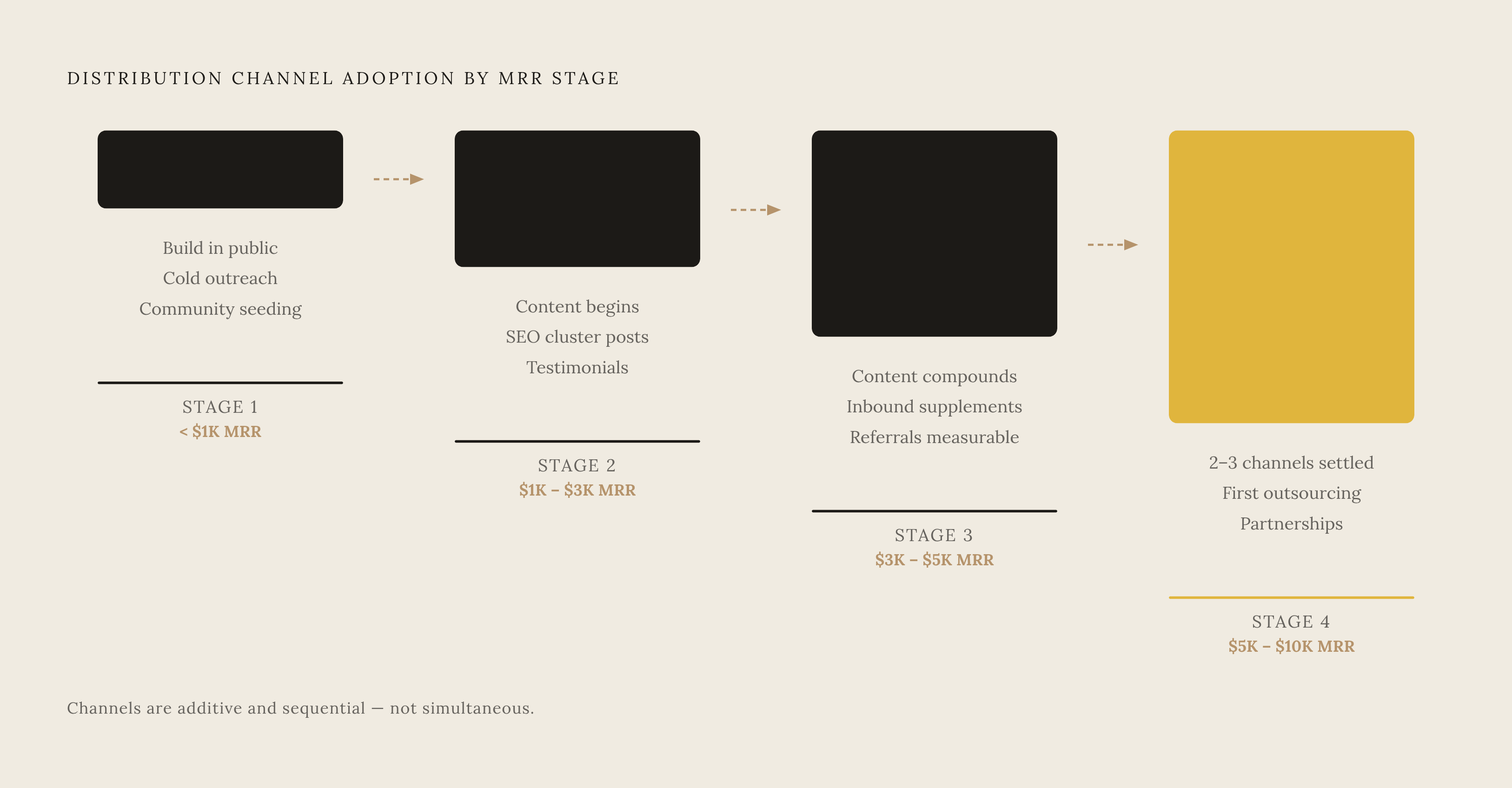
Before $1,000 MRR: build in public, cold outreach, community seeding. All founder-led, all direct, nothing automated yet.
Between $1,000 and $3,000: content enters the picture, built off the voice-of-customer research already collected. SEO starts with long-tail cluster posts. Hand-holding every user continues, and testimonials start getting collected on purpose instead of by accident.
From $3,000 to $5,000: content starts compounding on its own, and inbound from search begins supplementing outbound effort. Referrals become a measurable channel if churn stays low, and a public feedback board helps early users feel invested in what gets built next.
From $5,000 to $10,000: the channel mix settles into two or three working together, not five running in parallel. This is where first hires or outsourced repetitive tasks start making sense, and where partnerships and integrations become a real distribution channel.
Two to three channels, maximum, at any given stage. Founders who spread across every platform at once dilute their attention below the point where any single channel has a chance to compound. Churn needs to stay under 5% a month or the compounding math falls apart entirely, and customer acquisition cost should get recovered inside six months.
Around $2,000 to $5,000 MRR is a commonly cited inflection point where a stitched-together tool stack starts costing more in cognitive overhead than it saves in dollars. That's also, not coincidentally, the point where operations start eating into time that should be going toward distribution instead.
How non-technical founders can ship something worth distributing
The barrier to shipping has changed shape. It used to mean knowing how to code, or having the cash to hire someone who did. Now it means knowing what to build and being able to describe it clearly enough for a tool to build it correctly.
No-code and AI-assisted app builders are the default path now. The majority of new applications built today lean on low-code or no-code tools, a sharp reversal from where the market stood just a few years back.
The newer AI app builders differ from older no-code tools in one important way: some generate real, exportable code rather than locking a founder inside a proprietary visual editor with no exit ramp if the platform changes direction or raises its prices.
The hard part left over is the backend: the database, hosting, authentication, and third-party integrations, which most AI builders still hand back to the founder once the front end looks polished. That's the part no prompt fully solves.
Heavy users of credit-based AI builders can pay an extra $100 to $300 a month on top of the base subscription, and an agent stuck looping on a bug burns credits on every failed attempt whether or not it ever fixes the thing. That's an unpredictable bill showing up right when cash is tightest.
The year-one cost gap between paths is stark. A no-code SaaS build has been estimated to run between $5,000 and $30,000 in the first year, against $100,000 to $400,000 for a custom-coded build covering developer salaries, hosting, and infrastructure over the same stretch. The no-code path costs less up front, but its fees scale with usage, and the sticker price rarely reflects the integration work required to connect all the pieces together.
Comparing the platforms non-technical solo founders use to ship
A handful of platforms now cover most of what a non-technical solo founder needs to go from idea to a working, sellable product, and they split into two distinct camps.
Full-stack AI app builders sit at one end: describe the product in plain language, and the tool generates a working front end, wires up a database, sets up user accounts, and deploys to a live URL, all in one pass. The strongest of these have moved toward generating standard, portable code rather than locking founders into a closed system, which matters the day a founder needs to bring in a developer or switch hosting providers. Pricing in this category tends to run on credits, rewarding efficient prompting and punishing an agent that gets stuck in a loop.
One platform in this category was acquired for roughly $80 million in 2025, with additional payments tied to performance through 2029, a sign of how fast this segment has consolidated. It builds full-stack apps from plain-language prompts, bundling database, authentication, and hosting into one package with nothing external required. That bundling makes it fast for a beginner to get moving, but it carries a real trade-off: the backend runs on infrastructure that belongs to the platform, so pulling out and rebuilding elsewhere later means genuine rework, not a quick export.
At the other end sit the more established no-code platforms built for complex logic: workflows, databases, and multi-step user interactions, all without a line of code. These have powered plenty of real SaaS products and marketplaces over the years, and they typically offer a free tier to start, with paid plans beginning around $29 a month.
None of these tools replace the interview process, the pricing decision, or the six-week scope discipline covered earlier. They just remove the excuse that not knowing how to code is a reason to wait.