Product Hunt Launch Strategy for Solo Founders
Earn thousands of launch-day visitors by preparing four to six weeks ahead.

Product Hunt remains one of the only free channels where a solo founder can put a product in front of thousands of genuine early adopters in a single day. That much hasn't changed since the platform's early years, even though the mechanics behind a good launch have gotten a lot more complicated.
A strong launch can pull in anywhere from 5,000 to 50,000 visitors inside 48 hours. It also hands you a backlink from a domain with an authority score in the low 90s, which keeps paying off in search rankings long after the launch-day traffic disappears. And it gives you a public marker, a badge, a rank, a real number, that works in a pitch deck or a cold email to a journalist in a way that "we launched our product" never will.
What it won't do is keep growing on its own. Product Hunt doesn't fix a product that hasn't found its market, and it can't rescue a signup flow that loses people at the second screen. Treating launch day as the entire growth plan makes the new-user chart look great for 24 hours, then it flattens by the next afternoon. The launch is a concentrated, one-day distribution event and a validation moment. Founders who go in understanding that get far more out of the day than the ones chasing a vanity badge, because they've already built the systems the badge is supposed to feed.
Featured selection, the engagement algorithm, and the old playbook's collapse
The biggest shift in how Product Hunt works: products no longer land on the homepage automatically just because someone posted them. An editorial team now reviews every launch and manually decides which ones get "Featured" placement, the badge and visibility that used to be handed out by default to anyone who showed up.
Everything that doesn't get picked goes into the "All" feed instead, still technically live and open to votes, though without the reach of a Featured launch. It's still technically live. People can still find it and vote on it. But the gap in reach is stark: a Featured launch might pull thousands of visitors on day one, while a non-Featured product in the All feed often sees fewer than 100.
Editors score launches against four criteria: usefulness, novelty, craft, and creativity. A launch doesn't need to hit all four. It needs a clear, obvious spike on one or two of them, something that makes an editor stop scrolling instead of moving past it.
Some categories get filtered out before craft or novelty even enter the conversation. Waitlist-only products, blog posts, curated lists, directories, templates, service offerings, lead-magnet pages, and how-to guides all get excluded from Featured consideration. If the thing being launched isn't a usable product on launch day, it won't get picked, no matter how good the idea sounds on paper. Most founders treat Featured as a visibility lottery, when it's really a filter for whether the product itself is done.
Traffic, signups, and conversion benchmarks by rank
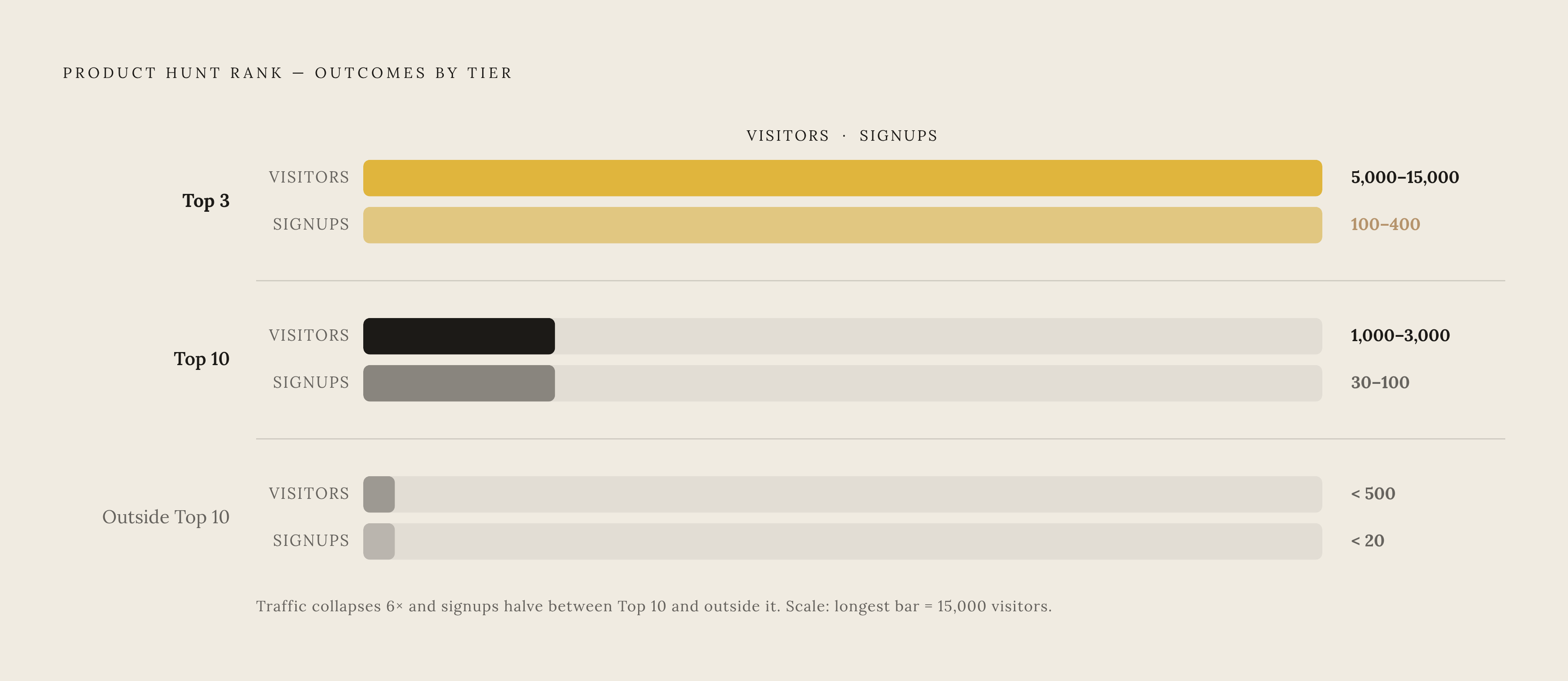
Rank matters, and the curve is steep. A top 3 finish brings 5,000 to 15,000 visitors on launch day and 100 to 400 signups. A top 10 finish brings 1,000 to 3,000 visitors and 30 to 100 signups. Finish outside the top 10, and traffic drops under 500 visitors with fewer than 20 signups, with most of that activity concentrated in the first few hours as the listing fades down the feed.
Conversion follows its own pattern on well-run launches. Top performers see 15% to 25% of visitors turn into signups. Of those signups, 35% to 45% become activated users within a week, and of the activated users, 5% to 10% become paying customers within 30 days. That last number is the ceiling. A more modest but still meaningful outcome, for a founder with no existing audience, is getting Featured at all and converting 2% to 4% of visitors into signups. Most products never get near even that.
Rank is what separates these two outcomes, and rank is earned in the weeks before launch, not on launch day itself.
The 4–6 week preparation timeline that closes the gap between solo founders and funded teams
Most products that land in the top five follow something close to a 30-day preparation runway before launch day. Launches with four or more weeks of structured prep convert several times better than launches thrown together the week before. Time spent before launch day is the mechanism that decides the outcome. It's the mechanism that decides the outcome, and skipping it is the single most common mistake solo founders make.
Four things determine how launch day plays out, and each needs its own runway.
The hunter matters less than founders think. On Product Hunt, someone other than the maker can "hunt" a product by posting it, and if that person has a large following, their followers get notified the moment it goes live. That first wave becomes an initial upvote push that's hard to replicate any other way. Find a well-connected hunter well ahead of launch and explain honestly why the product fits what their audience cares about. But a hunter's follower count means little if they have no real interest in the category. A hunter who understands the product and can speak to it in the comments drives more engagement than raw reach ever will. Assets and story carry more weight than a name attached to the post.
The listing itself needs to survive a five-second glance. The thumbnail has to read clearly even shrunk down in a crowded feed. The tagline should communicate the core value in fewer than ten words, built around the terms buyers actually type into a search bar, not marketing language. The image gallery should tell the story visually, with annotations, so someone scrolling understands what the product does in about 30 seconds without clicking through to the site. The description should open with a specific problem being solved, and the category should match where real search demand actually lives.
A prepared audience has to exist before launch morning. None of this works if there's no one primed to be there the moment the listing goes live.
A maker comment strategy gets its own full breakdown in the next section, since timing on that first comment turns out to be one of the most decisive variables in the whole launch.
And the product has to actually work on launch day. A closed beta with no real access fails the "usable" bar editors check for Featured consideration, no matter how compelling the pitch sounds.
Timing the launch and structuring the critical first six hours
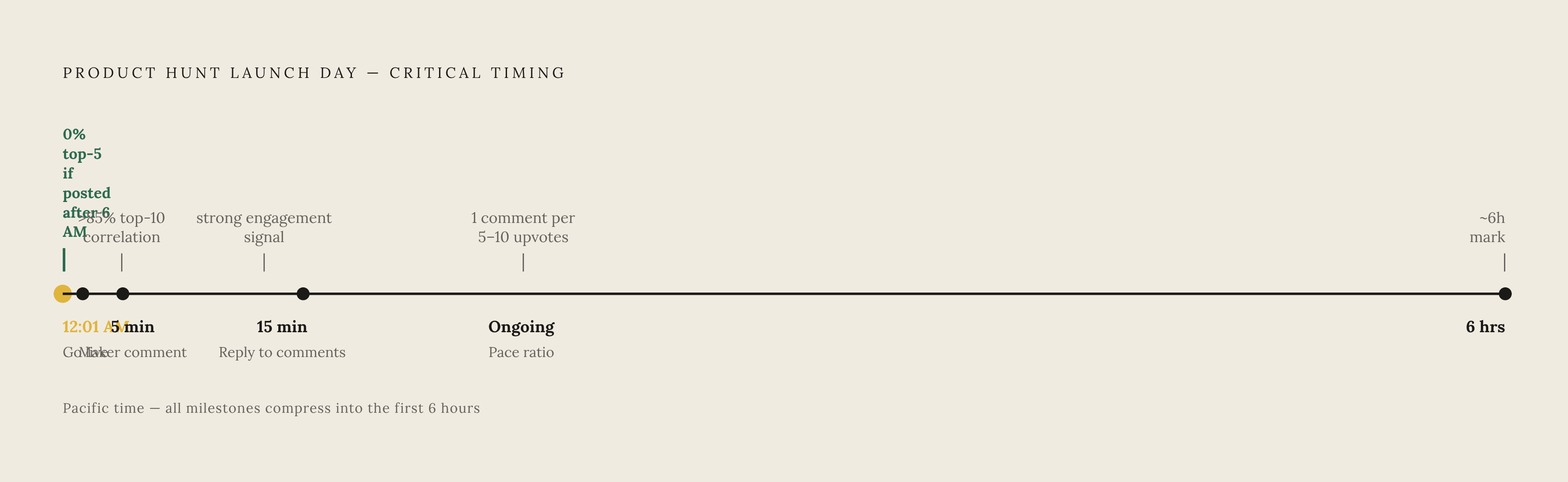
Product Hunt's day resets at 12:01 AM Pacific Time, and that first minute is when a launch needs to go live. Products posted after 6 AM Pacific had a 0% rate of reaching the top five in tracked launch data. There's no making up for a late start. The leaderboard is already moving by the time a late launch even appears in the feed.
Day of the week changes the calculation, and it's a real trade-off, not a footnote. Tuesday through Thursday bring the highest traffic and the highest competition, which suits a founder chasing raw numbers over rank. Friday through Sunday bring softer competition and a realistic shot at the top five or the #1 badge. A Tuesday launch that finishes #6 can still generate more total traffic than a Sunday #1, because the relationship between rank and traffic isn't a straight line. Skip Mondays, Fridays, and major holidays. Check Product Hunt's upcoming launches page about two weeks out so the date doesn't collide with a well-funded competitor.
The maker's first comment carries outsized weight. Posting it within five minutes of going live correlates with reaching the top 10 in more than 85% of tracked launches. That comment needs to read like a person talking: the real story of why the product got built, who it's for, what problem it solves. Write it ahead of time, have it ready to paste, and post it the second the listing goes live at 12:01.
From there, the first six hours decide most of the outcome. Replying to comments within 15 minutes reads as a strong signal to the community, and by extension to whatever weight Product Hunt's engagement scoring gives it. Replies need to sound like an actual conversation. The community notices the difference fast and reacts badly to anything that smells automated. The ratio of comments to upvotes matters too: the sweet spot is one comment for every five to ten upvotes. A launch with 300 upvotes and 30 to 60 real comments will outperform one with 500 upvotes and only 10 comments, because comment activity is what the ranking system reads as genuine engagement rather than a vote-trading push.
Converting the traffic spike: landing page, onboarding, and the 30-day window after launch
Most Product Hunt launches fail in the weeks after launch day, not on launch day itself, because nobody built a system to catch the traffic once it arrived. A launch is a 24-hour visibility event, not a growth plan, and the founders who get real value out of it treat the days right after launch as seriously as the launch itself.
The landing page a Product Hunt visitor lands on should not be the same page everyone else sees. A version that says something like "Welcome, Product Hunt community," paired with a specific, time-limited offer, converts noticeably better than a generic homepage. The Product Hunt audience is curious by nature but slow to commit, so urgency closes the gap. Whatever the value proposition is, it needs to be immediately obvious on landing, since visitors who encounter anything unclear tend to leave quickly. For a B2B tool, the goal is a qualified demo request. For a consumer product, it's a trial signup. For a solo founder without an existing audience, even a modest outcome, 30 honest pieces of feedback and 5 paying customers, counts as a genuinely good result.
Onboarding is where most of that traffic gets won or lost. Products that require booking a call or walking through a long sales process tend to underperform on Product Hunt, because the audience there wants to try something immediately, not schedule a meeting about it. A key factor in moving someone from signup to an active, engaged user is whether they can get real value out of the product quickly. That's a tight window, and it means onboarding needs to be simple enough to ship fast and adjust the day after launch based on what visitors actually do. Non-technical founders building with app tools that handle authentication, the database, and hosting without a developer on standby have a real edge here: they can watch where users stall in the funnel and fix it the same day, instead of waiting on a dev cycle while the traffic spike quietly fades.