Lifetime Deal Pricing for Bootstrapped SaaS

Subscription pricing feels like the safe bet for a new SaaS product. It isn't, not before you've earned a buyer's trust. A lifetime deal, sold right, can fund the months of work it takes to get there, but only if the pricing and structure protect the business from the day it launches.
The math on the standard playbook doesn't add up before product-market fit. A $10 or $20 monthly charge asks a stranger to compete for a permanent slot in their budget, next to tools from companies with a decade of track record and a support team on call. Most say no. Prren found this out directly: left a $250,000 salary, built an AI app, launched it with a free trial and a monthly fee, and got almost nothing for the effort. The pivot to a lifetime deal changed the trajectory. Six months later, the product had brought in $80,000 (per stormy.ai).
Part of that gap is psychological, and it's easy to miss if you're only looking at spreadsheets. A handful of $10 monthly subscribers feels like a hobby project limping along. A $49 or $99 one-time purchase lands like six months of revenue in a single afternoon, and that jolt of cash does something for morale that a trickle of recurring dollars doesn't. The buyer feels it too. The average solopreneur already spends somewhere between $200 and $500 a month on software, which adds up to $2,400 to $6,000 a year, often before their own business is generating much of anything. A lifetime deal removes one of those bills permanently. That's a real trade, not a gimmick.
The scale here isn't a rounding error either. SaaS founders raised $14.6 billion through lifetime deal launches in 2024 alone, and AppSumo alone processed more than 800,000 individual purchases (per fungies.io). This is a mainstream funding channel used by SaaS founders across the board. But a big market doesn't mean the tactic is forgiving. Lifetime deals work. They just only work when the pricing and structure are right from day one, and the rest of this piece is about exactly where founders get that right and where they get it badly wrong.
What a lifetime deal is and what "lifetime" legally means
At its core, a lifetime deal is simple: the buyer pays once, usually somewhere between $49 and $299, and gets permanent access to the software. No monthly bill, no renewal decision, no cancellation flow to design.
"Lifetime" Doesn't mean what it sounds like, though, and this trips people up on both sides of the transaction. It refers to the life of the product. If the company shuts down, gets acquired, or quietly rewrites its own terms, the deal ends with it. Ivacy VPN did exactly that, capping a previously open-ended lifetime term at five years. SiriusXM ran into the same problem from the other direction: its "lifetime" plan was tied to the device, not the customer, and when that mismatch surfaced, it led to a class-action settlement with a real payout attached. Fine print is the actual contract. It's the actual contract.
That mismatch between promise and structure is a big part of why an estimated 40% of lifetime deals fail within three years (per truescho.com). The concept isn't broken. The execution usually is.
The tool that keeps a lifetime deal from turning into an unlimited liability is the tier system, usually labeled Tier 1 through Tier 3, sometimes stretching to Tier 5 depending on the platform. Each tier defines a hard boundary: how many seats, how many workspaces, which features unlock, what usage caps apply. That's the mechanism, full stop. It's what keeps a one-time payment from becoming an open-ended promise.
A properly built lifetime deal includes a discounted one-time price, clearly stated tier limits, a refund window (60 days is standard on AppSumo, shorter on other platforms), and a commitment to deliver updates within the tier the customer actually bought. What it should never include: unlimited future features, unlimited usage, or an implicit promise to absorb the cost of metered services like AI compute forever. Those are liabilities wearing a perk's clothing. They're liabilities wearing a perk's clothing, and the next few sections dig into exactly why.
The conditions that make an LTD the right move, and the ones that don't
Some situations call for a lifetime deal. Others call for anything but.
Run one when the product already works but has not yet found product-market fit, and what's needed is real signal from people who put money down, not another wave of free-tier users who vanish after one login. Run one when the infrastructure cost per user is low and predictable enough that the math on a fixed price actually holds. Run one when the goal is capital without giving up equity or taking on debt. And run one when there's a specific question that needs answering, like whether real users engage with the product heavily or barely use it after purchase (per freemius.com).
Skip it under a different set of conditions. If infrastructure cost scales with usage, meaning AI compute, video rendering, or heavy API calls, a fixed price can't cover an unbounded cost. If the product already has product-market fit and organic growth, a lifetime deal just cannibalizes subscription revenue that would otherwise show up every month. If growth is slow or churn is high, a lifetime deal doesn't fix either problem, it just delays the diagnosis. And if the product can't technically enforce feature or usage limits, none of the tier promises mean anything anyway.
Abhishek Shah's evaluation of a lifetime deal for Testlify makes the tradeoff concrete. The deal was priced at roughly two to three times annual ARPU, which could have generated the equivalent of four to six months of MRR in one lump sum. He turned it down anyway, because every active user keeps generating server costs and support demands whether or not there's a recurring payment attached (per freemius.com). The revenue event ends. The obligation doesn't.
ChatPlayground AI shows what happens when a company promises "unlimited." The company sold unlimited messages at a low one-time price in 2025, then had to revoke every lifetime deal it had ever sold and ask customers to repurchase, a consequence of costs that the original pricing structure could not sustainably absorb.
Before running a lifetime deal, there's one question that settles the whole decision: can a ceiling be put on what each lifetime customer will cost, over time, no matter how long they stick around? If the answer is no, the deal is a liability schedule with a launch date, not a funding strategy. It's a liability schedule with a launch date.
How to price the tiers so the deal funds growth without creating a ceiling
The starting formula is straightforward: take the monthly price and multiply by 36 months for a top tier, 18 months for a mid tier, and 6 months for an entry tier, then round to a clean number (per fungies.io). A $29-a-month product, run through that formula, is around $999 for Tier 3, $499 for Tier 2, and $149 for Tier 1.
The tiered structure, something like $49 / $99 / $149, or $99 / $199 / $299, performs best on marketplaces like AppSumo, because buyers naturally upgrade tiers once they're already committed to buying, which pushes average order value up in a way flat pricing never does (per fungies.io). But the formula only protects the business if each tier has a hard cap attached, seats, workspaces, or usage limits (Tier 1 might mean one workspace, Tier 3 might mean ten). That cap does two jobs at once: it limits the long-term support burden, and it gives buyers a real reason to pay more for the tier above.
Prren's pricing ladder shows how price itself can double as a validation tool. The first 100 buyers got in at $29, a price low enough that if strangers wouldn't pay it, the problem was the product, not the number on the page. Once that milestone hit, the price moved higher, a signal to fence-sitters that the product was moving and the deal wouldn't stay this cheap. From there the price kept climbing as the user count approached 500, then 1,000. By 1,200 users, the running total had reached $80,000 (per stormy.ai).
The math has a ceiling built into it. If a product is sold as a lifetime deal priced to recover costs within a year or two, the deal works on paper. If that customer actually stays for a decade, the business has eaten years of unpaid cost. That's a structural feature of every lifetime deal, and it has to be priced in from the start, not discovered later. It's a structural feature of every lifetime deal, and it has to be priced in from the start, not discovered later.
The BYOK model, bring your own key, solves the sharpest version of this problem for AI and API-heavy tools. Instead of the vendor absorbing variable compute cost forever, users supply their own API key and pay the usage cost directly. Prren's operating costs held near $200 a month for development tools even after crossing 1,200 lifetime users (per stormy.ai), because the variable cost never touched his books in the first place.
Platform vs. self-hosted: where the revenue goes
Lemlist's AppSumo run generated $161,896 in two weeks, a number that looks like an unqualified win until the fee structure gets factored in. After AppSumo's cut, Lemlist kept about 30% of that revenue, roughly $100,000 went to the platform, while the business retained 100% of the cost of serving more than 3,000 lifetime customers going forward (per thebootstrappedfounder.com).
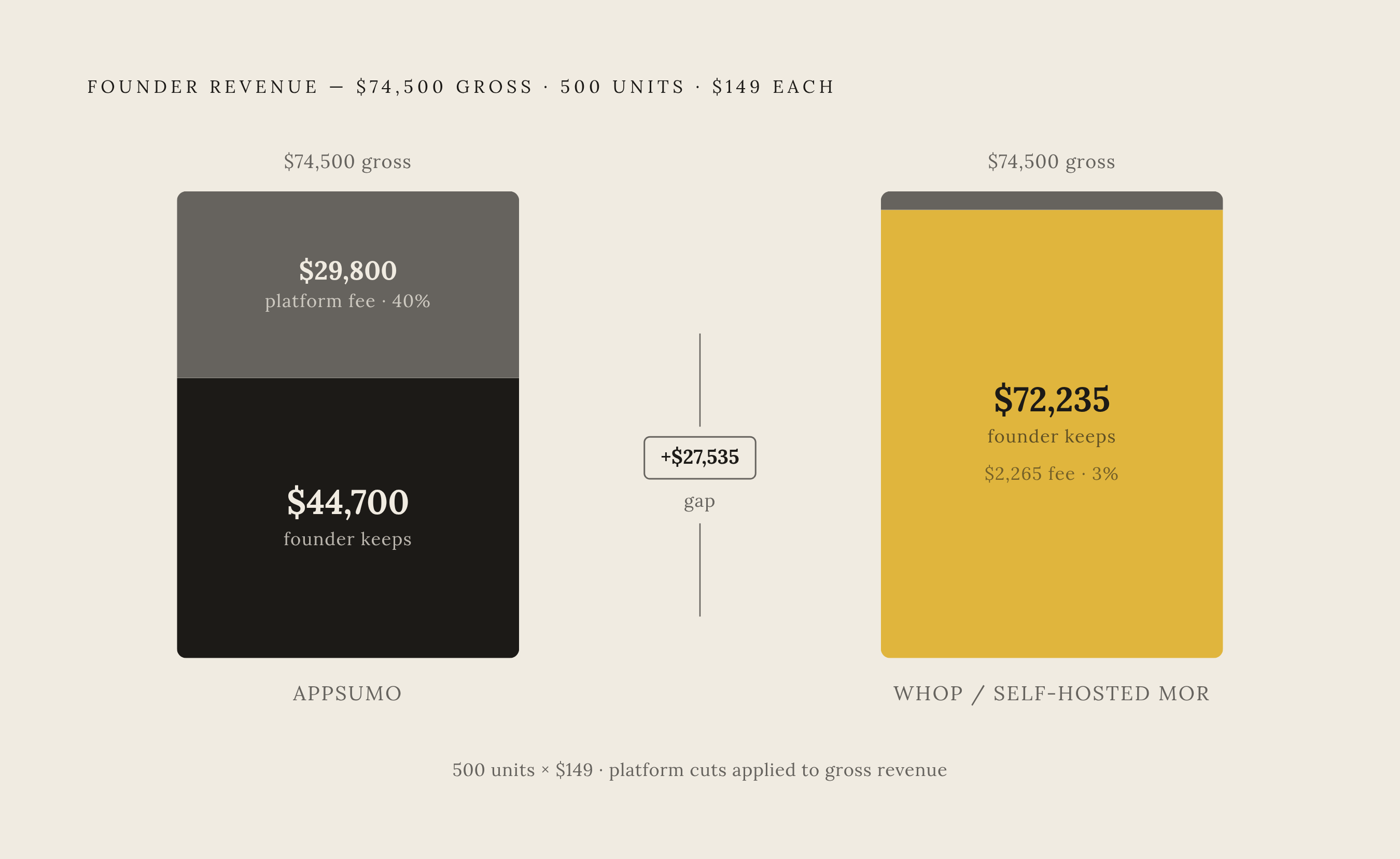
That's the core tension of running a lifetime deal on a marketplace: the platform takes the majority of the revenue and leaves the founder holding 100% of the cost. AppSumo offers over a million buyers, an active marketing engine, and front-page placement for the deals it chooses to push. For a founder with no existing audience, that exposure is worth paying for. But the fee structures across platforms vary a lot, and the difference compounds fast at any real volume. AppSumo typically takes something in the 30% to 50% range. Whop charges a flat 3%. Self-hosting through a Merchant of Record adds a 2% to 5% MoR fee, and the founder keeps the entire customer relationship, including the data.
Run the numbers on a $149 Tier 1 deal sold 500 times. On AppSumo, a 40% cut leaves the founder with about $44,700. On Whop, or through a self-hosted MoR at 3%, that same deal leaves about $72,235, on top of full ownership of who the customers actually are (per fungies.io). The gap isn't small.
The decision rule follows the audience. Anyone already running a newsletter, a community, or a real social following is almost always better off self-hosting through a Merchant of Record. Anyone starting from zero distribution might find AppSumo's cut worth paying, treated honestly as a customer acquisition cost rather than a fee.
Platform risk isn't only about the percentage taken, either. Multiple founders who launched through SaaSzilla have reported never receiving their payouts at all (per earlybird.so), which is a reminder that platform choice carries counterparty risk on top of the fee math. Whatever platform gets chosen, affiliate programs tend to amplify distribution regardless: offering a 20% to 30% commission to people who share the deal is a common way lifetime launches go viral, and that word-of-mouth tends to outlast the launch window itself.
The hidden liabilities: support load, tax obligations, and the promises that compound
Support cost is baked into the model. It's baked into the model. Even at a rate of one support ticket per 60 licenses sold, that adds up to real time and real money, and lifetime deal buyers tend to file more tickets than subscribers do, not fewer (per freemius.com).
Live Proxies' own numbers show that lifetime deal users generated 30% to 40% more support tickets per account than subscription users. They made up less than 10% of active users, yet accounted for 18% to 20% of total support volume (per freemius.com). A small slice of the user base, an outsized share of the workload.
The single most dangerous phrase in any lifetime deal's tier language is some version of "all future updates, forever." It sounds generous at launch. It becomes a roadmap obligation that outlives the founder's enthusiasm for building the thing that got promised. The same risk appears anywhere else a tier quietly expands its own scope: unlimited seats, unlimited usage, AI features tied to metered API costs, white-glove onboarding, deep integrations with third-party tools. Every one of those widens what the business owes, long after the one-time payment cleared.
Then there's tax, which most founders discover the hard way. Lifetime deal revenue is still taxable revenue, subject to sales tax, VAT, or GST depending on where the buyer lives. The US alone has economic nexus rules spread across a patchwork of states, and EU VAT applies starting with the very first sale to an EU customer. Most lifetime deal marketplaces don't handle any of this for the founder. On AppSumo, the platform does not handle tax on the founder's behalf; the tax exposure sits with the founder, not the platform (per fungies.io).
The fix is a dedicated Merchant of Record service, Fungies.io is one example, which steps in as the legal seller, collects and remits tax across jurisdictions, and absorbs chargeback risk. Setup is generally straightforward (per fungies.io). For a lifetime deal specifically, the features that matter most from an MoR are support for true one-time payments (most billing tools default to subscriptions and have to be forced into a one-time mode), embeddable checkout, multi-currency support, affiliate tracking, and automated license key delivery.
What Michael Aubry and Robert Gelb got right that the numbers alone don't capture
The spreadsheet only tells part of the story. Michael Aubry, who built Motionbox, chose a lifetime deal over freelancing or venture funding to keep the video-editing SaaS moving forward, even though it meant rebuilding technical infrastructure mid-sale while customers were actively buying in. What he got in return wasn't just cash. It was a group of customers who had put money behind the idea itself, not just the product as it existed on launch day. Motionbox is still running (per thebootstrappedfounder.com).
Robert Gelb took a different but related approach with HeySummit. He treated the AppSumo launch primarily as a marketing and community event. The deal answered a specific question, whether people would actually pay for the product, and it left behind something harder to buy outright: a group of early supporters personally invested in seeing the product succeed.
That's the flywheel that a straightforward revenue comparison misses. Lifetime buyers behave differently than free-tier users, because their money is already committed and their outcome is tied to whether the product keeps improving. Guillaume Moubeche, Lemlist's co-founder, ran into the harsh economics of the 30/100 platform split directly, and still built the launch around personal engagement and a steady drumbeat of feature announcements afterward, treating the launch window less like a sale and more like an ignition event for the community around the product.
The right way to think about a lifetime deal is as an accelerant. It buys time, it buys runway, and it buys a first wave of people who talk about the product because their own stake in it depends on the product getting better. None of that appears on the initial invoice. The plan for what happens after the deal closes matters just as much as the deal itself: the goal is to use that window to build a subscriber base large enough that the lifetime cohort becomes a funded, bounded minority of the business, not the whole business.
How no-code and AI building tools change the LTD risk calculus for solo founders
The real ceiling on lifetime deals for solo founders used to be infrastructure. Serving a growing base of lifetime customers meant hiring developers, paying for external hosting, managing a database, and stitching together a pile of services, each one its own recurring bill that the fixed lifetime price had to cover indefinitely.
That equation changes when the backend, database, hosting, authentication, email, and basic SEO all come bundled into a single flat subscription instead of a dozen separate line items. When the ongoing cost of serving a customer is known and bounded from the start, the lifetime deal pricing formula, a fixed multiple of the monthly price that shrinks as the commitment shortens, is a number that actually holds up.
It's the same logic as the BYOK model applied one layer down. Just as offloading AI API costs onto the user protected Prren's margins directly, an all-in-one infrastructure setup shifts the unpredictable part of the cost structure off the founder's books before a single lifetime deal customer ever signs up. The tighter that cost picture is, the more a lifetime deal looks like a funding strategy, and the less it looks like a bet the founder can't actually price.
Sources
- How to Run a SaaS Lifetime Deal in 2026: Pricing, Payment Setup & Tax Guide
- What Is a Lifetime Deal SaaS? The Complete 2026 Guide
- SaaS Pricing Strategy: Why a Lifetime Deal (LTD) is the Secret to Bootstrapping Your First $80K
- Lifetime Deals and SaaS Businesses
- gotopshelf.com
- SaaS Lifetime Deals: When to Run One & How to Structure It
- The Complete Guide to Lifetime Deals in 2026: What Smart Buyers Need to Know - Earlybird