Usage-Based Pricing Risks for One-Person SaaS
Solo founders lack the finance oversight that protects funded teams from surprise AI tool bills.

Usage-based pricing has stopped being a niche billing choice and become the default architecture for AI software. That shift creates a specific set of risks for solo SaaS founders that funded teams simply don't carry the same way, because funded teams have finance staff and monitoring systems built to catch cost anomalies before they compound. A solo founder doesn't have that layer of protection, so the same pricing model that scales beautifully for a much larger company can quietly bleed a one-person shop dry.
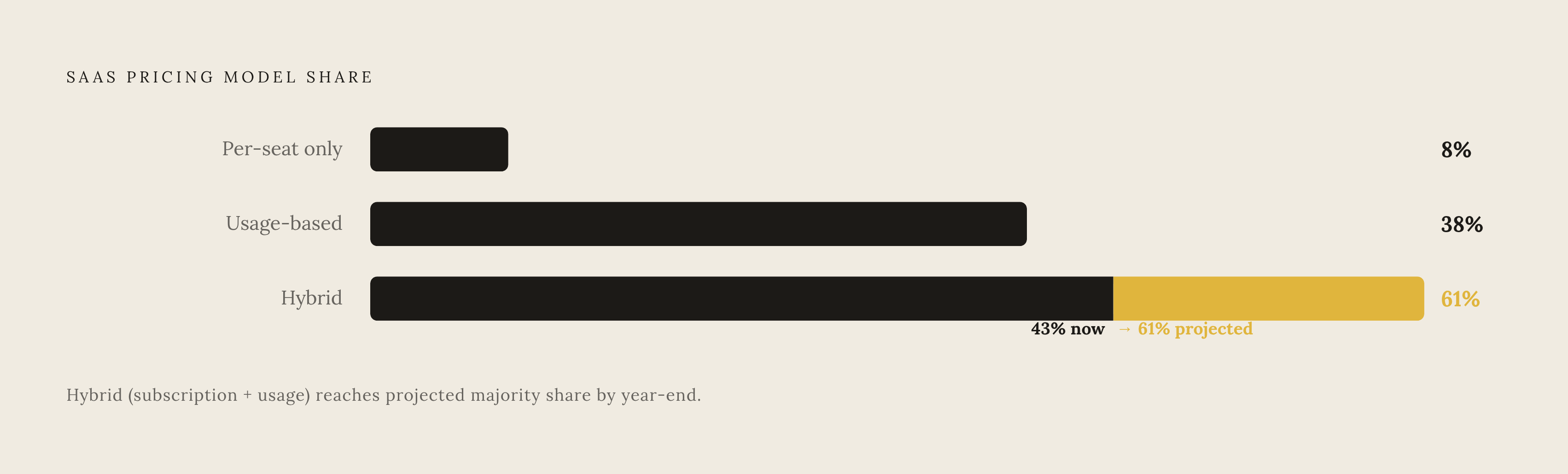
The numbers back up how fast this moved. Usage-based pricing now shows up at 38% of SaaS companies, according to the Momentum Nexus pricing guide, and Chargebee's State of Subscriptions Report puts the number combining subscriptions with usage components at 43%, projected to climb to 61% by year's end. Per-seat-only pricing, meanwhile, has shrunk to just 8% of the market. More than 80% of vendors still use seats as one ingredient in the pricing mix, but seats alone no longer carry the weight they used to.
AI is the reason why. When one agent can do the work five employees used to do, counting seats stops measuring anything real. Vendors now carry a variable cost, inference, that moves with usage instead of headcount. And even though a16z's LLMflation research found commodity-tier inference costs dropped by a huge multiple over three years, frontier model pricing hasn't followed that curve down. That gap between cheap commodity tokens and expensive frontier tokens is a cost spread every AI vendor now has to manage, whether they built a finance team to do it or not.
None of this is a passing fad. It's a structural response to how AI software actually gets used and how its underlying costs behave, and it touches solo founders from both directions: as buyers of the AI tools already sitting in their stack, and as sellers making their own pricing calls.
What makes a solo founder structurally more exposed to UBP than a funded team
Bigger companies build teams whose whole job is watching metered software. Someone reconciles invoices. Someone flags a usage spike before it turns into a five-figure surprise. That function exists whether or not anyone outside finance ever notices it's running.
A solo founder has none of that, because a solo founder is every department. Product, support, marketing, billing: one person cycles through all of it in a single afternoon, and real-time cost monitoring rarely gets picked as the hat worth wearing when a usage spike actually hits. Blog.mean.ceo's July 2026 analysis on usage-based pricing states that solo founders and early-stage startups don't have finance teams watching metered software every day, so they need clearer controls than large enterprises need, not fewer.
The data on this is not gentle. Per blog.mean.ceo, 78% of IT leaders reported unexpected charges tied to consumption-based or AI pricing in the past year, and 61% cut projects outright because of surprise SaaS cost increases. Those numbers describe companies that have IT departments. A solo founder has less structural protection than the companies already getting burned.
None of this means usage-based pricing is a trap by design. The risk is a mismatch: a pricing architecture built with enterprise buyers in mind, dropped onto a one-person operation that can't absorb a bad billing month the way a funded team can call it a cost of learning.
Bill shock: how a single day of usage became a $7,225 invoice and a lesson in pricing design
In July 2025, a single Cursor user ran up a $7,225 invoice in one day. The developer burned through 500 requests on an annually billed plan, according to Digital Applied's usage-based pricing decision matrix, and the billing was, technically, correct the whole time.
The post documenting it hit 797,000 views within a week, per Aakash Gupta's analysis. That kind of reach doesn't happen because one person had a bad day. It happens because a huge number of people recognized the fear immediately: that could be the reader's invoice next month.
Cursor's CEO, Michael Truell, apologized publicly on July 4, 2025, admitted the communication around the billing had been unclear, and offered refunds for unexpected usage racked up between June 16 and July 4, according to flexprice.io's Cursor pricing guide. Digital Applied's read on the incident cuts right to it: bill shock is a pricing design failure. The system needed a cap. Nobody needed a better explainer. The system needed a cap.
Cursor has since added usage meters and spend alerts to every pricing change it ships. That's an admission, in effect, that guardrails aren't a nice UX touch you add later. They're engineering requirements, full stop.
This happened to a developer, someone who presumably understood the tool better than most of its users. A non-technical founder, or a founder too buried in a launch week to check a dashboard, is even more exposed to the same failure mode. The real question was never whether usage-based pricing is fair in principle. It's whether the billing system was built to protect people who aren't watching it hour by hour, because almost nobody is.
The broader repricing wave hitting AI coding tools, and why it matters beyond Cursor
Cursor wasn't an isolated case. Copilot, Cursor, Codex, and other AI coding assistants have all shifted to usage-based billing within the same twelve-month window, per Josh McDonald's Medium analysis of what he calls the quiet repricing of AI coding tools.
OpenAI moved Codex from per-message pricing to token-based billing on April 2, 2026, for Plus, Pro, and Business plans, then extended the change to existing Enterprise, Edu, Health, and Gov plans on April 23, 2026. GitHub followed on April 27, 2026, announcing that every Copilot plan would move to usage-based billing starting June 1, 2026.
Cursor's current 2026 lineup shows how granular this has gotten: Hobby is free, Pro runs $20, Pro+ runs $60, Ultra runs $200, and Teams splits into $40 per user for Standard and $120 per user for Premium. There are two separate usage pools inside that structure, and per flexprice.io, knowing which pool you're actually spending against can keep your bill at $20 a month or push it to $200.
Stacking four or five of these tools together, which plenty of solo founders do without thinking twice, compounds the exposure. Each tool carries its own meter. Each meter can produce its own surprise invoice, independent of the others. And this is happening against a backdrop of rising SaaS costs generally: pricing rose 11.4% in 2025 compared to 2024, and per Momentum Nexus, businesses now spend $7,900 per employee on SaaS tools, up 27% in two years. Tools that used to be flat-rate or marketed as "unlimited" are getting repriced mid-contract, because vendors are finally looking at their own cost of goods sold and not liking what they see.
How variable AI inference costs erode a solo SaaS vendor's gross margin from the supply side
Flip the lens around. A solo founder selling an AI-powered product under flat or tiered pricing is carrying a cost they don't fully control: whatever the underlying LLM charges per token or per call.
Digital Applied's 2026 decision matrix lays out the spread clearly. OpenAI's o1 launched at $60 per million output tokens, matching GPT-3's 2021 price point, even as commodity-tier inference fell to $0.06 per million tokens elsewhere. That's an enormous gap between frontier and commodity pricing, and which side of that gap a vendor lands on often depends on customer behavior, not vendor choice.
The gap between frontier and commodity pricing means a vendor's margin position can shift dramatically depending on which tier of inference their customers drive toward. Without someone watching the per-customer margin line, a solo founder may not know which situation they're in until it's already a problem.
Hybrid pricing exists specifically to patch this hole: a base fee covers fixed costs, a usage meter captures the variable inference cost on top. Per OpenView Partners, 46% of SaaS companies already run this hybrid structure, against only 15% running pure pay-as-you-go. For a solo founder building an AI feature, model the cost per usage unit before setting a price, not after the first power user shows up and quietly wrecks the plan's economics.
Revenue volatility: why unpredictable customer consumption makes forecasting almost impossible without systems
Pure usage-based revenue rises and falls with what customers happen to do, not with the calendar, and a solo founder has no CFO building rolling cash flow models to smooth that out.
Hybrid pricing solves part of this too. A base subscription gives a revenue floor; metered usage on top gives upside without total unpredictability. Per the PwC and m3ter survey of more than 350 software leaders, 72% of companies already running usage-based pricing use exactly this hybrid structure. Without that floor, a solo founder's monthly budget becomes a function of how active customers happened to be last month, and that instability appears in hesitation to hire, anxiety over tool spend, and an inability to plan a content calendar or a growth push with any confidence.
The retention math is unforgiving too. Research has found that a bad pricing structure can depress revenue by 30% to 50% versus optimal pricing, even when the price itself sits right at market rate. Structure failure isn't a growth-rate problem at that point. It's a survival problem.
There's a real upside to contrast against this. Per OpenView data, companies running usage-based pricing well see 38% faster revenue growth and 54% higher growth rates at scale compared to traditional subscription peers. But those numbers belong to companies with metering systems, alert infrastructure, and dashboards built to manage the volatility. A solo founder running usage-based pricing without any of that infrastructure gets all of the volatility and none of the expansion upside. Revenue predictability under this model takes the same kind of system a bigger company builds a whole team around. Without the team, the tooling has to do the job instead.
The four guardrails UBP requires that solo founders almost never have in place
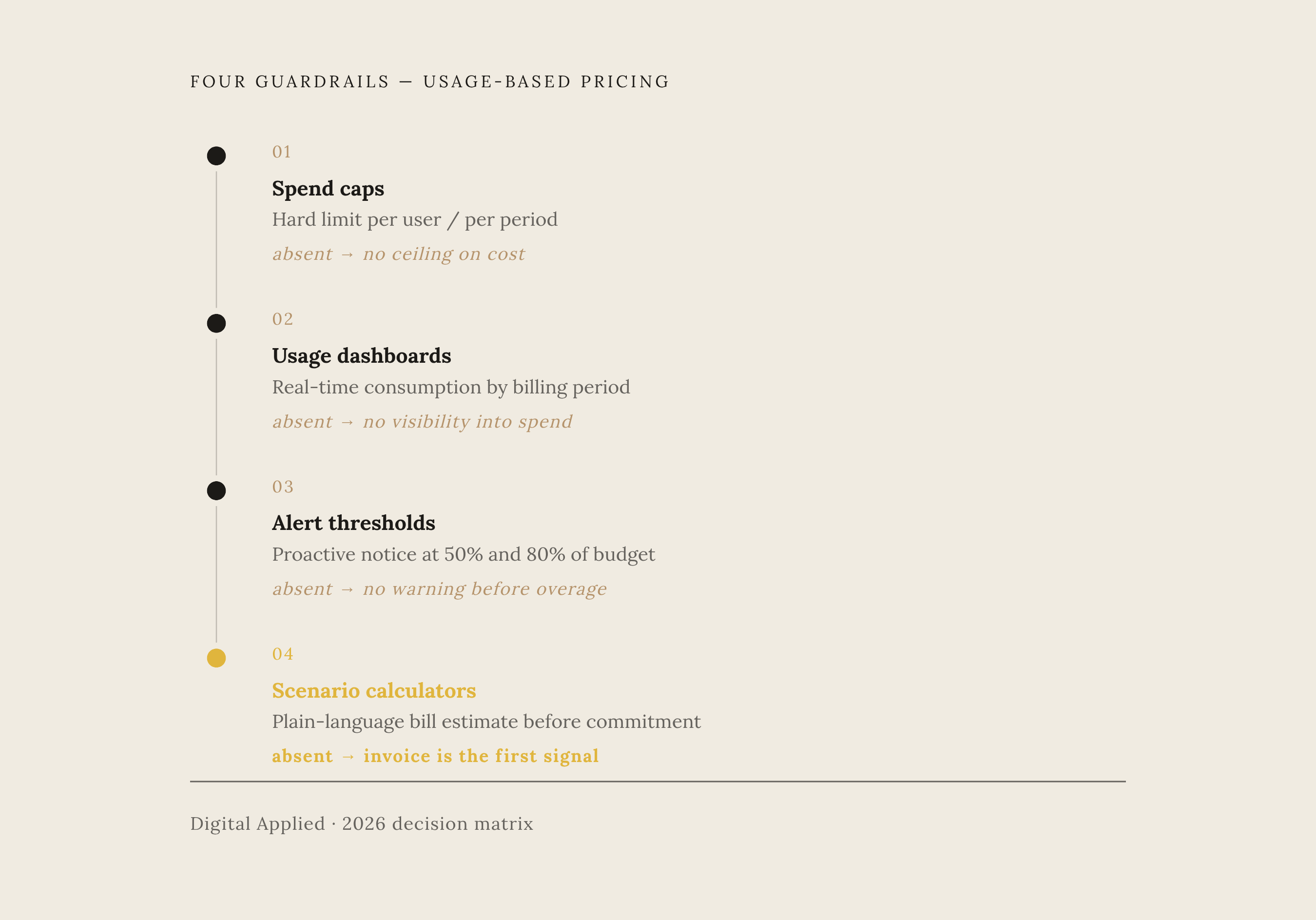
Digital Applied's 2026 decision matrix identifies key architectural pieces that usage-based pricing needs and seat-based pricing never did. Solo founders rarely have all four running at once.
Spend caps are hard limits on usage per user, per team, or per billing period, configurable at more than just the account level. A single account-wide cap doesn't stop one user from burning through the entire allotment before anyone else gets a chance to react. This is exactly where the Cursor incident broke down: an annual plan with no per-day or per-request ceiling let one user run up $7,225 before any limit stepped in.
Usage dashboards give real-time visibility into who's consuming what, and how much, broken down by billing period. Without one, the invoice is the first signal anything went wrong, and by then the usage already happened. There's no undoing it.
Alert thresholds are proactive notices at set percentages of budget or included usage, so a customer (or founder) finds out at 50% or 80%, not after usage has already run well past what was included. These matter more for solo operators than for enterprises specifically because protection needs to be baked into daily use. It can't depend on someone remembering to go check.
Scenario calculators and plain-language plan pages. Customers need a way to estimate their bill before they commit to it. If they can't, they either walk away or sign up and churn the moment the first unpredictable invoice lands. The underlying dynamic is clear: token billing just relocates the unpredictability from the subscription tier to the usage meter. The anxiety doesn't go away. It just moves.
Solo founders sit on both sides of this list. As buyers, the question is whether their vendors built these guardrails in. As vendors, the question is whether they built them for their own customers.
Mitigations a one-person operator can implement without a finance team
None of this requires a finance department. It requires deliberate choices, made early, before the first surprise invoice forces the issue.
Start with pricing structure. A hybrid model, base fee plus metered overage, gives a solo founder's own product a revenue floor while still letting the meter absorb variable inference cost instead of swallowing it as margin loss. Per blog.mean.ceo, 59% of SaaS products are already moving this direction, making hybrid the market default now, available to companies regardless of resources. Set that base fee against worst-case inference cost, not average-case. A solo founder has no cushion if the average-case math turns out wrong.
Audit the tools already in the stack. Before adopting anything billed on usage, check for per-user caps, real-time dashboards, and alert thresholds. If a tool doesn't have them, set a recurring calendar reminder to check usage manually, because the absence of a guardrail doesn't mean the absence of risk, it just means nobody's watching. Where a flat, predictable plan delivers the same value, take it. Variable billing is only worth the exposure when it actually tracks how the tool gets used.
Model the cost per usage unit before setting a price, not after. Know the inference cost per API call or per resolved task ahead of time. Outcome-based pricing, along the lines of a flat fee per resolved case or per completed conversation, shifts inference cost onto the buyer, but it only works if usage can be metered reliably. Without that metering in place, outcome-based pricing turns into a margin trap instead of a margin shield.
Build usage visibility for customers, even a simple one. Customers who can see their own consumption in real time trust the product more and churn less; it's a retention move as much as a fairness move. If a user can accidentally generate a trust-destroying invoice, the system was badly designed to begin with. A visible meter heads that failure off before it happens.
Last, separate infrastructure cost from tool cost where possible. Paying an AI provider directly, rather than paying a marked-up, per-token rate baked into someone else's platform fee, is a structural way to dodge one layer of margin erosion entirely. It's not always available, and it's not free of its own tradeoffs. But for a solo founder counting every basis point of margin, it's important to check before signing anything annual.
Sources
- Usage-Based Pricing Trends | July, 2026 (STARTUP EDITION)
- Medium
- SaaS Usage-Based Pricing Models: Decision Matrix 2026
- The SaaS Pricing Strategy Guide for 2026: Why Usage-Based is Winning (And When to Use Tiered, Per-User, or Value-Based Instead) - Momentum Nexus Blog
- Usage-Based Pricing Trends | September, 2026 (STARTUP EDITION)
- flexprice.io
- joshmcdonald.medium.com
- m3ter.com