Hybrid Subscription and Pay-per-Use Models for Micro-SaaS
AI-powered workflows broke flat pricing, so founders are shifting to usage-based layers.

Flat subscriptions worked fine when the cost of serving a customer barely moved month to month. That math breaks the moment an AI agent enters the picture: one workflow can fire off thousands of API calls and token generations in minutes, burning real money on the back end while the customer pays the same $29 they paid last month. Hybrid pricing, a fixed base fee plus a variable layer tied to actual usage, is becoming the default answer for micro-SaaS builders because it ties revenue to the cost of serving each customer instead of guessing. This piece walks through how to design that layer, when to add it, and how to talk about it without scaring off buyers.
Per-seat pricing rested on a quiet assumption: more people using a tool means more usage, so charge per head and the math works out. That assumption falls apart when one person, or one automated agent, can trigger the workload of an entire team. New cost primitives, cost per thousand tokens, cost per resolved request, cost per agent minute, are increasingly the numbers actually driving pricing decisions now, not seat counts. Seat-only pricing shows meaningfully higher churn than hybrid or usage-based billing, and AI products priced purely per seat run noticeably thinner gross margins, according to saasranger.com. "Unlimited AI" bundled into a flat plan sounds generous. It is usually just margin leaking out quietly, one API call at a time.
What hybrid pricing means and what it is not
Think of a phone bill. A flat monthly plan covers a set amount of data, and anything past that gets billed separately, or draws down a bucket you already paid for. That is hybrid pricing in a sentence: a fixed recurring fee plus charges that move with actual consumption.
It is not one single model. It is a spectrum built from four pieces, and most hybrid products use some combination of them:
Base or platform fee. A fixed recurring charge that sets the revenue floor and covers core access. This is the number on the pricing page. Usage-based charges. Variable fees tied to consumption, API calls, tokens, compute minutes, records processed. Credits or tokens. Prepaid units a customer burns against usage. This is an abstraction layer that makes variable consumption feel controlled rather than open-ended. Add-on tiers. Optional upgrades for premium features or higher limits, sitting on top of the base.
Pure usage-based pricing has no floor, so revenue swings with customer behavior and finance teams hate it, because it is nearly impossible to forecast. Pure subscription has the opposite problem: a floor and nothing else, so a customer who runs your product ten times harder than average pays exactly the same as one running it lightly, and margin erodes on the heavy end. Hybrid sits between the two. It gives the business a predictable floor and gives the customer a sense of fairness, since heavier use costs more, without forcing either side into a sales call every time usage creeps up.
Credits deserve a closer look, because they are doing more work than they get credit for. A customer buys a block upfront, which is committed revenue for the founder and a predictable budget for the buyer, then draws it down against actual use. According to Kyle Poyar's Growth Unhinged newsletter, the companies winning with credits are the ones where the unit is obvious: one enrichment, one conversation, one generation. Credit-based pricing has grown fast: 79 companies in the PricingSaaS 500 Index now use credit-based pricing, up from 35 at the end of 2024, a jump of about 126% in a year.
How the major players have structured their hybrid models, and what micro-SaaS founders can learn from them
Clay runs usage-scaled subscription tiers with two credit buckets layered on top: Data Credits for enrichment data, and Actions for platform usage. Customers know their floor cost going in, and pay more only as they extract more value out of the tool. This structure is a clean example of credits sitting on a subscription without confusing the buyer.
HubSpot added AI credits to its existing per-seat tiers in 2025, charging roughly $9 to $10 per 1,000 AI credits beyond what a tier already includes, with pricing varying between annual and monthly billing. Poyar calls this the "great re-bundling," AI folded back into core pricing through credits instead of bolted on as a separate, confusing line item.
Zendesk prices its AI resolution agent at $1.50 per resolved conversation under committed volume, or roughly $2.00 per resolved conversation on a pay-as-you-go basis. That is an outcome-based layer sitting cleanly on top of existing subscription access, and it works because "resolved conversation" is something a customer can count without a spreadsheet.
Announced at $2 per conversation in September 2024, Salesforce's Agentforce shifted to Flex Credits at $0.10 per action by May 2025, then added per-user licenses starting at $125 per user per month in June 2025. Three pricing models for the same product in about 18 months. That kind of churn in pricing strategy erodes buyer trust even when each individual model made sense on its own.
What actually transfers down to a solo-built product is narrow: the credit layer, and the discipline of picking one intuitive value metric and sticking with it. Outcome-based pricing, charging per result rather than per action, is not something to copy yet; it requires measurable attribution that is still hard even at enterprise scale. And multi-vector billing schemes like the ones used by large infrastructure vendors, billing by host, by data ingested, by traced request, simultaneously, are engineering-heavy and assume a finance team on both sides of the transaction. That is not the world of a founder with under 50 paying customers.
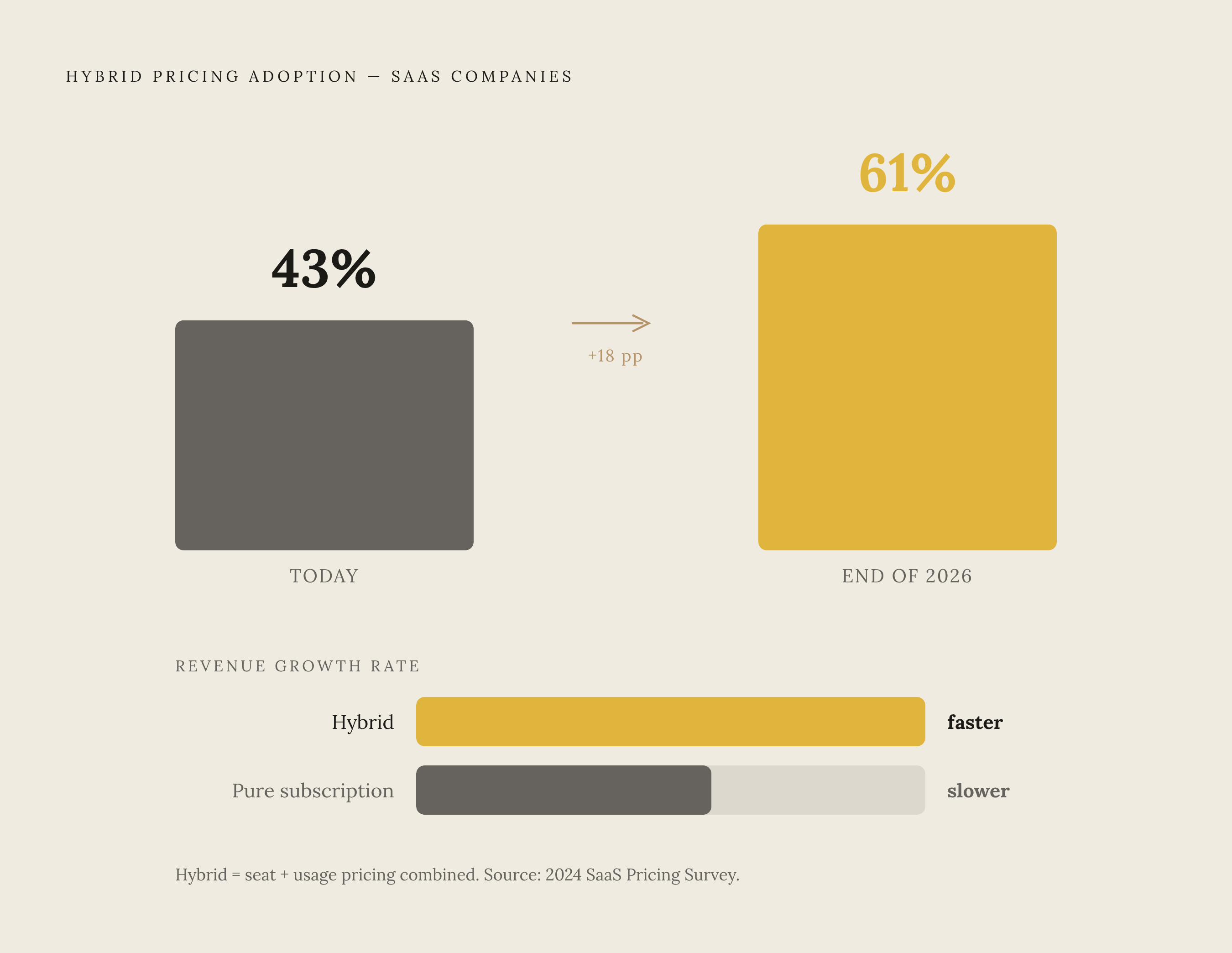
The direction of travel is clear regardless. Per Chargebee's State of Subscriptions Report, 43% of companies use hybrid models today, and that's projected to reach 61% by the end of 2026. Companies running hybrid report notably higher revenue growth than pure-subscription companies, per the Chargebee 2025 State of Subscriptions Report.
When a micro-SaaS product is ready to add a usage layer
Hybrid pricing shows up in a large share of high-growth micro-SaaS products and correlates with meaningfully higher median growth rates, per saasranger.com and Freemius data. But it adds real complexity, billing logic, usage tracking, customer communication, and none of that is worth taking on before there's a customer base large enough to show real usage patterns. The rough threshold in the data: 50 or more paying customers.
Before that point, simpler wins. Freemius data points toward a single paid tier, somewhere in the $29 to $49 per month range, with a 14-day free trial and no free plan at all. No tier ladder, no meters, just one price and a trial.
Getting to $5,000 a month at $29 per month takes 173 customers. Getting to $5,000 a month at $29 per month takes 173 customers. At $9 per month, it takes 556. That is 383 fewer people a founder has to find, onboard, and support, just by pricing higher from day one, according to Freemius data.
There's a churn pattern buried in that same data that runs against intuition. Products priced between $79 and $149 a month often see monthly churn in the 3 to 5% range, while products at $9 to $19 a month see 8 to 12% churn. Customers who pay more tend to integrate a tool more deeply into their workflow, and they don't cancel on a whim the way a $9-a-month subscriber might.
So when is a usage layer actually warranted? A few signals to check for:
- A small cohort of customers is using the product far more heavily than the median, and it's easy to point to who they are.
- There's one clear, countable value metric, one document processed, one conversation resolved, not tokens or compute minutes, which nobody outside an engineering team can map to real value.
- AI inference or compute costs are visibly eating into margin on the heaviest accounts.
- There are 50-plus paying customers generating actual usage data, not guesses.
Kyle Poyar's outlook for 2026 applies here too: after a year of pricing pages getting more complicated with credits and meters, the correction is already starting toward simplicity, with some vendors reintroducing plain seat-based packages or tightening usage caps to restore predictability. The lesson for a founder building hybrid pricing for the first time: build it in stages, not all at once on day one.
Choosing the value metric that will hold up as your product grows
The rule that matters most here: credits and usage meters only work when the customer can mentally map one unit to one piece of value they received. Break that mapping, and hybrid pricing produces the exact same confusion that has always made enterprise pricing pages miserable to read.
Metrics that tend to work at micro-SaaS scale:
Actions completed, one email sent, one record enriched, one report generated. The customer can count these independently, without trusting a dashboard. Outcomes delivered, one ticket resolved, one lead qualified. This aligns tightly with value, but only works if the product produces a discrete, measurable result. Most products aren't there yet. Volume processed, documents, images, rows. Works well when customers already think in those units naturally.
Metrics that tend to backfire:
Tokens. Customers have no intuition for what a token is worth. Billing by tokens just exposes infrastructure cost without communicating value. Compute minutes or GPU seconds. Same failure mode: opaque, technical, meaningless to a buyer. Multiple meters running at once. Salesforce's three-model pivot in 18 months is the example to keep in mind. At micro-SaaS scale, one meter is plenty.
If the underlying technical metric is too abstract to put on a pricing page, wrap it in credits, but only if the credit-to-value link is obvious on first read. A useful gut check before building any billing logic around a metric: ask five current customers what "one unit of value" looks like in the product. Five different answers means the metric isn't ready yet.
Outcome-based pricing is generating some of the strongest retention numbers in the data, per NxCode's guide citing a research firm. Consulting: companies using outcome-based components see notably higher customer retention. But adoption is still thin, only a small fraction of companies have fully implemented it, and a16z's field research suggests most vendors haven't moved to pure outcome-based models yet. File it as a direction to grow into, not a day-one decision.
Structuring the tiers: what to include in the base, what to meter, and how to set limits
The base tier has one job: feel substantial enough that a customer commits, without giving away so much that nobody ever touches the usage layer. Core feature access, authentication, basic support, and a real (but not unlimited) usage allotment belong in the base. The highest-compute AI features, bulk processing, and API access at real scale belong outside it, as the natural triggers for overage.
When someone blows past the base allotment, there are three ways to handle it:
Hard cap. Usage simply stops until the next billing cycle. Lowest revenue ceiling, and the highest risk of an angry customer mid-project. Reserve this for cases where overage would genuinely wreck margin. Automatic overage. Usage keeps running, and the customer gets billed per unit above the cap. Good for revenue, bad for surprise: per S3, 78% of IT leaders report unexpected charges tied to consumption-based or AI pricing models. This only works paired with real-time spend alerts. Credit top-up. The customer buys more credits when the well runs dry. Predictable on both sides, no bill shock, and the customer stays in the driver's seat. For most micro-SaaS products early on, this is the better fit.
Annual billing deserves a place in the tier structure from the start, not as an afterthought. A meaningful discount for prepaying a year correlates with fewer cancellations, per Freemius data.
For a product under 200 customers, two tiers is enough: one paid plan, and one usage-gated upgrade above it. A third tier only earns its place once there's real evidence of a distinct customer segment with a genuinely different willingness to pay, not a hunch.
A workable shape, built from the patterns above rather than any one company's actual pricing page:
Starter: flat monthly fee, core features, a fixed usage allotment included. Pro: higher flat fee, expanded features, a bigger allotment, credit top-ups available past that. Annual discount available on either tier.
What to avoid: too many meters running at once, credit units too abstract to explain in one sentence, and pricing that needs a calculator to understand. Skip the free tier too. Industry-wide, only about 3.7% of free users ever convert to paid, per Freemius data via S2, and hosting a free tier costs real money every month regardless of whether anyone upgrades.
Communicating hybrid pricing so it does not confuse or repel buyers
Bill shock is the single biggest complaint hybrid pricing generates, and it's the most common reason it quietly damages retention instead of helping it. Per S3, 78% of IT leaders report unexpected charges on SaaS bills tied to consumption-based or AI pricing. That number alone should shape how a pricing page and a billing dashboard get built.
Spend visibility needs to be a feature, not something bolted on after a support ticket. Show customers their current usage and a projected bill inside the product itself, in real time. Send an alert at 80% of the included allotment, before the overage hits, not after. And every month-end summary should let a customer point at each line item and know exactly which action produced it.
On the pricing page itself, a few things matter:
- Lead with the flat fee. That is the anchor a buyer's brain latches onto first, so put the usage complexity behind a "see usage rates" link or a small calculator instead of upfront.
- Name the value metric in plain words, "each document processed," not "1 credit," not "1 unit."
- Show a worked example: a team running 500 documents a month pays approximately this much. Concrete numbers beat abstract formulas every time.
- Stick to one meter on the main page. If there's more than one, pick whichever one customers will hit first, and push the rest into an FAQ.
Salesforce's Agentforce arc is the lesson in what not to do: three pricing models in roughly 18 months for the same product. Whatever model gets picked, commit to it, and if it has to change, give existing customers advance notice and grandfather their current terms. Trust in a pricing page, once broken, is expensive to rebuild.
The infrastructure a solo founder needs to run hybrid billing
Running hybrid billing solo comes down to a short list of real requirements, not a long one. Usage needs to be metered accurately at the source, whatever the value metric is, whether that's documents processed or conversations resolved, and that metering has to tie directly into whatever billing platform issues invoices. Payment processors and subscription billing tools built for SaaS generally support usage-based line items and credit balances natively at this point, which means a solo founder is rarely building metering and invoicing logic from scratch.
What actually takes the most care is the customer-facing side: a usage dashboard inside the product, alerts before someone crosses their allotment, and a monthly summary that shows the math behind every charge. None of that needs to be elaborate on day one, but all of it needs to exist before the usage layer goes live, because a customer's first encounter with an overage charge is exactly the moment trust in the pricing model gets decided.