Reducing Involuntary Churn With Automated Billing Recovery
Automated recovery can reclaim a quarter of your lost customers without fixing your product.
A lot of founders look at their churn number, see it climb, and reach for the wrong fix. They ship a new feature, adjust pricing, or launch a win-back campaign aimed at customers who were never actually trying to leave. Involuntary churn is a billing failure, not a customer decision: the subscriber still wants the product, but a declined card or an expired credential ended the subscription before anyone noticed. That's a fundamentally different problem from voluntary churn, which needs a real fix to value or fit. Involuntary churn just needs a successful retry or an updated card, since the customer's intent to stay was never in question.
Recurly's benchmark data, cited in RetentionLens's reference report, puts involuntary churn at close to a quarter of all churn at a typical SaaS company, and higher still in consumer-adjacent segments. That's a huge chunk of "lost" customers who didn't choose to go anywhere.
Most billing dashboards make this hard to see. They lump payment failures in with genuine cancellations under one blended churn rate, so a founder staring at the topline number can't tell whether the real fix is better dunning or a better product. Pulling those two apart takes a specific filter: look at subscriptions that ended because of payment failure, invoices tagged past_due, unpaid, or delinquent in Stripe, Chargebee, or Recurly, rather than subscriptions that ended by explicit cancellation. Run that calculation every month. It gives a baseline number that any recovery effort, from a simple retry schedule to a full recovery platform, has to beat.
What the research shows about payments failures and recoverability
Payment failures break down into two categories, and the type of failure determines what kind of fix actually works. Treating them as one undifferentiated queue wastes retry attempts and, in some cases, puts a business in violation of network rules. The failure type has to determine the fix before any recovery system can work.
Hard declines are structural. A card has expired, been replaced, the account is closed, or a fraud block has been triggered. If you retry a hard decline without changing the underlying credential, nothing happens, and for certain decline codes, you've already committed a compliance violation just by trying.
Soft declines behave differently. Insufficient funds is one of the most common decline reasons, but it isn't the easiest to recover. Expired cards and network errors actually carry higher recovery rates once retried at the right moment. Timing matters here in a concrete way: retrying an insufficient-funds decline around a payday cycle changes the odds of success substantially. Expired-card failures occur less often than insufficient-funds declines, but they need an entirely different response: swapping in a fresh credential, not tuning the timing of another retry attempt.
Before any of this recovery logic runs, your card mix already shapes the baseline failure rate. Credit cards fail at an average rate near 15%, compared with far lower failure rates for ACH or direct debit. A business that bills mostly through cards starts from a higher failure floor than one that bills through bank debit, regardless of how good its recovery stack is.
Tenure adds another wrinkle: a customer who signed up years ago has had far more time to go through a card expiration, a fraud reissue, or a bank's portfolio migration to a new processor. The longest-tenured, most loyal subscribers are often the ones most exposed to credential aging, simply because they've had more years for a card to change underneath them.
False declines are the quieter twin problem here: legitimate charges that get blocked by an issuer being overly cautious. The customer has the funds and wants to pay, so counting that decline as a final, unrecoverable loss misreads what happened.
A mature recovery stack's three layers
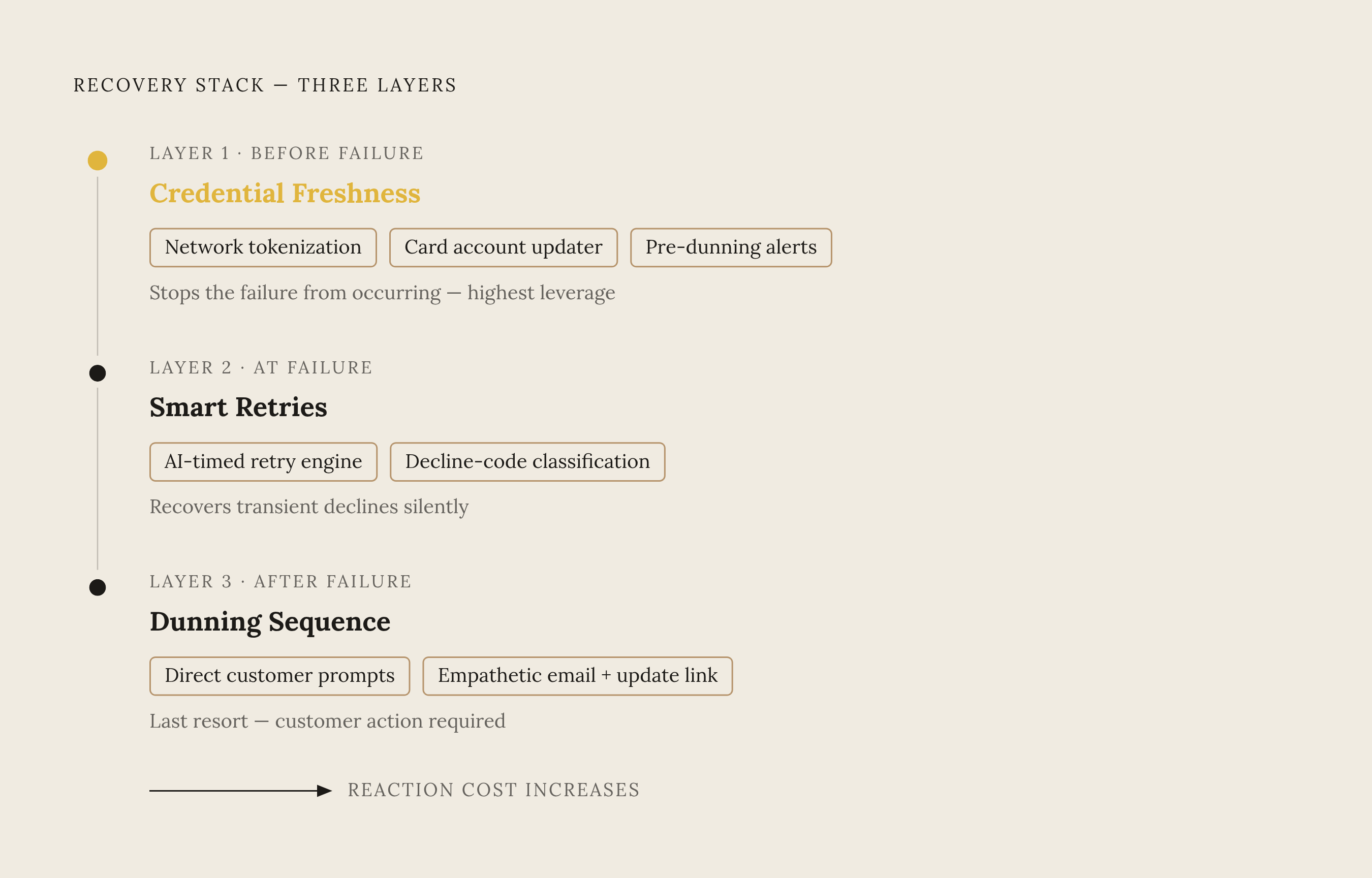
A disciplined recovery system doesn't treat every failure the same way. It works in three layers, run in a specific sequence: stop credential failures before they happen, recover soft declines automatically with smart retry timing, and prompt the customer directly when a hard decline needs their action.
Layer one is credential freshness, upstream prevention rather than a reaction to a failure that already happened. Network tokenization keeps vault credentials current on its own. The system stores a token tied to the card network rather than the physical card number that can expire, and this approach covers the majority of major issuer portfolios. Card account updater, often shortened to CAU, fills in what tokenization doesn't reach. It corrects a stored card number after the card has already changed, so it's reactive rather than structural, but it catches the credentials that fall outside tokenization coverage. Doist, the productivity software company, runs both Stripe network tokens and card account updater together, and it saw a meaningful increase in subscription auth rates as a result. Pre-dunning alerts round out this layer: notifying a customer that their card is about to expire before any charge attempt fails. Pre-dunning prevents failures that no retry logic, however smart, could otherwise fix. This move stops the failure from happening at all, making it the highest-leverage move in the entire stack.
Layer two handles soft declines through smart retries. Static retry logic can't tell one decline from another, so it treats them all the same way. An AI-powered retry engine reads the failure type, the customer's payment history, issuer behavior, and timing signals, then decides when, or whether, to retry. Smart retry timing meaningfully outperforms a fixed schedule of retry attempts. A card declined for insufficient funds can clear within hours, especially if the next business day or a payday cycle is close. A static system can't tell that case apart from an expired card, and it burns a retry attempt on a decline that timing alone could have fixed. Compliance sits inside this layer too. Visa and Mastercard both publish rules capping how many times a merchant can retry a non-retryable decline code within a set window, and retrying a prohibited code triggers compliance fees. Classifying decline codes correctly is a requirement for staying within network rules.
Layer three is the dunning sequence, which exists for the failures that retries can't fix on their own: expired cards, closed accounts, the structural cases from layer one that slipped through. A well-built dunning sequence prompts the customer directly to update their card or supply a new payment method. Card-updater services already recover a substantial share of invoices before a retry is even attempted, which shrinks the volume of cases that ever reach this stage. The dunning message itself should read as empathetic and frictionless, with a direct link to update payment information. Every extra step a customer has to take between the email and a fixed payment method is a chance for them to give up partway through.
Recovery rates reveal the gap between approaches clearly. Businesses running no retries at all recover almost nothing. Basic fixed-interval retries recover a moderate share. The industry median blends a mix of approaches and recovers about half of failed charges. Running smart retries, a card updater, and a structured email sequence together puts recovery outcomes in the high range.
What native billing platform retries do well
Most founders already have some retry logic running through their billing platform, and starting there is a reasonable decision. Stripe Billing includes Stripe Smart Retries, which uses an AI model to time retry attempts, but you have to opt in separately if you want automated recovery emails inside Stripe Billing's revenue recovery suite. It covers the fundamentals of recovery without any extra tooling or setup cost, which makes it a sound starting point for an early-stage business.
The ceiling appears in recovery data as volume grows. Smart retry timing lifts recovery by roughly 25% over fixed intervals, according to RetentionLens's benchmark. Stripe's model is trained on a global, heterogeneous base of merchants, so it optimizes for the average case across millions of businesses rather than the specific decline-code distribution, card mix, and customer behavior of any one company. A per-merchant machine learning model can adapt to a business's own payday cycles and bank mix in a way a model trained on the global average cannot, a gap FlyCode's 2026 platform comparison lays out directly.
Native tools also tend to operate on a single processor, so a failed charge has nowhere else to go. Native retry logic typically won't give you dedicated tools to route a declined attempt to an alternate payment provider in search of a higher approval path.
Stripe Billing also adds a per-transaction fee on top of standard processing costs, so you still pay for the native retry setup even if no separate subscription shows up on the invoice.
Some founders skip paid tooling altogether and wire up a workflow automation tool instead, so it pings a messaging channel when a payment fails. That setup catches the alert, but it has no retry logic behind it, no way to segment by decline reason, and no audit trail. It works fine at very low failure volumes. But once failure counts grow past a small handful a month, you can't manage it by hand anymore, and it becomes a source of quietly missed revenue.
The strongest case against moving past native tools is cost. Most dedicated recovery platforms price on a pay-on-lift or pay-on-recovery basis, so the fee only applies when the tool outperforms whatever baseline Stripe's native retries are already delivering. Cost applies only when the tool delivers a demonstrated improvement.
How dedicated recovery tools differ from one another
Dedicated recovery platforms solve the same basic problem, but they aren't interchangeable. They differ in whether they act silently in the background or prompt the customer directly, how their machine learning models are trained, which processors and platforms they plug into, and how they charge for the work. Those differences decide which tool actually fits a given business.
Redux Payments runs as a silent-first AI layer, and it's built specifically for the Stripe ecosystem. It reads metadata signals, issuer behavior, geography, card type, and payday patterns, to retry a failed charge without the customer ever seeing a failure notice. It includes trial-to-paid optimization and no-login magic links for updating a card, and it prices on a pay-on-lift basis, charging only when it beats Stripe's native baseline.
Churnbuster takes a multi-channel approach, running advanced SMS and email sequences alongside silent retries. It supports Shopify, other eCommerce platforms, and B2B SaaS, making it platform-agnostic across verticals, and it charges on a monthly tiered subscription.
Stripe Smart Retries remains the native baseline built into Stripe Billing: zero setup, a global ML model, and basic automated emails. It's a reasonable starting point for small businesses and startups that haven't yet hit the volume where a dedicated tool's edge matters.
Revaly, formerly known as FlexPay, specializes in payment performance management: pre-authorization optimization, intelligent retries, and recovering false declines specifically. It prices on a pay-on-lift basis or through custom contracts, and it suits high-volume subscription businesses where issuer over-rejection is already a measurable, material problem.
Paddle Retain draws on cross-platform data across the Paddle ecosystem, so you can benchmark recovery performance with it. It comes bundled with Paddle billing at no extra cost, with performance-based or flat-fee pricing available for companies outside that range. It's also available as a standalone product for businesses running Braintree, Chargebee, Stripe Billing, or other billing platforms that aren't Paddle.
Vindicia Retain is built for enterprise use, with regulatory compliance support across a dense set of global markets. It runs on custom enterprise contracts and takes a rule-based, legacy approach to recovery, layered with dynamic dunning workflows.
The pricing model reveals whether a vendor's incentives match a business's own, and a pay-on-lift tool only gets paid when it beats a baseline that's already being measured. A flat subscription fee, by contrast, gets paid whether or not you actually see performance improve. Neither model is wrong on its face, but knowing which one a business is signing up for, before results come in, is part of choosing the right tool for the size and shape of the business running it.