Seat-Based vs. Feature-Based Tier Design for Micro-SaaS
Choosing the right pricing structure early determines whether micro-SaaS survives and scales.
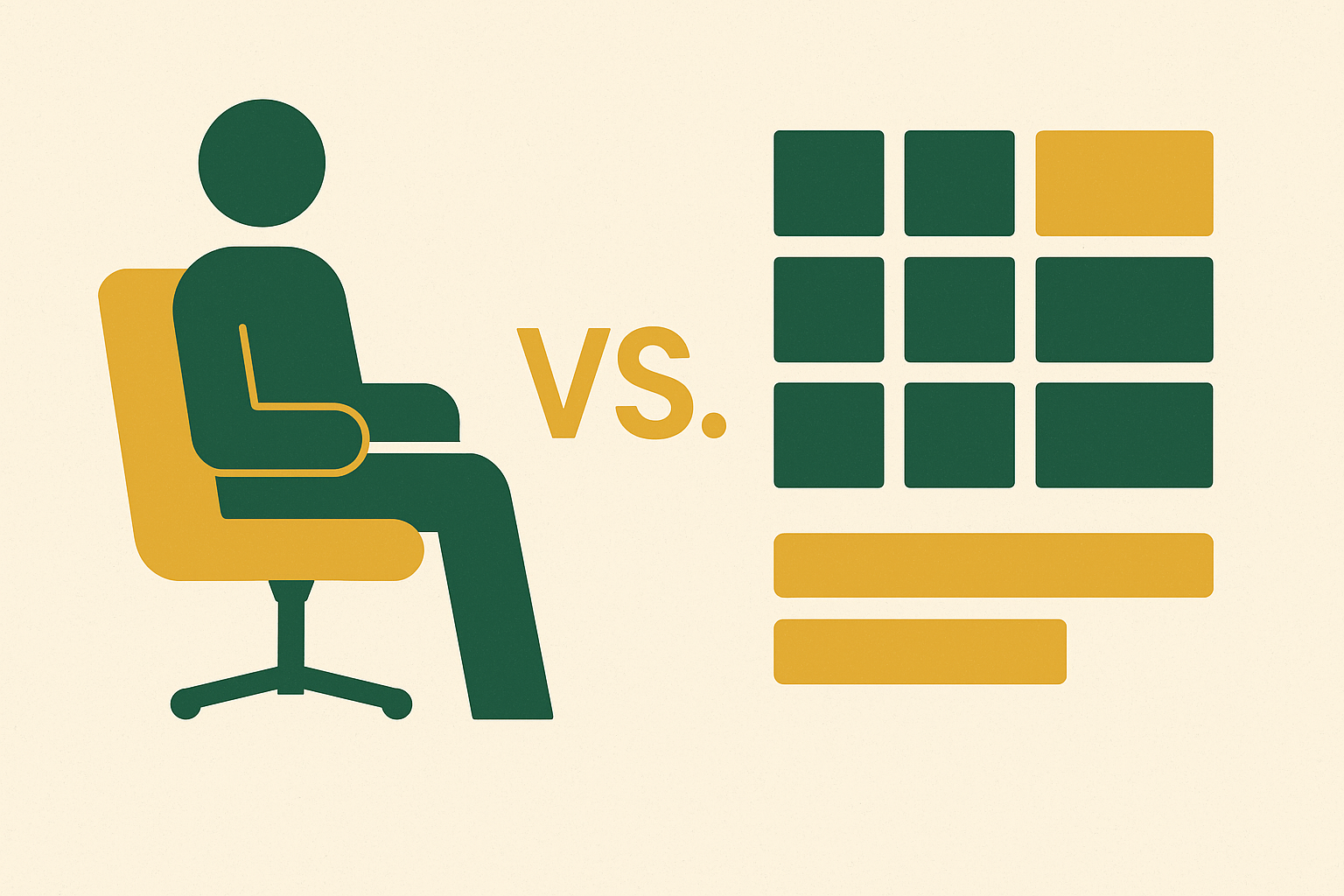
Most founders spend their time agonizing over the exact dollar amount to charge. The harder, more consequential question comes first: should the product even charge per seat, or should it charge for what the product can do? The choice between seat-based and feature-based tier design determines who upgrades, who churns, and whether the pricing model can survive as the product grows. A product priced at the wrong shape loses to a higher-priced competitor with the right shape, because the structure of a pricing model governs buyer behavior more than the number printed on the page.
This decision is not something to revisit later, once the product has traction. It gets built into the billing code, the upgrade logic, and the customer's expectations from the first day someone pays. For a micro-SaaS founder working alone or with one or two collaborators, undoing a bad pricing structure means rebuilding the billing system, re-educating existing customers, and absorbing the churn that comes from changing the deal mid-relationship. A funded team with a few engineers can afford to rip out a payment model and rebuild it in a sprint. A solo founder usually cannot.
The wider SaaS market has already started moving away from pure per-seat pricing toward hybrid and feature-gated structures. Micro-SaaS founders face a sharper version of that same decision than their enterprise counterparts do. Enterprise software has procurement cycles, customer success managers, and negotiated contracts that smooth over a pricing model's rough edges. Micro-SaaS has none of that cushioning. It lives or dies by whether one person, alone at a laptop, clicks "upgrade" without ever talking to a salesperson.
What seat-based and feature-based tier models do differently
Seat-based and feature-based tiers point customers toward upgrading for entirely different reasons, and mixing up the two leads founders to build pricing that fights against their own growth.
Seat-based pricing charges by the person. Every user with a login is a line item on the invoice. When a customer's team grows, the bill grows with it, automatically, with no sales conversation required. This works well when a product's value comes from the number of people actively using it: project management tools, shared documents, team chat, anything where the goal is to get everyone on the team logged in.
Feature-based tiering works on a different axis. It sells specific capabilities at each plan level, so the thing that triggers an upgrade is what the product can do for the customer, not how many people are using it. The customer picks a plan based on the capabilities they need right now, and moves up when their needs grow. The most common shape for this, and the one that converts best according to the sources behind this piece, is three tiers: a basic plan that's clearly limited, a middle plan built to look like the obvious smart choice, and a premium plan for the small number of power users who need everything. Each tier has to offer a real, visible jump in value. An upgrade that feels like a tax for no new benefit kills conversion before it starts.
The question every founder needs to answer for their own product is simple: what grows as the customer gets more value out of this? If the answer is "more people doing the work," seats make sense. If the answer is "more powerful things the product can do," feature tiers make sense. If the answer is "more volume processed, computed, or sent," that points toward usage-based pricing, a third path that sits outside the focus of this piece.
Where per-seat pricing breaks down for micro-SaaS products
Per-seat pricing is usually the first instinct, because it's what founders see in the enterprise software they use and study. Micro-SaaS products are built differently enough that seat-based billing often works against growth.
Per-seat pricing assumes a product's value multiplies as more people use it. Most micro-SaaS products don't fit that assumption. They get bought and used by one person, or by a small team with one person doing the real work and a few others checking in occasionally. When that's the shape of the customer base, per-seat pricing overcharges the casual users and undercharges the one person actually driving value. The customer's rational move is to ration seats: give access to fewer people, keep adoption shallow, and never let the tool become something the whole team relies on. Founders respond by locking features behind higher tiers to compensate, customers feel nickeled and dimed for every extra login, and both sides end up frustrated with a model that was wrong from the start.
Seat-based pricing also works against products that should spread by word of mouth inside a team. If every new person added means a new line item on the bill, the natural spread of a useful tool turns into a cost conversation instead of a shared win. That tension gets worse as markets mature and seat prices get compressed by competition, squeezing the unit economics that the model depended on.
AI features have made this problem sharper. Any product exposing AI capabilities to users runs into a cost structure that per-seat billing was never built to handle. A user running heavy AI-assisted tasks all day costs meaningfully more to serve than a user who never touches those features. That's a real asymmetry in serving cost, and flat per-seat fees don't absorb it. One power user running an AI feature constantly can quietly eat into gross margin if the seat price was set before inference costs were even part of the equation. This is a direct part of why the broader SaaS market has been drifting away from pure per-seat structures, with the share of companies on flat per-seat plans declining and hybrid, usage-aware plans taking their place.
There's also a pricing band problem specific to micro-SaaS. The sustainable price point for a solo-run product tends to be in a narrow range: high enough to support one person's business, low enough that a buyer doesn't need approval from anyone else to pay it. Per-seat billing rarely fits cleanly into that band, because most buyers at this price point are teams of one. A seat-based model breaks the moment the real customer is a single user. Feature-gated tiers can operate cleanly inside that same narrow price band without that breakage.
When per-seat pricing is still the right answer
None of this means per-seat pricing is wrong everywhere. It's the right answer for a specific, well-understood category of product, and a founder building in that category without seats is leaving expansion revenue on the table.
Seats make sense when a product's value comes directly from the number of people using it at once. Project management software, team communication tools, shared document platforms: these products require multiple people active simultaneously for the product to do its job. In that category, seats generate expansion revenue without any extra sales motion. As the customer's team grows, so does the invoice, automatically. Procurement teams at larger companies already understand per-seat pricing and can budget for it without needing it explained.
Flat pricing, a close relative of the feature-tier approach, works well for solo-buyer products where value doesn't scale with seats or usage, and where the buyer wants simplicity more than flexibility. Plenty of bootstrapped, founder-led SaaS products run profitably on flat pricing for years, because their buyers are individuals who want one clear price and no surprises on the invoice.
The honest way to frame this choice: match the pricing dimension to whatever creates more value for the customer as they grow. Seats make sense when the work scales with headcount. Needing more powerful capabilities points to feature tiers. More volume processed points to usage-based pricing. More than one of those at once points to a hybrid model.
Why feature-based tiers fit the majority of micro-SaaS products
Most micro-SaaS products solve one specific workflow problem for one specific type of buyer.
Micro-SaaS products are usually built for a micro-segment: a specific job, a specific workflow, a specific kind of user, not a ten-person team collaborating in real time. Closet Tools, a browser-based automation tool built for Poshmark resellers, runs at $30 a month ($25 a month billed annually) and serves exactly one kind of buyer doing exactly one kind of job. There's no "team" to charge by seat. There's a reseller who needs the automation to work, and who upgrades or stays put based on what the tool can actually do for their shop. Feature-gated tiers fit that reality directly: the customer upgrades when they need a capability they don't yet have, not because a coworker joined the account.
Feature-based tiers also give founders direct control over which capabilities drive upgrades. The features placed behind each tier's gate should be the ones power users genuinely need, not arbitrary limits designed to annoy free users into paying. Pricing itself functions as a feature here. Where a capability sits in the tier structure tells the customer what the product believes its most valuable features actually are. For founders building on platforms where the backend, billing, and database are already handled as one connected system, this decision carries less risk: the choice between seats and features shapes not just pricing but how the product itself gets built, and founders who aren't stitching together their own backend and billing infrastructure by hand can make that call without worrying about a costly rebuild if they need to change course later.
The practical structure of a feature-gated tier
Deciding to use feature-based tiers is the easy part. Deciding which capabilities go where is where most founders stumble, because getting the placement wrong either traps people in the free tier forever or removes any reason to upgrade.
Start with one question: which features create the most value for a customer who's getting serious about using this product daily? Capabilities that power users need but casual users rarely touch, things like automation, integrations, advanced analytics, priority processing, or team-level reporting, belong behind the upgrade gate. Capabilities that make the product useful enough to keep opening every day belong in the entry tier. Stripping those out of the free plan drives people away before they ever see the product's value. The entry tier's job is to build trust, not to function as a trap.
The upgrade trigger should land at the moment a customer's use of the product naturally expands. Common triggers include a usage threshold, like a cap on the number of projects, records, or workflows created, a capability that serious users consistently need, like API access, integrations, or custom domains, or a depth of workflow that only matters once the product is embedded in someone's daily operations. The trigger should feel like a natural consequence of using the product more, not an arbitrary wall. A customer upgrades because they need what's on the other side of the gate, not because a counter hit zero.
Keep the pricing page itself simple: three tiers maximum, which the sources behind this piece commonly identify as the conversion-optimal range, sometimes stretching to four. Use the premium tier deliberately as an anchor, so the middle tier looks like the obviously sensible choice by comparison. Labeling that middle tier as "most popular" or "best value" is a conversion mechanism that nudges undecided buyers toward the plan that works best for both sides.
New products should launch with a simple pricing page. One plan, one price, is the right starting point for something still finding its first customers. Adding tiers too early tells buyers the product is already more complex than it needs to be, and it locks a founder into feature-gate decisions before there's enough data to know which capabilities actually drive upgrades. Prices can be raised later without losing the business. Raising them fivefold overnight without losing customers is a different problem entirely, and a much harder one.
For micro-SaaS products built around AI features, a hybrid approach often works better than cramming variable inference costs into a flat tier. Zapier's MCP connector is a useful model here: there's no separate price tag for the MCP connector itself, but each successful tool call spends two tasks out of the plan's existing task allowance. That's a usage-metered feature bundle layered on top of a simple tier structure, one that tracks the actual cost driver without making the pricing page more complicated to read. Zapier's own plans show this shape: the Free plan includes 100 tasks a month, enough for roughly 50 MCP calls; the Professional plan billed yearly includes 750 tasks, enough for roughly 375 calls; the Team plan billed yearly includes 2,000 tasks, enough for roughly 1,000 calls. The base subscription stays simple and easy to understand, while the usage meter underneath quietly absorbs the cost variability that AI features introduce.
For a micro-SaaS founder building and shipping a product without a background in backend engineering, this is exactly the kind of decision that's easier to get right from the start than to fix later. Platforms built for non-technical founders, designed so the entire stack from billing to database to backend logic is already handled, make this a decision a founder can make with confidence on day one, instead of a problem to be solved with a rebuild six months into a growing customer base. Floot works this way, handling database, hosting, and App Store publishing through Claude or ChatGPT so founders never have to set up infrastructure separately.