Marketplace Revenue Splits Founders Should Avoid
Understanding where your take rate should sit prevents early marketplace collapse.

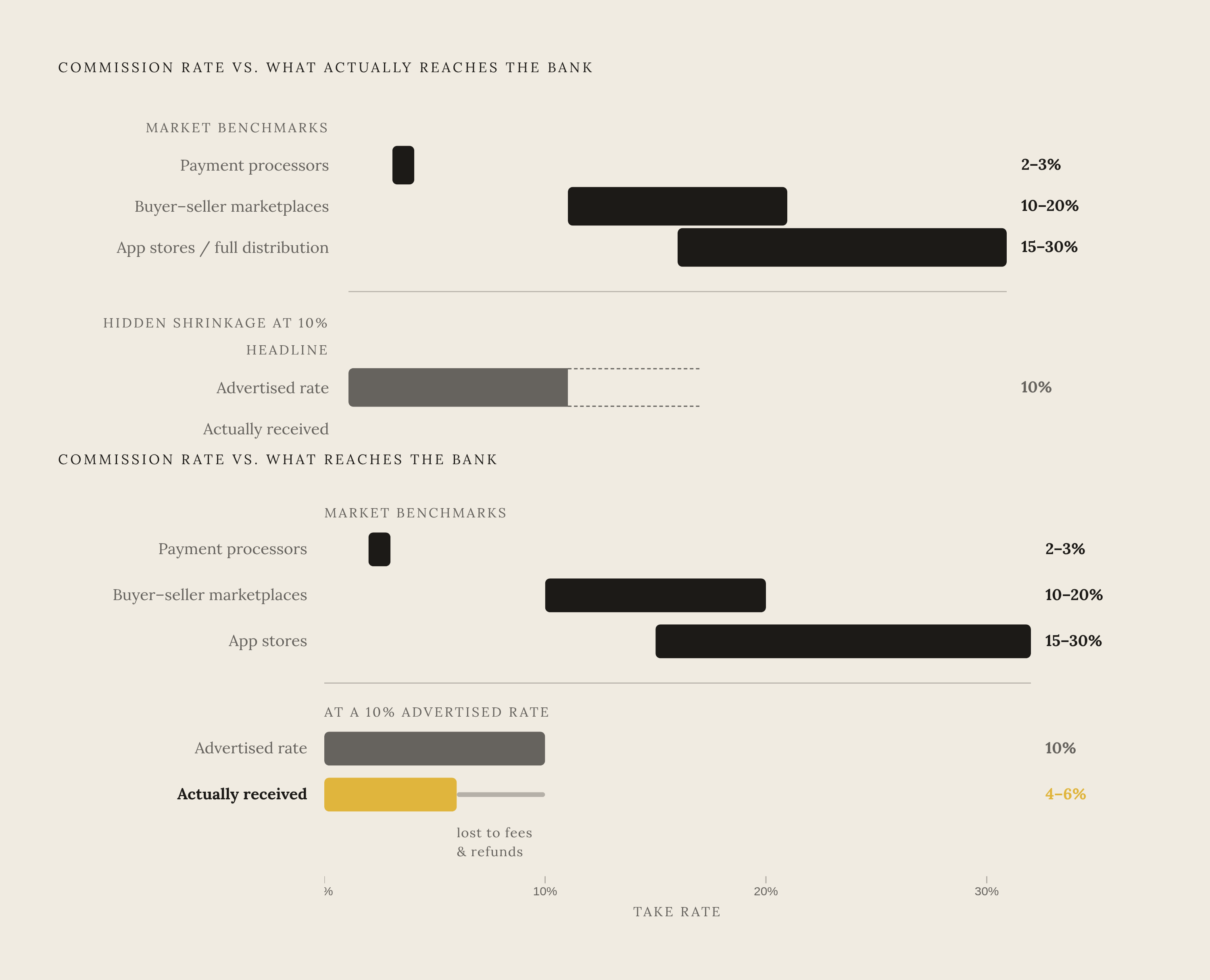
Setting a marketplace's commission rate is a growth decision, a retention decision, and a positioning decision, bundled into one number that founders often pick by gut feel or by copying whatever a bigger competitor posts on its help page. That copying instinct is the first problem: a visible take rate is a surface number, stripped of the context that made it work. It says nothing about the competitor's liquidity, its supplier alternatives, or its cost structure. And it hides a bigger confusion: take rate is not platform revenue. A marketplace charging 10% commission might see only 4% to 6% actually hit the bank once processing fees, payouts, refunds, and disputes chew through the rest.
What take rate benchmarks tell you, and what they hide
Rates cluster by platform type, not by what a founder wishes they could charge. That clustering is where the diagnosis should start, before anyone touches the actual number.
Payment processors sit lowest, usually 2% to 3%. Stripe charges 2.9% plus $0.30 on domestic cards, with another 1.5% for international ones, the price of moving money and not much else. That's the price of moving money, and not much else.
Marketplaces that connect buyers and sellers run higher, usually landing between 10% and 20%. Etsy takes 6.5% on top of payment processing. Other major marketplaces layer on additional fees beyond payment processing. The extra points pay for something processors don't offer: search, discovery, trust signals, dispute resolution.
App stores often cost 15% to 30%. App stores often cluster around 30% because the fee covers full distribution: payment rails, customer acquisition, hosting, review systems, a bundle rather than a tax. That's a bundle, not a tax.
A benchmark tells a founder what category they're in. It says nothing about whether their platform has earned the top of that range yet, and that gap is where most of the damage in this piece starts.
Mistake 1: Maximizing take rate at launch before the platform has earned it
The instinct is understandable. Pick the highest sustainable rate in the category and charge it from day one, since that's what the eventual winners charge anyway. It's also backwards: it picks a rate suited to an eventual winner before the platform has done the work to earn that position.
A high take rate at launch is friction with nowhere to hide. Charge sellers too much and they raise their own prices to compensate, which prices out the buyers a young marketplace hasn't built loyalty with yet. Volume drops. Liquidity, the one thing an early marketplace can't survive without, dries up before it ever forms.
Trajectory affects how sellers respond: a rate that starts low and climbs is tolerated far better than one that starts high and must be defended once a competitor undercuts it. Starting low and climbing gradually is a much easier path than launching high and defending it once a competitor shows up undercutting the rate. Sellers tolerate a rate that creeps up gradually far better than one that gets hiked all at once. A creeping rate feels like the cost of a platform proving its worth. A hiked rate feels like a bait and switch, even when it isn't one.
Mistake 2: Applying one commission rate to every supplier regardless of volume, tenure, or acquisition cost
A flat rate sounds fair on paper. Everyone pays the same percentage, no favorites. In practice it's regressive: the more a supplier transacts, the more they end up subsidizing the platform's fixed costs, with zero recognition for the volume they bring in.
Tiered structures fix this by charging less as sellers do more. A common setup layers subscription tiers against sliding commission rates, a free entry tier at the highest commission, mid-tier plans at reduced rates for a monthly fee, and enterprise pricing negotiated around volume. Lower rates reward the sellers doing the most business. The monthly fee gates the features that pull people up the ladder.
Upwork's older structure worked on a sliding scale tied to cumulative billing with a given client: 20% on the first $500 billed to a client, 10% between $500.01 and $10,000, and 5% above $10,000. The design rewarded relationships that had already proven themselves, rather than treating a freelancer's fifth project with a client the same as their first.
The retention risk with flat rates is specific. The suppliers doing the most volume are also the ones with the most leverage and the most alternatives elsewhere. They're the easiest to lose and the hardest to replace, and charging them the same rate as a brand-new, low-volume seller amounts to a loyalty tax dressed up as fairness.
Mistake 3: Structuring fees so that suppliers cannot see what they are paying
A marketplace can advertise a clean 10% commission and still take far more than that once every layer gets counted. Payment processing adds 2.9% plus $0.30 on domestic cards, with more for international transactions. Chargebacks, disputes, and other deductions carry their own costs on top. None of that appears in the headline number.
Lago's marketplace billing guide describes the gross-versus-net revenue recognition problem, in which a single transaction can touch the platform, one or more sellers, a payment processor, and a tax authority, with each taking a slice. Most founders advertise the platform's cut and let sellers find the rest on their own, usually at the worst possible moment, like their first payout.
Visible fees create visible friction, and that friction is at least honest. When Uber raises driver commission, drivers feel it right away in what lands in their account. When the App Store changes its revenue split, developers organize and go public with complaints. Hidden fees don't avoid that friction, they just delay it, and they add a trust problem on top once sellers figure out what they've actually been paying all along.
Gumroad's 2025 shift points the other direction. In January 2025, Gumroad became a full Merchant of Record, taking on tax obligations that sellers had previously managed themselves. Framed as relief, sure, but Gumroad's flat 10% fee sits at the higher end for its category, and it makes the platform a tougher sell for higher-volume creators. What matters is that the fee structure stayed visible the whole time. Sellers could look at the number, do the math, and decide to stay or go with real information in hand, which is the opposite of Mistake 3, and it's why the backlash never showed up the way it might have with a buried fee.
Mistake 4: Charging the wrong side of the marketplace (or both sides equally)
Every marketplace has one side that creates the value and another side that captures it. Fees should track that split, not flatten it out because equal treatment feels tidier on a pricing page.
Airbnb makes the asymmetry obvious. Hosts create the value. The property, the photos, and the experience of staying somewhere are what hosts provide. Guests capture it. Airbnb's earlier model charged hosts around 3% and guests roughly 14.2%, a split that recognized hosts would route around any platform taxing them too hard, while guests would tolerate paying more for search, trust, and support. Airbnb's October 2025 shift to a 15.5% host-only fee for users of its property management software marks a real structural change, moving the cost onto the side that historically had less price sensitivity, once the platform had built enough guest-side trust to carry it.
Uber runs the opposite dynamic. Drivers create the value, riders capture the convenience, and Uber takes roughly 20% to 25% from drivers because drivers have few alternatives while rider prices stay anchored to old taxi benchmarks. That imbalance is why driver pay has been a running source of friction for the company for years.
Splitting fees evenly between both sides without asking which one has more alternatives, more price sensitivity, or more ability to walk away is a guess. It's a guess, and it's a guess on the single most consequential structural decision in the whole business model.
Mistake 5: Raising take rate without the conditions that make suppliers accept it
Raising a take rate is fatal without three conditions in place at the same time. Analysis of marketplaces that pulled off increases successfully points to the same pattern each time.
First, the marketplace already needs to represent a meaningful share of supplier revenue, more than 30%, often above 50%, so that leaving the platform costs more than accepting the new terms. Second, the increase has to come bundled with something suppliers can actually feel: better tools, wider marketing reach, payment protection, less operational friction. Third, the timing has to be telegraphed well in advance, with substantial notice and a clear explanation of what's changing and why.
Airbnb's October 2025 move from a split fee (around 3% host, 14.2% guest) to a 15.5% host-only fee is one of the boldest revenue-share overhauls a platform this size has attempted. Its implied take rate landed around 13.6% in Q4 2025 results, slightly down from 14.1% the year before, part FX, part deliberate pricing experimentation aimed at holding market share against Booking.com and Vrbo. Airbnb could take this swing because years of supplier dependency and brand trust gave it room to move.
Upwork shows what happens without that room. On May 7, 2026, Upwork announced its second round of layoffs in two years, cutting 25% of its workforce. Shares fell roughly 19% over the next five trading sessions. Q2 2026 results showed year-over-year declines across gross services volume, revenue, and active clients. Whether the take rate itself was the direct cause or not, it's a live example of what supply-side trust erosion looks like once it sets in: not one bad headline, but a slow bleed across every metric that matters.
Auditing your current split structure for these failure patterns
None of this comes down to landing on a magic percentage. It comes down to stress-testing a fee structure against the five failure modes above before a competitor, or a supplier revolt, does it first.
Start by finding the effective take rate, not the headline one. Mapping every deduction between gross transaction value and what actually lands as platform revenue reveals processing, payouts, refunds, disputes, and currency conversion. If that gap is large and nobody outside finance could explain where it went, transparency is already a risk sitting on the balance sheet.
Next, test the rate against the value-creation asymmetry. Figure out which side of the marketplace actually creates the supply and which side is capturing convenience or access, then check if the fee structure reflects that difference or instead splits the difference by default because that felt safer at launch.
Then check the rate against the cluster for the category. Labor and gig platforms run in a sustainable range of 15% to 25%; goods marketplaces run closer to 10% to 20%; app stores and platforms bundling full distribution run 15% to 30%. Sitting well above the cluster for the category isn't automatically wrong, but it needs an answer. What, specifically, does the platform deliver that a seller can't get anywhere else for less? Without a clean answer to that question, the rate is an open invitation for someone else to launch at a lower one.