Adding a Services Revenue Layer to a Solo Software Product
How services work alongside a subscription business when revenue plateaus.

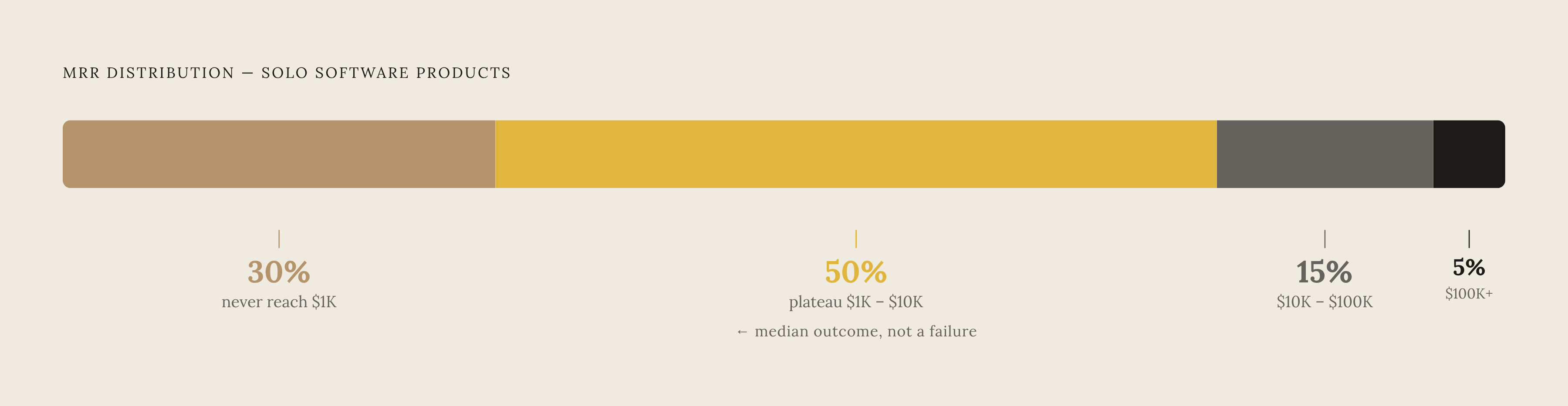
Most solo software products stall out somewhere between $1,000 and $10,000 in monthly recurring revenue, and that's not a failure state. It's the majority outcome. About half of solo products plateau right there in that range, another 15% climb to $10K-$100K MRR, and only 5% ever clear six figures a month. The remaining 30% never even hit $1K MRR. So the plateau is the median ending, not the bad one, and the way past it for a lot of builders is adding a second revenue stream that runs on the same expertise the product already proved out: a services layer. It's adding a second revenue stream that runs on the same expertise the product already proved out: a services layer.
Solo founders make up 42% of companies that cross a significant revenue milestone, which means the ceiling is a matter of what most single-operator businesses do with subscription revenue alone, not a permanent structural limit. It's just that subscription revenue alone, priced for scale and self-serve, doesn't clear it for most single-operator businesses. Something else has to carry part of the weight.
What a services layer is, and what it is not
A services layer is not freelancing with a nicer name. It's a productized service, a repeatable request from customers packaged into a fixed offer with a set price, a set timeline, and a documented delivery process, sold well enough that a stranger can buy it without three rounds of scoping calls.
Not every service offer carries the same overhead, either. There's a real spectrum here, running from lightly systematized consulting (still fairly hands-on, still requires judgment calls per client) down to something close to automated delivery, where the founder's involvement per client comes in minutes.
The strongest version of this is a Software Enhanced Service: domain expertise paired with the founder's own product, sold as one offer. That combination is hard for an outside agency to copy, because the agency doesn't own the tool. A generalist consultant can sell advice. A founder-consultant can sell advice plus the exact software built to act on it.
What a services layer is not: open-ended custom development, a retainer with no defined scope, or a default "yes" to whatever a client happens to ask for that month. Those are jobs with worse benefits than the job the founder already left, not productized services. They're jobs with worse benefits than the job the founder already left.
The three offers worth building where the services layer earns its place
Three types of offers tend to work, and they work for different reasons.
Personalized onboarding lets existing subscribers pay for a guided setup instead of muddling through the free onboarding flow alone. This deepens the relationship, adds revenue from people already paying, and (maybe most useful of all) surfaces exactly where the product's onboarding is confusing, because the founder is now watching it happen live. Acquisition cost is close to zero: the buyer already trusts the product enough to be a subscriber.
Premium support tiers work because a lot of indie hackers find that dedicated, fast-response support justifies a monthly fee well above the standard plan. This is recurring, it's bounded in scope (support, not development), and it scales reasonably well because the work is reactive rather than open-ended.
Done-for-you implementation is where the founder applies product expertise directly to a client's specific setup: fixed scope, fixed price, delivered once, then done. Not a retainer, not an ongoing engagement. This is where the founder's knowledge of the product's edge cases becomes billable in a clean, closed-ended way.
There's a documented case on Indie Hackers of a founder running a consultancy on the side of a product, covering data and AI strategy, data governance, and organizational change, currently pulling in over $15K MRR. The infrastructure behind it produced real, bounded costs: branding, a website, legal and commercial document templates, accounting and timekeeping systems, all a one-time-ish cost rather than an ongoing tax on every deal closed. Real setup cost, but bounded, one-time-ish cost, not an ongoing tax on every deal closed.
Pricing a services offer without underselling or overcomplicating it
Price from what the founder already knows, not from a generic market rate. The product itself is proof of domain depth that a generalist consultant charging similar rates simply doesn't have. That prior knowledge, priced from what the founder already knows rather than a generic market rate, is leverage the founder should use. Use it.
Fixed pricing, not hourly. This is not a style preference, it's the mechanism that makes the productized model work at all. The moment billing goes hourly, scope creep walks back in the door, and so does the negotiation the whole point of productizing was meant to kill.
For a sense of scale, consulting retainers among location-independent operators average somewhere in the $5,000-$9,000 a month range, with top performers reaching $15,000-$30,000 a month. Useful as an anchor for what's realistically possible over time, not a number to chase in month one.
On margin: bootstrapped micro-SaaS businesses typically run north of 70% profit margins. A services offer that's actually productized has a delivery process that is documented and repeatable rather than reinvented per client, and it can get close to that same margin. An offer that isn't documented yet can't, because every client becomes a custom job again.
The burnout constraint (what happens when services swallow the product)
Burnout, not a weak strategy, is the biggest predictor of solo-founder failure. It's burnout. Recent survey data on solo founders puts the burnout rate at 54%, with 75% reporting anxiety episodes tied to the work. Burnout, not the financial plateau, is the real ceiling.
Distribution, not product quality, is what most founders name as the hard part: 99% of solopreneurs cite marketing and distribution as their central problem, and 72% of successful indie hackers say distribution, not the product itself, was what determined the outcome. Client delivery work eats directly into the hours that distribution requires. Every hour spent on a client deliverable is an hour not spent writing the post, running the ad test, or following up on the partnership that would have brought in ten new subscribers.
A solo founder is already juggling four roles: Builder, Marketer, Seller, Operator. Those four already compete with each other for the same 10 or 12 working hours a day. A services layer adds a fifth: Client Manager. And client management doesn't politely wait its turn, it has deadlines attached to other people's businesses, which means it tends to win the fight for attention even when it shouldn't.
Call it the Manual Service Trap, where energy drains steadily into delivering for clients, the product stops getting built or maintained, and the founder doesn't notice until months later. Service revenue feels good immediately. Product stagnation appears on a lag because service revenue feels good immediately while the product's decline takes months to become visible, which is exactly what makes the trap so easy to walk into without noticing.
How to bound the services layer so the product stays the primary business
Structural limits set before the first client signs, not willpower, are the fix. It's structural limits set before the first client signs.
Cap the client count before launch by deciding, in advance, the maximum number of concurrent engagements the services layer will ever carry, and saying it out loud publicly: "Taking on two clients this quarter." A public cap does something a private intention doesn't: it gives the founder a reason to say no that isn't a negotiation.
Document delivery before selling it: if the process can't be written down as a repeatable checklist, the offer isn't ready to sell yet. Documentation is the actual mechanism that turns custom work into a productized service, not a nice-to-have that gets added later.
Time-boxing every engagement, with a fixed deliverable and a defined end date, protects the calendar the way nothing else does. Open-ended retainers are the single most common route into the Manual Service Trap, because there's no natural point where the engagement is supposed to stop.
Spend the services revenue on product infrastructure, not on headcount. Running a production-grade solo product now costs somewhere around $85-$200 a month in tooling and hosting. Services income can cover that many times over and still leave real surplus, all without the founder hiring anyone or adding a management layer they'd then have to run.
Building the service offer when you don't have a developer background
A non-technical founder's service offer has to be anchored in the thing they actually understand: the domain their product addresses, not the code that runs underneath it. That's the credible foundation, and it's a foundation a lot of generalist consultants simply don't have.
The product itself functions as the credential here. A founder who built a working app for a specific niche has more proof of domain fluency than most consultants walking into that market cold, because the product serves as evidence.
Non-technical founders have historically stalled the moment a client needs something custom, such as a new workflow, a data integration, or a one-off dashboard that doesn't exist in the core product. That used to require either learning to code or hiring someone who already could. AI-assisted app building has changed that math. Tools in this category now produce a working app, complete with frontend, backend, database, and hosting, from a plain description of what's needed, dramatically reducing the time and technical skill required to go from idea to something functional. The same infrastructure running the core product can, in practice, run the one-off client deliverable too.
What the combined revenue model looks like in practice
Take the base case: a product priced at $3,000-$8,000 MRR, which is squarely the plateau range most solo products land in, paired with a productized service adding a meaningful amount on top. The dollar figures don't have to be enormous to matter. What matters is that they come from two sources that don't move together.
That's the real structural benefit: two revenue streams with different demand drivers make the whole business less fragile. A bad churn month on the subscription side doesn't take total revenue to zero, because the services income isn't tied to the same customer behavior or the same seasonal pattern.
There's a compounding effect on top of that. Services clients who get real results tend to become product subscribers themselves, refer other subscribers into the funnel, and hand over qualitative feedback that's hard to get any other way, since they've seen the product applied to a real problem up close. Run correctly, the services layer feeds the product's growth instead of competing with it for the founder's time.
For a sense of where the well-bounded version of this can go, some solo operators running AI-powered service offers report $10,000-$30,000 a month while managing 20-plus clients, with roughly 80% of delivery handled through automation. That's the productized, disciplined version of a services layer, built on caps, documentation, and time-boxed scope. The uncontrolled version, the one without those guardrails, is the Manual Service Trap wearing a nicer outfit.