Problem Validation vs. Solution Validation in Solo SaaS
Problem validation only proves a pain exists, not that customers will buy your solution.
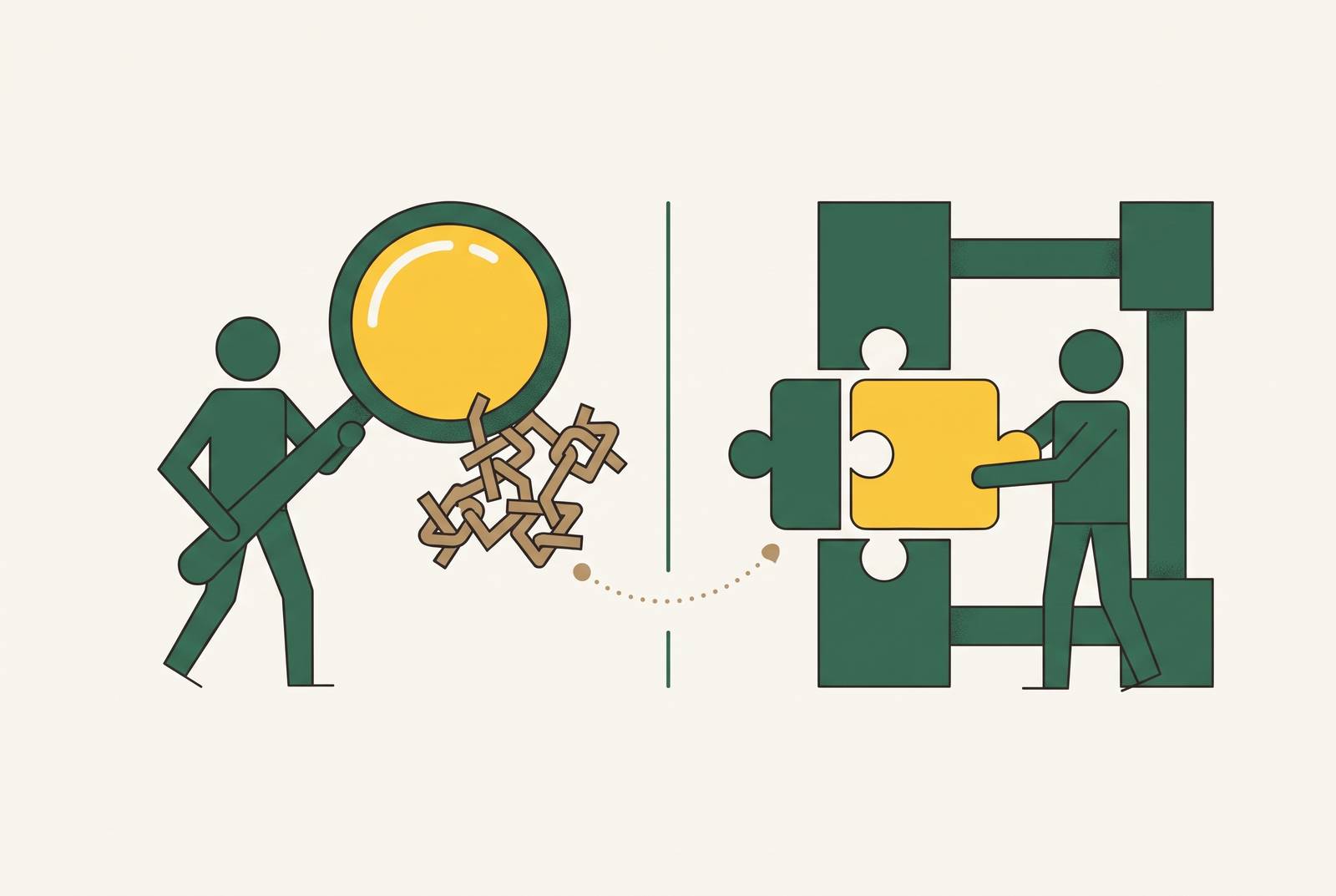
In solo SaaS, problem validation and solution validation each ask a different question. One establishes that a problem exists. The other tests whether a proposed solution offers a better answer than what people already do. Founders get into trouble when they treat the first result as proof of the second, then build something for people who have a real complaint but no reason to buy.
Why solo SaaS founders fail at validation even when they try to validate
The mistake is not laziness or ignorance of validation. A founder can talk to people who might buy, hear the same complaint again and again, and still take it the wrong way. Those talks show that something is hard, costs a lot, or frustrates people. They do not establish that the founder’s idea will sell.
AI and no-code tools make that leap easier because building now feels so cheap. A weekend prototype looks like progress, even when no customer has confirmed demand for it. For AI-native builders, the order can run backward altogether. The founder becomes excited about what the tooling can do, then hunts for a problem that fits. Customers pay for a problem to disappear.
A majority of founders say they validated before building, but only a fraction used structured methods with their actual target market. The evidence needs to remove a specific uncertainty to be useful.
What problem validation actually tests — and what it cannot tell you
Problem validation asks whether the problem exists for the people the founder believes have it, in the form the founder believes it takes. Each part of that question limits the claim. A problem can be real but affect different people, or it can affect the intended customer for a different reason. General agreement that a task is annoying does not settle those distinctions.
The method, unprompted problem elicitation, asks people to describe their work before introducing the idea. The lesson for a founder running these interviews is to begin with the last time the participant tried to do the job in question. Ask what made it hard, how they solved it, and how much time, money, or frustration it cost. Then ask what they would do differently if it happened again next month. Keep the proposed product out of the conversation.
These five prompts cover existence, intensity, the current workaround, the cost of the status quo, and switching intent. Together, they show whether the task is just unpleasant or hurts enough for someone to rethink how they do it. The workaround is especially important because it shows how the participant already responds. The final prompt tests whether that response is likely to change. Neither answer needs to match the founder’s preferred story.
A clean result comes from participants surfacing the problem without being led toward it and describing its cost. That is a narrower finding than approval of a business idea. It supports the claim that the intended customer experiences the pain the founder suspected. Passing this test establishes a necessary basis for evaluating whether a particular solution is the right answer.
What solution validation actually tests — and why a prototype is the wrong tool for it
Solution validation asks whether a description of the proposed product feels like a meaningfully better answer than the participant’s current workaround. The comparison is the heart of the test. An idea can sound good on its own and still lose to what someone already does. The concept has to give the participant a reason to prefer it.
At this stage, the appropriate tool is a concept test. A one-page description of what the product does, who it is for, and what it replaces is enough. Nothing needs to be built to ask that question. The participant is judging the proposed answer, rather than reacting to an implementation the founder has already chosen. That leaves the idea open to change.
A prototype reverses that order by locking in assumptions before they have survived scrutiny. Once something works, feedback can become a reason to spend weeks modifying it while leaving the concept unexamined. The more basic question remains unresolved. Is this the answer they want at all.
For someone who has already built a prototype, this diagnoses what the test can establish. The prototype may show that the founder can make the product function. It cannot substitute for evidence that the underlying concept beats the current workaround. A concept test avoids sunk cost and anchoring from a built implementation, so feedback can reshape the idea itself. The prototype belongs after that scrutiny.
If participants cannot explain what the concept does after reading it, the problem statement from the first step is probably wrong. That does not automatically mean the solution needs more features or a better demonstration. The description may be answering a problem in terms the intended customer does not recognize. In that case, the founder needs to check the earlier finding before doing more work on the build.
Why passing problem validation tempts founders to skip solution validation
A strong problem result can create the exact confidence that makes founders skip the next test. Participants describe their frustration vividly, put a cost on it, and make the opportunity feel obvious. The founder hears emotional resonance as purchase intent. That leap is understandable, but it is still a leap. The participant has explained the pain of the current situation.
The gap is easy to see in ordinary complaints. Someone who says a CRM is too complicated has not said they will switch. Someone who hates doing invoices has not agreed to buy an invoicing tool. A manual process is not, by itself, a request for automation.
PODTurbo illustrates why the current alternative deserves its own examination. Its founder experienced the cost and risk of paying a virtual assistant to handle uploads to print-on-demand marketplaces. With direct knowledge of the pain, he also established that there was no tolerable alternative before building the tool with a co-founder who became its CTO. The product went on to generate meaningful recurring revenue.
The second check shows how the founder examined the alternatives. Having done the task can give a founder a place to start while leaving open what should replace the way it is done now. Nor is this an example of a founder doing everything alone. The two-person founding team does not change the distinction between knowing a problem and testing the answer.
AI-native products need a validation check beyond both questions. An agent must deliver the promised outcome reliably on messy real-world inputs. Demand does not establish that reliability either. The risk that an appealing concept will fail in production because it needs repeated babysitting requires a separate reliability check.
The strongest objection — skip both steps and just charge money
The payment-first objection is stronger than a complaint about spending too much time on interviews. People can describe problems and approve concepts without making any commitment. Money forces a different choice because the buyer must give something up. On this view, complaints and enthusiasm are cheap talk. A payment is the signal that cannot be explained away in the same way.
This argument has real force for founders who have already heard plenty of encouraging feedback. A concept can pass a conversation and fail when the price appears. The person who likes it may not be the right buyer. Or the existing workaround may remain preferable to any new tool once a purchase is required.
The strongest version of payment-first also does not require building software before making an offer. A founder can operate as a human API, manually delivering the outcome that a product would eventually automate. That approach lets the customer experience the result directly. Manual delivery can also clarify what the eventual software needs to do.
None of that makes the earlier questions irrelevant. It shows why payment must be a gate, rather than why problem and solution validation should disappear. A concept test exposes a weak answer before the founder builds it or tries to sell it.
The steps are complementary because they challenge different assumptions. A founder who skips straight to charging for an unvalidated concept may learn that nobody buys, but the rejected offer still contains several unanswered questions. The problem, the answer, the buyer, or the price could be wrong. Earlier tests separate some of those uncertainties before money enters the sequence. Launching blind with a paywall does not make the launch less blind.
How the full four-step sequence runs in practice for a solo founder
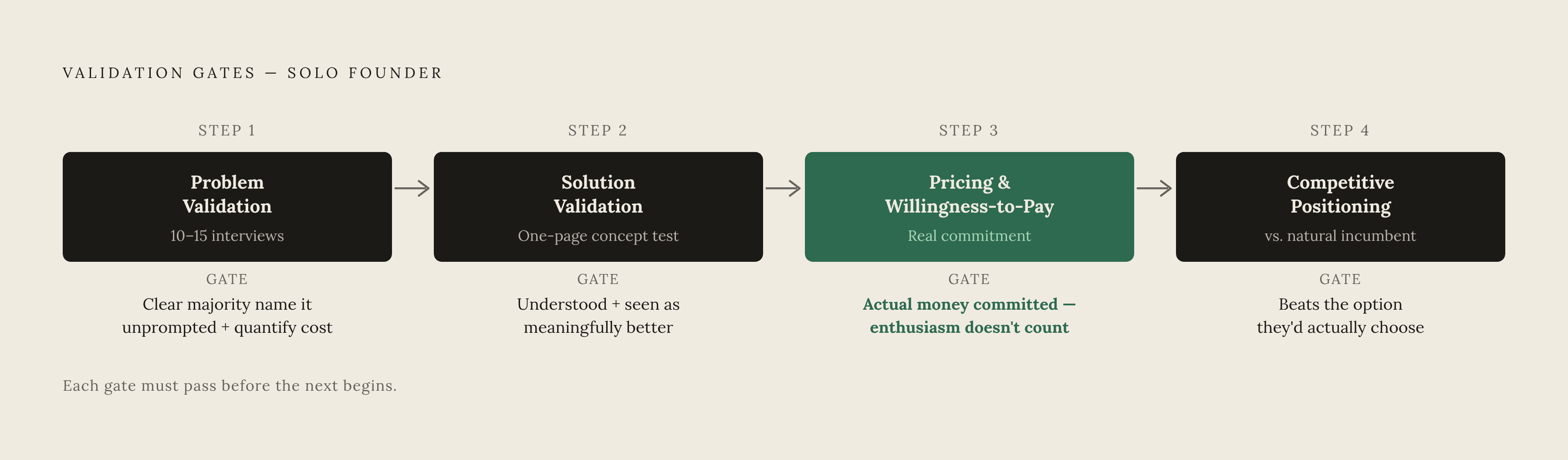
For a solo founder, the practical process has four steps, which are problem validation, solution validation, pricing and willingness-to-pay, and competitive positioning. Each has a distinct passing condition. Research before development is meant to avoid paying for uncertain assumptions with weeks of implementation without becoming another large project. The early work consists of conversations and a description.
The first step is ten to fifteen interviews with people who fit the ideal customer profile. The founder asks about the participant’s last attempt at the relevant job without suggesting what made it difficult or describing the idea. Progress depends on a clear majority surfacing the problem without prompting and being able to quantify its cost. A few enthusiastic responses are not the stated threshold.
The second step puts the one-page concept in front of participants and compares it with their current workaround. The test asks whether they understand the proposed answer and see it as meaningfully better. Feedback changes the concept before it changes a product. If participants cannot say what it does, the founder needs to take another look at the problem statement.
The third step tests pricing and willingness-to-pay through a commitment of money. This is where payment enters the sequence. A participant who likes the concept but will not commit has not supplied the evidence this step requires. The distinction protects the founder from treating enthusiasm as a sale. It also brings the proposed price and the actual buyer into the test.
The fourth step tests competitive positioning against the incumbent a well-prepared participant would compare the product with. People still make that comparison even when the price works for them. Even a validated concept can lose if its positioning fails to show why it should be chosen over the alternative. The customer’s comparison sets the standard.
Once all four gates pass, the founder has a defined basis for deciding what to build, who will pay, at what price, and against which alternatives. That makes the build an execution task grounded in demand research. The infrastructure implication follows from that shift. For an AI-native product, the system still has to deliver the validated promise repeatedly on real-world inputs without babysitting.