The Consultant Who Uploaded to the App Store From a Coffee Shop With No Mac in Sight
AI platforms now let consultants ship native apps from anywhere without owning a Mac.
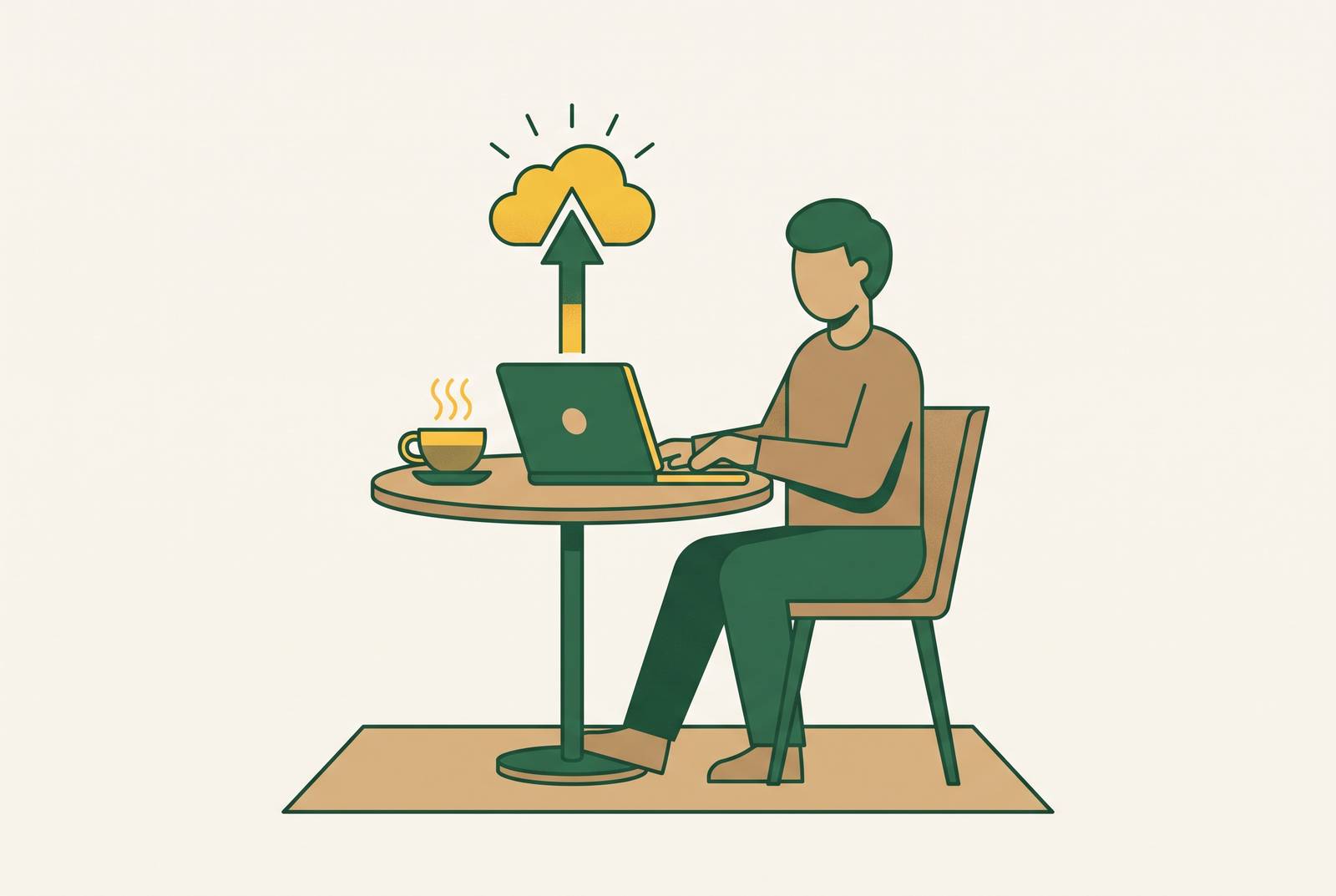
Publishing an AI-built app to the App Store and Google Play without platform-specific hardware or native development tools requires more than an AI chat tool. It requires a platform that produces native binaries and handles the build-and-submission work beyond the conversation. The coffee-shop launch is about that shift. Coding, hardware, location, and infrastructure no longer have to be separate barriers for a consultant with an idea.
Why the coffee-shop launch moment is structurally different from what came before
At a coffee-shop table, there is a laptop, an open conversation, and no dedicated build machine in sight. Previously, getting an app out meant finding someone who could write it, arrange its infrastructure, and navigate the hardware and tools needed to publish it. Generating code removed only one of those obstacles.
Andrej Karpathy coined “vibe coding” in February 2025 for describing software in plain language and letting AI generate the code. Managed infrastructure addresses a different problem by taking care of the services that keep that software running. Location-agnostic tooling also lets the work move off a single machine, so the founder no longer has to rely on it. These changes reinforce each other. The useful breakthrough is not a clever answer in a chat window, but a route from that answer to a working product.
The founders who already made it to the other side
Maor Shlomo built Base44 alone, without a co-founder or an engineering team. Within six months of launching, it had reached significant recurring revenue, grown to approximately 250,000 users, and sold to Wix for a substantial cash exit.
Sage Causie, a fine art photographer with no technical background, built Museboard in an eight-hour session through the night. She launched the free, no-login mood boarding tool in May 2025.
Robin Singhvi, the founder of Gramms, described having no technical background and never having built an iOS app. He used Claude for most of the work on an app that generates personalized bedtime stories with AI narration.
A free creative tool is not an acquisition, and an iOS app is not a web service. The useful pattern is narrower than a promise of instant success. People can now turn a description into usable software without first assembling an engineering team. The common thread is access to tooling.
What "the technical stack" actually means for a consultant who has never needed to care
A database is where an app stores records such as users, bookings, payments, and content. For the founder, the question is whether the platform provides that storage or leaves another service to connect. Backend logic reads, writes, and acts on those records. A working screen is not enough on its own. The platform also needs to handle what happens after someone presses a button.
Authentication, usually shortened to auth, establishes who a user is and what they can do. Google login and email authentication cover most use cases, so the practical question is whether login and access controls come included. Hosting keeps the app available at a public URL. Managed hosting takes the server work away from the founder, including the need to operate through a terminal or cloud console.
Together, these services form much of what builders call the technical stack. A platform either handles these jobs or leaves some of them for the founder to arrange. A code generator that returns files may help build the product but still leave the founder to set up the infrastructure and keep it running. That distinction is more useful than a long feature comparison.
How MCP connectors make any AI tool — Claude, ChatGPT — a capable building environment
Anthropic open-sourced the Model Context Protocol on November 25, 2024. MCP gives AI assistants a common way to connect to external tools, including databases, deployment platforms, browsers, design files, and issue trackers. This is the bridge beyond the chat window. Instead of working only with the information pasted into a conversation, an assistant can interact with connected services.
The protocol is client-agnostic, so the connection is not tied to one AI product. Claude, ChatGPT, and Cursor can use compatible MCP connections rather than requiring a different integration for every tool. That differs from an extension restricted to one browser or a plugin restricted to one application.
Notion or Obsidian connectors can supply context from a knowledge base. Supabase lets the conversation reach a database without the founder having to write SQL, and Perplexity or Brave Search can add live web search. Stripe’s official connector, @stripe/mcp, lets Claude interact with payment data. Each connection has a specific job to do. MCP supplies the plumbing, but the connected platform still produces the result as a web app, a native build, or simply generated code.
Web app or App Store app — how can you publish without a Mac or Xcode?
The prototype looks finished until the founder asks to submit it to the App Store and gets a web link. That link may open a product that does everything it was built to do. It is still not a native binary. Many app builders make progressive web apps, or PWAs, instead of the native output needed to submit an app to a store. Discovering that difference late can leave the build, iteration time, and subscription spending stranded.
For a consultant without local platform-specific hardware, native output is therefore a buying criterion. To build without local platform-specific hardware or native development tools, the founder needs a platform that does the required build work as well as generating screens. Submission support is a separate criterion from code generation. Developer accounts alone do not settle either question, and a finished binary does not guarantee approval.
Dhruv Amin, co-founder of Anything, reported that Apple removed the app on March 26, 2026, and that the company could not secure re-approval despite a brief reinstatement.
For most consultants launching a first product, a web app is the faster, lower-friction choice and can support real users, payments, and business logic. Native-first makes sense when push notifications, offline use, or in-app purchases are core requirements. Store fees and the platform subscription also belong in that decision.
What the all-in-one versus stitch-it-yourself decision looks like in practice
An all-in-one platform reduces the number of places a founder must visit to design, publish, and manage an app. That reduction affects both launch speed and later delegation. Fewer connections mean fewer integration decisions to make. For a lean consulting business, keeping the work in one interface can be more useful than having a specialist tool for every layer.
Stitching tools together has a different advantage. A Stripe payment event can feed an automation tool, connect to a CRM, and trigger customer-success emails without another hire. Specialist tools can improve a particular part of the business under a modest monthly budget. But the founder then has more services to keep working together.
A free tier can work for a small workflow, while per-execution pricing can cost less than per-task subscriptions as more work runs through it. A core platform with selective specialists often works well in practice. Keeping the center of the product in one place preserves speed, while adding a tool for a measurable improvement in quality, revenue, or delivery avoids integration for its own sake.
What a realistic build stack actually costs a consultant in 2026
AI-assisted app building costs a fraction of traditional custom development, with launch timelines measured in days. At the validation stage, one AI subscription and a platform that includes backend services and hosting can run to tens of dollars per month. For most founders at that stage, the annual total is well under a thousand dollars. Before committing, the founder needs to budget for Apple’s and Google’s fees along with the subscription to the chosen platform.
The common waste is paying for overlapping AI subscriptions that all provide much of the same coding assistance, writing, research, and brainstorming. One general-purpose subscription can do those jobs without the founder paying for a tool for each one. Stripe is the default payments layer at this stage because its per-transaction pricing has no monthly fee, until volume makes a flat-rate processor worth evaluating. The resulting stack has three tools, namely one AI subscription, one infrastructure platform, and Stripe, covering work that previously required a developer, a DevOps engineer, and multiple service contracts.
The objections worth taking seriously before you ship
Security is the strongest objection to the easy-launch story. AI can produce working code without auditing it for exploits, and non-technical founders may not recognize the vulnerabilities. A demo that succeeds shows that a feature works. It does not prove that access to the underlying data is properly restricted. A platform that manages authentication, database permissions, and hosting reduces this exposure compared with generating code and self-hosting it.
Maintenance creates a second, less visible risk. One founder said they did not fully understand half their codebase, which may cause trouble only after several requests for changes. When chat history is the only specification, the assistant can lose track of earlier decisions as its context fades and leave them out of later work. Launch day can conceal that maintenance gap. Keeping the build inside a platform that maintains state reduces the burden of managing a collection of files the founder cannot confidently change.
Even with managed hosting, an app sold through a store still depends on that store. The Anything case shows that a live product can lose access to its distribution channel without a guaranteed route back. That risk makes store review a business constraint. The mitigation is to use managed infrastructure to reduce security and maintenance work, and take on store gatekeeping only when the product’s requirements justify it.
How to get from the coffee shop to a live, shareable app in a single conversation
For a consultant ready to build, the process starts with one core function. Describe what the user should be able to do and what a successful result looks like. Keep the first version small enough to test. Museboard’s no-login mood boarding tool shows that a first product can do its job without all the features of a larger business. Before selecting a platform, settle whether that function needs native capabilities or can work at a public URL.
Next, connect the infrastructure before prompting the assistant to build. Choose a platform that handles the backend, database, authentication, and hosting by default, then connect it to the AI tool already open through an MCP connector. If native distribution is essential, the platform must also support the required native output and publishing route. This is the point where hardware independence becomes practical. The conversation can direct the work because the connected services handle the infrastructure beyond it.
Then describe the behavior, test the result, and report what breaks. Follow the Gramms founder’s working pattern rather than asking for a fresh rebuild every time something disappoints. A precise description gives the assistant a concrete correction to make. The skill being developed is clear observation.
Before publishing, check that the output matches the earlier distribution decision. A native product needs its planned store submission process, while a web-first product can go live without taking on Apple’s review at validation. Put the working app in front of real users before adding features. More conversation cannot substitute for their response. For the web-first consultant, the tangible result of that first building conversation is a live, shareable link.