Waitlist Strategy for Bootstrapped SaaS Launches
Building a smaller, qualified waitlist converts better than chasing thousands of unvetted signups.

A waitlist strategy for a bootstrapped SaaS launch is a plan for turning interest into revenue. The goal is to find people with a real problem, ask for signs of commitment, and give them paid access before their interest fades. A smaller list that converts quickly is worth more than thousands of names that never become customers.
Why a long waitlist is not the same as a validated launch
A founder on r/SaaS collected thousands of waitlist signups and converted a tiny handful into paying customers. The list looked like traction, but nobody on it had been asked to commit to anything. These were people who thought the idea “sounded cool.” Their interest was real enough to produce an email address, but it did not establish purchase intent. The gap became visible only when payment was required.
That is the weakness of a signup count as evidence of demand. It measures willingness to join a list, leaving willingness to buy the product behind it untested. Without qualification, weak conversion is not an odd failure to dismiss. For a bootstrapped founder without VC runway, discovering that distinction late is especially expensive. A waitlist that goes cold while development continues can consume both scarce time and the only warm audience the business has.
How waitlist conversion actually decays over time
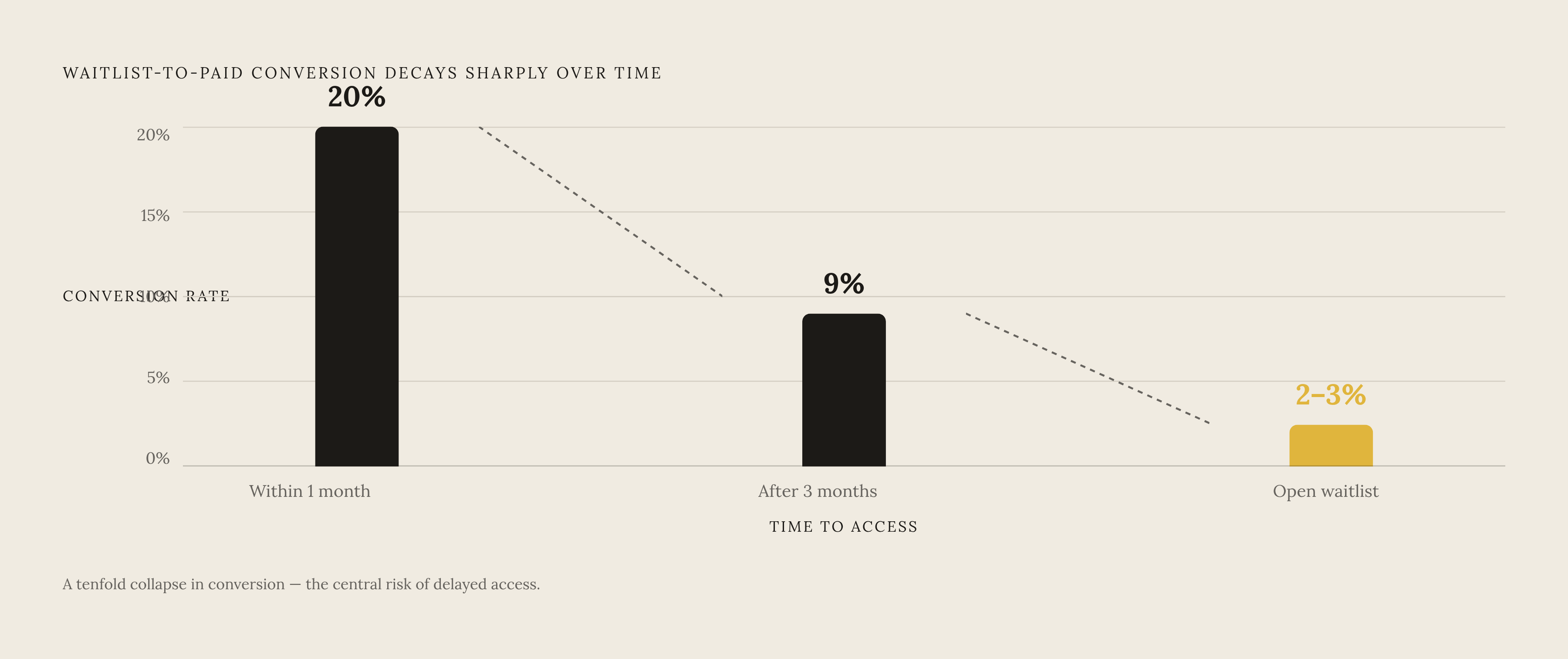
The clock starts when someone signs up. Waitlist-to-paid conversion averages roughly one in five, about 20%, when access arrives within a month. After three months, that falls below one in ten. Open waitlists with no nurture convert at only two or three in a hundred. Those figures make waiting a revenue decision.
The longer the gap, the less of the original interest remains available to convert. A founder can keep making progress on the software while losing ground with the audience. More finished features do not erase the time subscribers have spent waiting.
For a bootstrapped business, early access is a structural requirement, even when it means releasing a reduced feature set. The waitlist has to lead somewhere while the people joining it still care. That puts a limit on how much validation can be deferred until launch day. Before the clock runs out, the founder needs to learn which subscribers have a problem worth paying to solve. The first opportunity to find that out is the signup itself.
Designing signup friction that filters for intent rather than eliminating it
A form that asks only for an email address makes it easy to join, but tells the founder almost nothing about who is joining. Progressive profiling keeps that easy first step, then checks who has a problem worth paying to solve. Start with the email address, then ask one or two questions on the thank-you page or in the first automated email. Useful questions cover the problem the subscriber wants to solve, what they use now, or whether they would pay for a solution this month.
Answers help, but actions are stronger evidence. A deposit, a call booking, or a pre-payment requires more commitment than a survey response. These signals matter most when the business cannot afford a long discovery process that ends with nobody buying. A booked call is not the same as a payment, but both reveal more than an unchecked expression of interest. The signup flow should let people show their commitment through these actions.
Scarcity can make the offer stronger by limiting spots, showing people their queue position, or giving them early-access benefits that expire. Clubhouse invites sold for large sums on secondary markets, showing how access itself can signal that a product is worth having. This shows how much people may value the reward they expect, though every SaaS founder need not copy that launch model. Deliberate friction may reduce signup volume, but volume is not the objective. When more of the subscribers pay, the business needs fewer names to bring in the revenue it aims for.
The referral loop as a qualification multiplier, not just a growth hack
A referral program adds another layer of evidence because referring a friend is a social commitment. Someone who recruits another person is not just a number on a list. They have done something to advance the product before receiving access. That makes referral participation useful for qualification as well as growth. The same action can bring in a new subscriber and reveal the commitment of an existing one.
Referral is among the highest-converting acquisition channels for waitlists, second only to email on a per-signup basis. Yet only a small fraction of waitlists run a referral loop. For a bootstrapped founder, that leaves room to grow through people who are already engaged.
Rewards can include an earlier access position, lifetime pricing for top referrers, or a founding-member badge. These require no cash payout, while pricing-related rewards also establish that the product has a real price before launch. KickoffLabs has referral systems with point scoring, leaderboards, and fraud prevention, while simpler tools bought with a one-time purchase have what smaller lists need. Tool choice can follow the founder’s stage and list size without custom development. The software supports the loop, but the commitment shown by participation is what makes it valuable.
What to send between signup and access, and how often
Even after qualification, people can lose interest if the founder goes silent. The email sequence that runs from signup to access needs to be planned and written before the waitlist opens. Once signups begin, a workable minimum is to get in touch each week. This is a discipline problem more than a content problem. The sequence needs to keep running even in weeks with no product update to share.
Behind-the-scenes decisions and trade-offs explain how the product is taking shape, while the founder’s story explains the specific problem that motivated it. Questions about subscribers’ current tools and what is most broken about them serve as product research. A preview can then connect a specific feature to what subscribers said they needed.
Email converts at 4.29% on waitlists, making it the highest-converting channel for waitlist-to-paid conversion, with referral close behind. Beyond conversion, the sequence supplies a way to segment the audience by tracking opens, clicks, and replies. Those signals show which subscribers to invite ahead of people who only joined early. Choosing the first cohort by engagement rather than signup order brings in customers who care more, which cuts early churn and leads to better feedback. The sequence ends with a cohort invitation, where that accumulated interest must become a decision.
When and how to open access without losing the momentum you built
Open access through deliberate cohorts rather than treating launch as a single announcement to everyone. The first cohort should get access as soon as operationally possible after signup, even if the product is not complete. Select it using the commitment and engagement signals already collected. Cohort-based invitations with time limits carry the scarcity of the waitlist into the purchase step. Access should feel like the next stage of the offer.
The invitation needs to be direct and personal. A from-a-human email should include a direct product link, a launch-specific offer, and a launch-specific discount code. The launch email is typically the highest-converting send to the waitlist, so it should make the route from invitation to product clear. A time-limited invitation also gives the subscriber a defined window in which to act.
Cohorts also make the transition to early customer support deliberate. The invitation brings a selected group into the product, where manual onboarding can begin, rather than leaving the entire list to arrive without that structure. The offer must ask people who choose to get access to also choose whether to buy. That is where launch mechanics meet pricing. A discount can reward early commitment, but its value depends on the price and obligations behind it.
Pricing the founding cohort: anchoring value without trapping yourself
The founding price becomes a permanent anchor for how early users perceive the product’s value. SaaS products are far more likely to launch underpriced than overpriced, and later increases without grandfathering cause meaningful churn. Grandfathering typically reduces incremental churn to low single digits. The founder then has to weigh the early promise against what it costs to serve those customers.
Avoid starting at $9/month, which draws customers with little intent to use the product who then churn. The recommended structure is three tiers, each priced at roughly two-and-a-half to three times the previous tier, with the differences based on outcomes. Before access opens, send a different price point to each of two cohorts of waitlist subscribers and measure click-through to checkout as evidence of purchase intent. Click-through to checkout is closer to a buying decision than asking whether the idea sounds useful.
A lifetime deal can inject capital and reward the founding cohort, but the upfront payment has to cover the long-term cost of service. That concern is especially sharp for products with AI features and ongoing API costs. A flat lifetime deal is structurally dangerous there unless it includes usage caps. Treat it as a cash-flow tool with a cost attached.
Annual billing offers another way to improve upfront cash flow while reducing churn. Offer an annual discount of fifteen to twenty percent off monthly pricing, with monthly billing as the default and annual as the upsell toggle. That lets customers who are still testing the product commit less money at the start. It also gives committed customers a way to pay ahead without requiring a lifetime promise. The aim is early revenue on terms the business can keep.
What the first thirty paying customers tell you that the waitlist never could
Payment changes the kind of evidence available to the founder. Waitlist subscribers can describe a problem and say they are interested, but paying customers show what the problem really is as they use the product and whether they are willing to stay. The first weeks of paid access are therefore part of product strategy. The queue has done its job when it delivers people ready to use and evaluate the product.
Manually onboard every early customer. Set up their account, join a call, and watch them use the product, because the friction they encounter reveals what is broken. This is research rather than an inefficiency to remove as quickly as possible. Set up product analytics from day one to track signup, activation, and weekly active use. The data on how customers use the product also helps the founder decide what to build next.
The rates to track are visitor-to-signup, signup-to-activation, and signup-to-paid, or free-to-paid when the product has a trial layer. Visitor-to-signup still matters for bringing in new users, but activation shows whether those users reach the product’s core value. Paid conversion then shows whether that path leads to revenue. These measures move the business beyond the waitlist dashboard. They connect acquisition to use and payment rather than allowing the signup count to stand in for both.
After launch, distribution becomes the next constraint. As the cost of building has collapsed, speed alone offers less protection than distribution and product judgment. Solo founders whose products break out tend to put their effort into one distribution channel rather than spread themselves thin across every platform. Apply the same discipline to the paying cohort by acting quickly on what its use reveals. The real validation is that people pay, find value, and stay.