Using AI Tools to Prototype Before Committing to a Build
AI tools let founders test demand before spending months building the wrong thing.

The cost of being wrong about a startup idea has dropped close to zero, and that single fact is rewriting the order in which founders are supposed to do things. The old sequence ran on necessity, not wisdom: raise money, hire engineers, spend months building, then find out whether anyone actually wanted the thing. Founders followed that order because building was expensive. There was no cheaper way to find out.
That constraint is gone. No-code AI platforms have cut app development time by up to 90%, turning months of engineering into a matter of days. Hostinger's research found that most people using AI app builders today have no coding background. Building an app no longer requires a technical co-founder, a funding round, or a development team. It requires a laptop and a weekend.
This is a structural inversion, not a minor efficiency gain. When building costs almost nothing, the sequence can flip: validate first, build second, hire third. But the same ease that makes building cheap also removes the old forcing function that made validation necessary. When building took many months and a substantial sum, nobody skipped customer research, because the cost of being wrong was too high to risk skipping it. When building takes a weekend and costs a few hundred dollars, that pressure disappears. The risk this creates is specific: AI tools solve the building bottleneck beautifully. They do nothing for the selling bottleneck, and the selling bottleneck is where most startups actually die.
What "prototype" and "build" mean in the AI era
Everything that follows depends on holding two words apart: prototype and build. A prototype exists to test a hypothesis. A build exists to commit to infrastructure. Confusing the two is now the primary failure mode that AI tools have made possible, because AI tools make both of them look identical on a screen.
A prototype's only job is to produce a decision. It is a disposable artifact built to answer one question: does this idea deserve more of your time and money? Nothing about a prototype needs to survive contact with a large user base. It needs to survive contact with 20 conversations.
A build's job is different. It has to survive real usage. It needs production-quality infrastructure, it needs to handle edge cases, it needs to scale as users show up, and it needs to keep running without falling over six weeks later. A build is a commitment. A prototype is a question.
AI has made this distinction harder to see because the output now looks the same, even though the distinction itself hasn't changed. Tools that used to produce static mockups now produce functional front-ends with real data behind them and a real URL you can hand to someone. The output looks like a finished product. It may still carry prototype-level thinking about whether anyone actually wants it.
That gap creates a specific danger. A founder can ship a fully working app on day one and never once confirm that a customer wants it. A weekend build feels like progress because something now exists that didn't exist on Friday. Without real customer conversations behind it, that weekend build is an expense wearing the costume of a launch.
If AI can produce a production-grade app in a matter of hours, prototyping still earns its place. The answer sits in what the constraint actually is. The constraint was never the build. The constraint is the hypothesis. A live, working app answers the wrong question entirely if nobody has bothered to state the question first.
What AI prototyping tools produce
The tools available today split cleanly by the kind of output they produce, and picking the wrong category for the question in front of you wastes time, even when the tool itself works exactly as advertised.
One category handles UI and flow prototyping. These tools produce interactive mockups rather than running logic. Figma Make sits here: it renders interfaces and lets users click through a flow, but it doesn't offer real backend functionality. Prototypes built this way can't connect to actual APIs, can't pull real user data, and can't integrate with an authentication system, by design. The tool is answering a narrower question: does this flow make sense to a real user navigating it?
The second category is prompt-to-functional-app. Here, the output behaves like a real product: real data, real logic, a deployable URL someone can actually use. Emergent is an example of this category. It works by splitting the build across specialized agents, each handling a different piece: planning, interface work, backend logic, integrations, testing, troubleshooting, and deployment. The agents coordinate to produce a working, deployed app rather than a clickable mockup. This output answers a different question than a UI tool does: will someone actually use a working version of this?
What matters is matching the tool to whichever question needs answering right now. A UI prototyping tool like Figma Make is the right call when the open question is about flow and usability. A functional-app tool like Emergent is the right call once the question has shifted to whether real usage will happen. Neither tool is wasted effort. Using either one to answer the other's question is.
Sequencing prototype and build so each one earns the next
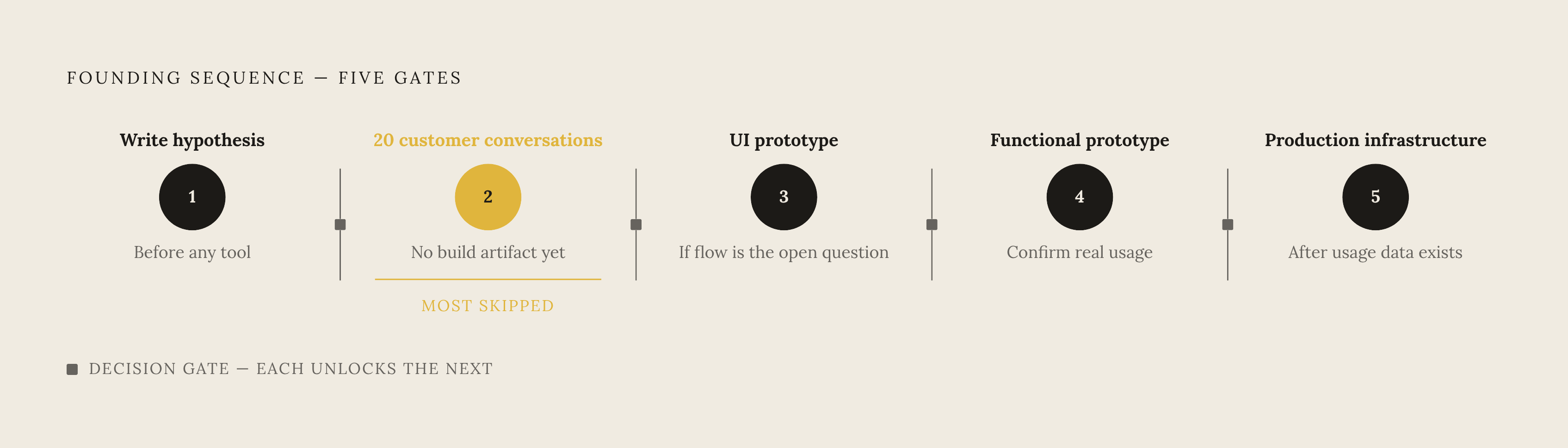
The discipline that makes any of this work is a sequence where every step has to answer a specific question before the next step is allowed to start, not a slogan like "prototype then build.
Step one is stating the hypothesis before opening any tool. What single question, if answered yes, justifies spending more time and money on this? Without a written hypothesis, every hour spent in a building tool afterward is just motion, not progress.
Step two is market exploration and real customer conversations, before any build artifact exists. This is the step that gets skipped most often, and it's the one that matters most. A solo founder who skips 20 customer conversations in order to ship a weekend MVP hasn't compressed the founding process. They've removed the one part of it that actually works.
Step three, following from signal gathered in conversations, is a lightweight UI prototype if the open question is about flow or usability rather than demand.
Step four is building a functional prototype once early signal exists, specifically to confirm that people will use a working version of the idea. Tools like Emergent fit here precisely because the output behaves like a real product and the code belongs to the builder, ready to extend if the idea earns the next investment.
Step five is committing to production infrastructure, and only after a functional prototype has produced real usage data. This is the point where backend architecture, database choice, hosting, authentication, integrations, and scalability become the actual conversation. Not before.
Maor Shlomo's path through Base44 shows what this sequence produces when it's followed completely. He built Base44, an AI-powered app builder, entirely alone, with no co-founder and no engineering team. He launched it, reached a million dollars in annual recurring revenue within three weeks, grew to a few million in ARR and hundreds of thousands of users, and sold the company to Wix for a substantial cash acquisition, all within four months of launch. That arc only works if validation happened before the scaling did. Rapid growth after launch is only survivable when the build was already pointed at confirmed demand.
Mattia Pomelli's story illustrates the earlier stages of the same discipline. He built an AI design tool in three weeks and reached meaningful monthly recurring revenue six weeks after launch, with no outside funding. The speed of that arc depended entirely on knowing what to build before he started building it.
If MCP connectors now let prototyping tools plug directly into real infrastructure, things like Stripe, email, and authentication, during the build session itself, the line between prototype and production remains meaningful. MCP collapses the integration phase. It does nothing to the validation phase. Wiring Stripe into a prototype in an afternoon is not the same thing as confirming that a real person will hand over real money.
How MCP connectors change the transition from prototype to production build
The Model Context Protocol is an open standard that Anthropic introduced in late 2024, and it lets AI agents call external tools and data through one common interface. It has become the connective tissue between prototyping tools and the actual services a real product needs to run.
What MCP changes in practice is how often integration work has to be repeated. Build an MCP server for a service like Stripe or Notion once; that server then works with any compatible host, whether that's Claude, ChatGPT, Cursor, or a custom interface. The protocol is shared across every compatible tool, so the integration work stops being tool-specific.
For widely used services, Notion, GitHub, BigQuery among them, open-source MCP servers already exist and can be deployed directly. That removes a phase of the build process that used to sit entirely separate from prototyping: wiring up external services by hand, one integration at a time.
By mid-2026, MCP had gone from a niche standard to something embedded in nearly every serious AI coding environment. Integrations that used to require a dedicated engineering sprint are now accessible from inside the prototyping session itself.
None of this touches validation: MCP makes the build phase faster and cheaper, full stop on what it accomplishes. It does not make validation optional, and it does not confirm demand on anyone's behalf. Connecting a real payments integration to an idea nobody has validated just gets you to the bad news faster. It doesn't change what the bad news is.
The pricing reality of building with AI tools
Plenty of AI building tools carry a sticker price that understates what the real monthly bill ends up being. The subscription fee is often the smallest part of the cost. AI usage itself is metered separately through credits or tokens, so real usage is what turns a cost structure that looks flat on the pricing page into a variable one.
The floor rises fast once a founder needs a custom domain, wants to remove platform branding, or crosses from a handful of test users into something that looks like a real user base. Scaling any single metric, users, storage, compute, tends to push a project into enterprise-tier pricing without much warning.
Pay-per-token pricing deserves close attention before committing to any platform. API calls to models like OpenAI or Claude are billed separately from the platform fee, and at real usage volumes those charges can exceed the subscription cost by a wide margin. A founder building on a platform that marks up those tokens is paying a surcharge on every single conversation their product generates. That surcharge compounds as usage grows, exactly when a founder can least afford a cost structure working against them.
The alternative, for comparison, is custom agency development. A basic AI app built this way typically starts in the tens of thousands of dollars and climbs from there. The entire point of a prototype-first approach is to defer or eliminate that cost. But that only holds if the platform chosen for production doesn't quietly recreate the same cost structure through variable billing dressed up as a subscription.
The practical implication for choosing infrastructure at the build stage is that flat, predictable pricing, with backend, database, hosting, and authentication included, is a financial requirement for any founder planning to keep an app running and growing past its first few months.
The solo-founder arc when the sequence is followed correctly
Pieter Levels' portfolio, including NomadList, PhotoAI, and Interior AI, runs on very low VPS hosting costs, even as AI inference costs for some of these products can reach into the tens of thousands of dollars per month. The economics behind that structure come from infrastructure decisions made early, not from the strength of the idea alone. A good idea with a bad cost structure still fails. A sound cost structure built on validated demand is what survives.
Dario Amodei, speaking at Anthropic's Code with Claude conference, predicted with high confidence that the first billion-dollar company run by a single human employee would appear in 2026. That prediction signals something larger than one company: the old assumption that team size is a proxy for execution capacity no longer holds the way it used to.
Across Base44, Pomelli's design tool, and Levels' portfolio, the pattern repeats. Validate with real conversations first. Prototype cheaply once a hypothesis exists that's worth testing. Get early signal from actual usage. Only then commit to production infrastructure built to scale without requiring a bigger headcount or a dedicated DevOps function. None of these outcomes came from a tool alone. They came from the sequence the tool was used inside of.
Where the validate-first discipline breaks down
The strongest challenge to everything in this piece is simple: AI building tools are so fast now that they create a brand-new failure mode. Founders start treating the act of building as validation itself, when building has never answered the question of whether anyone wants the thing.
A weekend MVP feels like real progress. Without real customer conversations behind it confirming actual demand, it's only an expense. The ease of building has quietly removed the forcing function that used to require validation simply because building used to cost too much to skip it.
The specific trap is treating an AI building tool as the first move rather than the reward earned after validation. The tool should answer a question that's already been confirmed.
A few signs tell you whether the discipline is holding. The hypothesis gets written down before any tool gets opened. The prototype is scoped tightly to answer that one hypothesis and nothing beyond it. The decision to move to a full build gets triggered by evidence from actual users, not by how polished the prototype happens to look.
A few signs tell you when it's slipped. The prototype keeps getting refined past the point of answering its original question. The feature list keeps growing. No real user has seen the thing yet. That's prototyping repurposed as procrastination, and it's easy to mistake for careful work because the tool makes refinement so effortless.
The recovery is straightforward: stop building, go run the customer conversations, and come back to the tool only once a specific question needs answering again. The sequence holds up as validate, prototype, build, not build, iterate, hope. It's a simple discipline to name, and once it's named, it's simple to hold onto.