Free Trial vs. Freemium for Solo SaaS Products
Solo founders should pick based on deal size, time-to-value, and free-user cost.

The freemium versus free trial decision is three questions, and solo founders tend to answer all three at once by glancing at what a competitor does, which almost guarantees the wrong answer for their own product.
The freemium vs. free trial question as three smaller questions
A solo founder picking a pricing model usually starts with the same instinct: look at what the market leader does, and copy it. If the category's biggest player runs freemium, freemium feels safe. If a well-known competitor gates everything behind a 14-day trial, that becomes the default. The trouble is that competitor's economics almost never match a solo founder's. A funded team can absorb a bloated free tier because support, infrastructure, and sales are someone else's job function, paid for by someone else's round of capital. A solo founder has none of that distance between decision and consequence.
The choice actually rests on three variables, and each one has to be answered on its own terms before any model makes sense. The first is deal size, the average contract value a paying customer is worth. The second is time-to-value, meaning how long it takes a new user to reach the moment the product actually proves itself. The third is the real cost of serving someone who never converts, measured not in abstract dollars but in the hours and infrastructure a solo founder personally has to absorb.
These three don't operate independently. A product with a low deal size, a slow time-to-value, and a high cost per free user has a clear answer, and it's not the one most people reach for first. A product sitting at the opposite end of all three dimensions has an equally clear answer, just pointed the other way. The ambiguous middle, where most solo SaaS products actually live, is where the real decision work happens. That's the territory the rest of this piece maps out.
Deal size and model selection thresholds
Deal size is the fastest filter available because it sets whether a large free user base can ever pay for itself. Average contract value sets a ceiling on how much free-tier weight a product can carry before the economics stop closing.
At the lower end, where monthly pricing runs a few dollars to a few tens of dollars, freemium's logic holds up reasonably well. Volume does real work at that price point. A product needs a wide top-of-funnel because any individual converted user contributes a small amount of revenue, and a free tier that spreads by word of mouth or embedded sharing can generate enough signups to make a low conversion rate survivable.
Past a modest monthly price point, the math flips. At higher ACV, a smaller and more qualified pool of trial users who get full access to the product converts at rates that outperform freemium's bigger but shallower funnel. A user who's given 14 days of the complete product, with nothing held back, experiences enough of the value to make a real buying decision. A freemium user poking at a limited feature set for months rarely reaches that same clarity, and at higher price points, that lack of clarity costs more than the smaller funnel saves.
Between those two thresholds sits a genuinely ambiguous band, and ACV alone can't resolve it. A product priced in the middle doesn't get a clean answer from deal size: it needs the other two variables, time-to-value and free-user cost, to do the deciding work. ACV sets the range. What happens inside that range depends on how fast the product actually proves itself to a new user.
Time-to-value and the trial deadline
A free trial works through a specific psychological mechanism: loss aversion under a deadline. A user who has experienced something valuable, and who knows that value disappears on a fixed date, is far more motivated to act than a user with no deadline. That mechanism only functions if the user reaches the product's real "aha moment" well before the clock runs out. If the deadline arrives first, the trial doesn't build urgency, it just ends access before urgency ever had a chance to form.
The 2026 ChartMogul / ProductLed report found that 62% of products use a 14-day trial, the most common length among the 200 B2B products analyzed. That number matters more as a trap than as a standard. A 14-day window is a fine fit for a product whose value is obvious within the first session or two, like a tool that generates a usable output the moment someone logs in. It's a poor fit for a product whose value only becomes visible after real integration work, behavior change, or a few weeks of accumulated data. A founder who defaults to 14 days because it's what everyone else does, without checking whether the product can actually deliver its core value inside that window, builds a trial that expires before it ever had a chance to convince anyone.
Freemium solves that specific problem by removing the deadline. For a product where value accumulates slowly, through habit formation, network effects, or data that compounds over weeks and months, an indefinite free tier gives the user room to get there on their own schedule. The tradeoff is that removing the deadline removes urgency along with it. Free trials tend to convert users to paid within days to a few weeks. Freemium conversion often stretches to months, because without a clock running, there's no forcing function pushing a free user toward a decision.
A founder who needs early cash-flow validation, who can't survive three or four months waiting to find out whether the pricing model even works, is not choosing between two equally viable options. The time gap between trial and freemium conversion is a constraint on survival, and it often settles the question before deal size or support cost ever get weighed. Activation speed, not preference, is the variable doing the deciding here.
The real cost of serving a free user at solo scale
A funded SaaS team treats the cost of supporting free users as a customer acquisition expense, spread across a support function staffed by people hired to absorb exactly that load. A solo founder has no team to spread it across. Every support ticket from a free user who will never pay is an hour pulled directly from the founder's own time, time that could otherwise go toward shipping a feature that keeps a paying customer around. The cost is measured in founder-hours, and founder-hours are the one resource a solo operation can't raise more of.
AI-native and hybrid SaaS products sharpen that problem considerably. A free user making AI-assisted requests isn't just consuming a founder's attention when something breaks. Every request carries real infrastructure cost, in compute and token usage, that scales directly with how much that free user does inside the product. A traditional SaaS product with a static free tier has a roughly fixed cost per free user. An AI-powered product does not: a heavy, free, non-converting user can cost as much to serve as a light-paying customer, without contributing any revenue to offset it. That's a cost structure a solo founder feels immediately, because there's no finance team smoothing it into a monthly report. The usage bill that results carries the founder's own name on it.
Free trials compress this exposure in a structural way. A user whose trial ends and who doesn't convert stops generating support load and stops consuming infrastructure, because access ends on a fixed date. A freemium user can keep generating both indefinitely, with no natural point at which the relationship closes. A 2026 breakdown of trial model economics names lower infrastructure cost per user as a direct advantage of the trial model, and the reason is exactly this: the support window is finite, so the cost it generates is finite too.
Solo founders building on platforms designed for their constraints are already ahead of this problem before pricing even enters the picture. Floot, for instance, supplies backend, database, and hosting automatically, so a founder isn't separately managing the infrastructure that a growing free tier would otherwise strain. The same first-principles thinking that goes into picking an infrastructure stack belongs in the pricing decision: know what a free user actually costs before deciding how many of them to carry indefinitely.
What the three variables together recommend
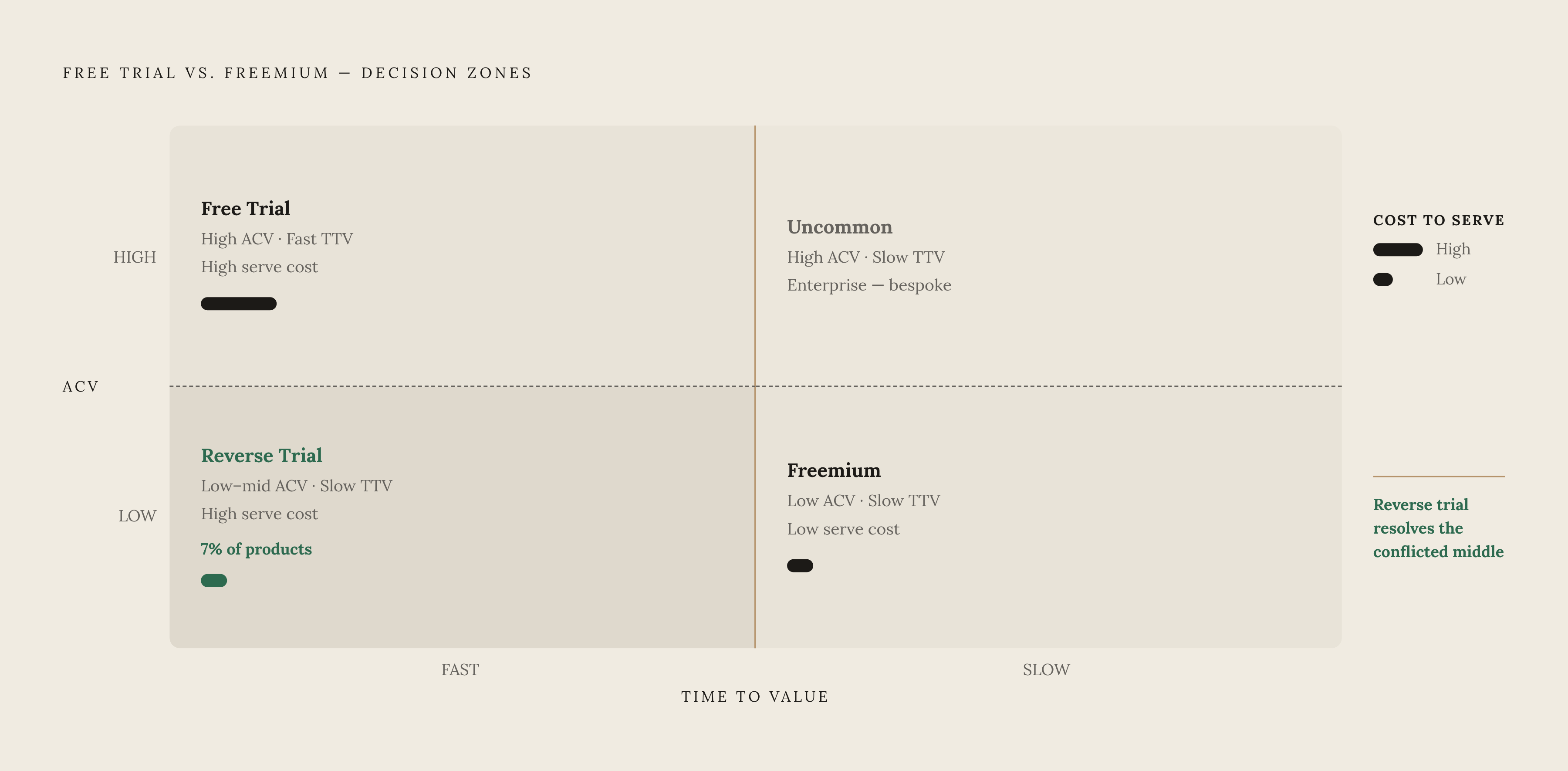
Lined up together, the three variables give a direct answer in the clearest cases. High ACV, fast time-to-value, and a meaningful cost to serve a free user: that combination points to a time-limited free trial, without much ambiguity. A product that's cheap to try, slow to prove itself, and costs almost nothing to host for a free user has a defensible freemium case. Most solo SaaS products don't land in either of those clean extremes.
The conflicted case that comes up most often looks like this: a low-to-mid ACV product, where volume genuinely matters to the business, paired with a slow time-to-value and a high cost to support free users. Freemium's pitch in that scenario is the wide top of the funnel it creates. But a wide funnel doesn't matter if feeding it costs more in founder-hours and infrastructure than it returns in eventual conversions. In this specific combination, freemium's funnel advantage loses to the support burden it creates, and a trial model, even an imperfect one, tends to be the safer structural bet.
There's a resolution that splits the difference, and it's earned enough attention to be treated as a real answer rather than a footnote: the reverse trial. A reverse trial gives a new user full premium access for a limited period, then drops them to a free plan. It captures the urgency mechanism of a deadline while still keeping non-converters inside the product as free users, available to convert later once time-to-value or usage patterns finally catch up. The 2026 ChartMogul / ProductLed report found that only 7% of products currently run a reverse trial as their primary motion, a strikingly small share given how directly it resolves the most common conflict solo founders run into.
The reverse trial isn't a starting point. It requires a founder to sustain a permanent free tier on top of a trial period; the infrastructure and support economics need to already be understood before it makes sense to build. For a founder still searching for product-market fit, a simple opt-in free trial remains the right starting move: it's the easiest to implement, it produces the cleanest conversion data of any of the three models, and it doesn't require building or maintaining a free tier's worth of permanent infrastructure. At that early stage, the goal is learning what the product's real time-to-value is and what a free user actually costs, not optimizing a hybrid funnel before there's enough data to optimize it well.
The infrastructure underneath your model
The pricing model a solo founder can run is bounded by what their infrastructure can actually support, and that constraint deserves as much weight as the strategic decision itself. A freemium tier and a reverse trial both demand infrastructure that has to run permanently: user authentication, usage tracking, feature gating by plan, continuous hosting, and often email automation to nudge free users along. Building that stack from nothing is a real project, one that competes directly with the time a founder would otherwise spend shipping the product itself.
A pure time-limited free trial carries a much lower infrastructure floor. Access gets revoked on a fixed date. Usage gating is binary, with just one plan level. The support window closes automatically when the trial ends. That lower floor is a large part of why the simple trial remains the right default for an early-stage solo product: it asks the least of a founder who hasn't yet built out the systems a permanent free tier requires.
The infrastructure a founder builds also sets how fast they can iterate. A founder stitching together separate services for hosting, authentication, a database, and email is spending cycles on operations rather than on the activation work that actually drives conversion, the same activation work the earlier sections identified as the real lever behind time-to-value. Floot addresses that constraint directly: a founder can add it to Claude, ChatGPT, or Cursor, describe what they want, and get backend, database, and hosting built and running without touching git, a terminal, or separate infrastructure vendors. That matters specifically for the freemium or reverse trial decision, because either model only becomes viable once a founder can stand up and maintain tiered access without it consuming the time meant for building the product. The practical question for a solo founder isn't which pricing model looks best on paper, but which model they can actually build, run, and support alone, and the infrastructure underneath it determines that answer.