Pricing Anchoring and Decoy Tiers in Solo SaaS
Decoys and anchors serve separate pricing jobs and fail in separate ways.
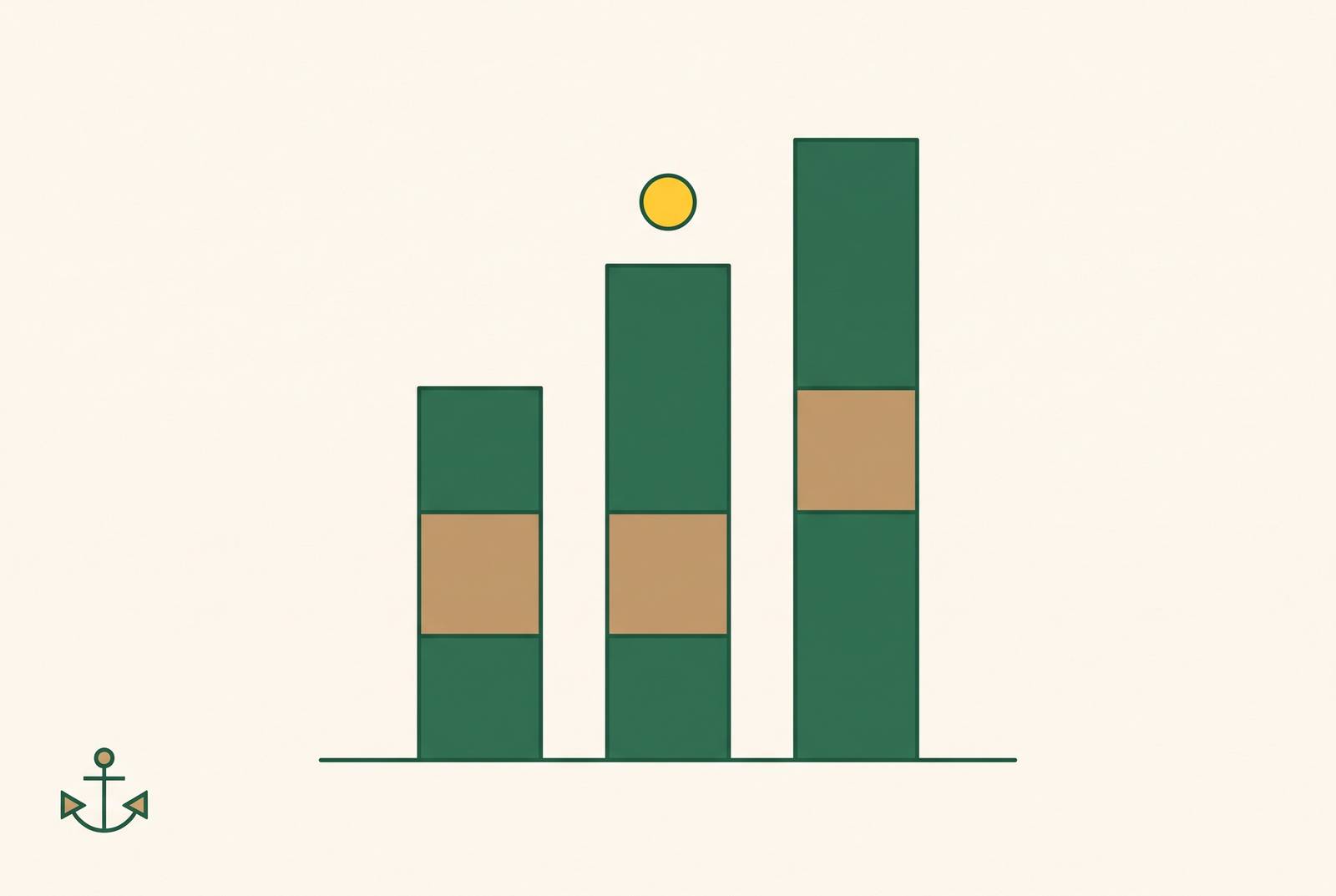
Anchoring and the decoy effect get treated as one idea in most pricing advice, but they do separate jobs and fail in separate ways. Anchoring sets a reference point so the price you actually want looks cheap by comparison. The decoy effect works differently: it adds a third option that loses to the plan you want buyers to pick, on purpose, so that plan looks like the obvious choice.
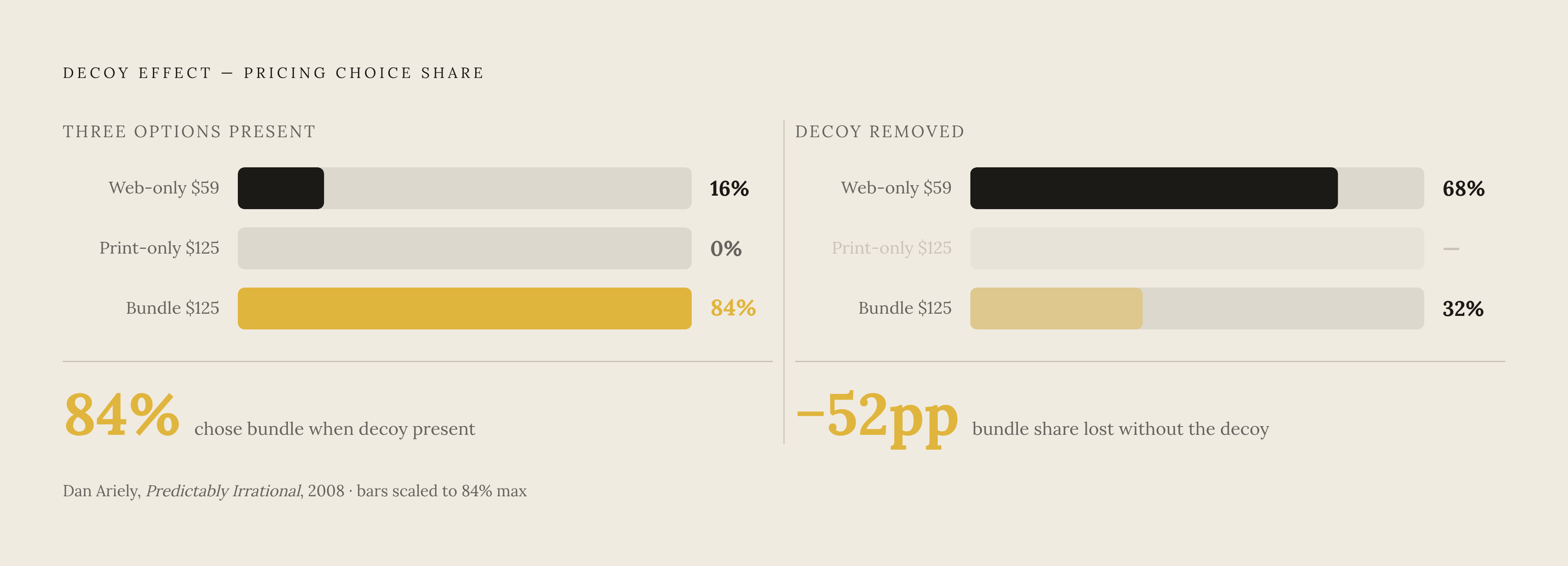
A classic test of this split comes from a pricing experiment offering three options: web-only at $59, print-only at $125, and print-plus-web also at $125. Given all three, 84% of buyers chose the bundle. The print-only plan was never meant to sell. It was there to make the bundle look free by comparison, since paying the same price for print alone looked absurd next to getting the web version thrown in. Take that print-only option away and only 32% chose the bundle, while 68% dropped to the cheap web-only plan. The decoy wasn't decoration. It was the entire mechanism holding the 84% number up.
That gives a clean test for whether a decoy is doing its job: it should almost never get bought. A decoy that captures real volume is a plan, and now it's costing margin instead of protecting it. The two failure modes that follow from confusing these tools are specific. Building a decoy when the real need is an anchor gives the pricing page an extra choice that just adds friction, without pulling anyone toward the plan you wanted. Building an anchor when the real need is a decoy risks the "reference" tier actually selling, in real volume, dragging the whole margin mix in the wrong direction. Neither mistake looks like a mistake on a dashboard. They look like a pricing page that converts fine, just not as well as it should, for reasons nobody can name.
How the three-tier structure exploits both mechanisms at once
Three-tier pricing pages beat two-tier pages, and the reason has nothing to do with three being some magic number. A clean three-option layout triggers what's called the center-stage effect: when people see three choices laid out side by side, they gravitate to the one in the middle, partly because it reads as the safe, balanced pick, and partly because the two options flanking it are doing real work. The top tier sets a price anchor. The bottom tier, sitting there with its limits and its missing features, quietly plays decoy. Both mechanisms are firing on the same page, in the same glance, aimed at the same outcome: pushing the buyer toward the middle.
A concrete version of this appears in storage-based tiers. Picture a lower plan with capped storage sitting next to a Pro plan priced only a little higher, with storage that's effectively unlimited. The price gap between the two plans is small. The feature gap is enormous. That mismatch is the entire trigger: paying ten or twenty dollars more for a feature so clearly superior stops feeling like a decision and starts feeling like common sense. The cheap plan exists to make the Pro plan look like the only sane choice, and if the structure is built correctly, the limited plan gets picked by almost nobody.
A "Most Popular" badge placed on the middle tier adds a second layer on top of this. The badge doesn't change the math on the page. It confirms, in plain text, what the layout was already nudging buyers to feel. Most people deciding between three plans are running on instinct, not spreadsheets, and a badge that names the safe choice out loud gives that instinct permission to stop deliberating. The badge is a default-option signal, placed right where the center-stage effect was already pulling attention.
Earning or losing anchor status
None of this works if the top tier reads as fake. Buyers, especially the kind who evaluate software for a living, spot a placeholder price fast, and once they decide a plan is padding rather than product, the whole anchor collapses. A dismissed anchor doesn't just fail quietly. It leaves the middle tier standing alone, forced to justify its price against some abstract idea of value instead of against a real, more expensive option. That's a much harder sell, and it's the exact position a founder ends up in after building an anchor tier that nobody, realistically, would ever buy.
The test for a credible anchor is simple to state and worth applying literally. Is there a real company, at a real stage of growth, that would actually pay this price for what's included? And do the capabilities in that tier generate enough return that the cost reads as a routine budget line, not a splurge? HubSpot's Enterprise plan, priced in the thousands per month, passes this test because large organizations genuinely need the scale and the customization that plan provides. That makes HubSpot's Professional tier look like a smart, grown-up decision. The anchor is real, so the comparison it creates is real too.
AI features have created a new, especially strong version of this effect. Framing a top tier around AI-powered capability shifts what buyers compare the price against. Instead of measuring the plan against another software subscription, they start measuring it against the cost of a hire, and a human salary is a much higher bar to clear than a competing tool's price tag. Buyers budgeting for AI functionality added to an existing stack tend to set aside meaningfully more money than they would for a plain feature upgrade, because the anchor has moved out of commodity software pricing.
The freemium decision and conversion math
Whether to offer a free tier gets treated as a product question, as if it's mostly about which features to gate. It's a conversion architecture decision first, with cost-per-customer consequences that catch solo founders off guard, because free signups get logged as a win on the way in and never get revisited as a cost on the way out.
Free-tier structure changes conversion rates by how the limits get applied, and the weakest version of this is a free plan limited by feature rather than by volume. If someone can stay productive indefinitely on the free tier, nothing is pushing them toward the paywall. There's no expiration, no moment of friction, just a standing invitation to keep using something for nothing, which produces the lowest conversion rate of the available structures.
The deeper problem lies in how acquisition cost actually gets calculated. The honest version of customer acquisition cost is the dollars spent divided by paying customers, counted against the entire pool of free users who never convert. A founder who brings in a large cohort of free signups, converting only a thin slice of them to paid, is quietly paying a real acquisition cost per paying customer that's far higher than the number on the dashboard suggests. Free users also file support tickets, report bugs, and leave reviews at roughly the same rate paying customers do. A solo founder handling all of that without matching revenue is spending real time and reputation on a funnel that may never close for a meaningful share of the people in it.
The practical move here is to skip the free tier in year one unless the product genuinely depends on network effects, where the product gets more valuable to each user as more free users join it. Outside of that case, a free trial does the useful part of freemium's job, giving prospective buyers a real look at the product, without the open-ended cost of hosting free users who never plan to pay.
Annual versus monthly framing as a margin lever that costs nothing to change
Annual versus monthly billing gets framed as a cash-flow question, something about smoothing revenue. It's also a behavioral lever, and one of the few in this entire discussion that can be flipped without touching the product, the tiers, or a single feature.
Annual plans churn at a fraction of the rate monthly plans do, and the mechanism is commitment and switching cost: once someone has paid for a year, canceling means eating a sunk cost, and most people would rather keep using something they've already paid for than walk away from it. That single dynamic does more to stabilize revenue than any retention campaign built after the fact.
The practical move is pricing discipline on the monthly option. Framed that way, the gap is a cost attached to not committing, and that's a different psychological trigger than a simple discount. On the annual side, a moderate discount, somewhere in the 15 to 20 percent range, tends to be enough to clear the mental bar for most buyers making this decision on their own, without a procurement team weighing in. A discount much lower than that stops registering as a real incentive.
Why transparency beats manipulation for solo SaaS specifically
The strongest objection to everything described above is that sophisticated buyers see the tricks coming. That objection is correct, and it matters more for solo SaaS than for almost any other kind of business, because a founder running a company alone has no sales team standing by to repair a buyer's trust once it breaks.
The clearest version of broken trust right now comes from credit-based and usage-metered pricing. Zapier's tiers get advertised at a modest monthly price, but AI-related tasks can consume credits at up to five times the rate suggested by the headline number. A buyer who signs up expecting one cost and discovers another, after the fact, doesn't just feel surprised. They feel misled, and they tell other people about it. The same pattern occurs in credit-metered app builders priced low on the surface, where active use pushes real spend to a multiple of the advertised rate. In both cases, the sticker price is technically an anchor, just one built to mislead rather than inform.
The fix isn't to abandon anchoring and decoy structure. Applied honestly, both are just information, helping a buyer reach the decision they'd likely reach anyway if they had the full picture up front. That means the top tier has to be a plan someone could genuinely buy and use. It means the weaker tier has to be honestly weaker, not secretly the better deal dressed down to manipulate the comparison. And it means the monthly price printed on the page has to be the price a typical user actually pays, not a floor that usage fees quietly build on top of.
Flat, predictable pricing solves this trust problem by removing the conditions that create it. Floot's monthly pricing is structured this way: free to start, then paid tiers with set prices and no per-token markup layered in afterward. Each plan is built so the jump in price lines up with a real jump in capability, infrastructure load, and service level, rather than a feature held back to manufacture scarcity. A buyer comparing tiers on a page like that is looking at an actual value stack, not a puzzle designed to obscure what they'll really end up paying. That's what lets an anchor hold up under scrutiny instead of collapsing the moment a buyer starts doing the math themselves.
A practical three-tier architecture for a solo SaaS in the typical self-serve price range
Solo SaaS products priced in the typical self-serve range sit in a window with a real structural advantage: at that price, a single professional can usually make the buying decision alone, with no procurement process and no committee sign-off standing between a founder's pricing page and a paying customer. That matters because every behavioral tool described above works better, and faster, when one person is making the call without anyone else's approval slowing it down.
The default shape that holds up across this price range is three tiers, offered on both monthly and annual billing, with the annual option priced at roughly two months free compared to paying monthly all year. This is the default structure that startup accelerators push founders toward, earning that status by being unglamorous and reliable. The top tier should function as a genuine anchor: real capability, a price a real company at the right stage would actually pay, built to make the middle plan look calibrated rather than built as a wall meant to push everyone toward a sales call. The middle tier is the plan most buyers should land on, typically priced somewhere between 50 and 70 percent below the anchor tier, carrying the "Most Popular" badge once there's enough traffic on the page to back the claim honestly. Platforms built with infrastructure, meaning backend, database, hosting, and integrations, included as a baseline across every tier get to anchor the top plan on genuine capacity and reliability instead of on features deliberately withheld from cheaper plans. Every tier earns its place in the structure, and the pricing page holds up exactly as well under scrutiny as it does at first glance.