Raising Prices on an Existing Indie SaaS
Three signals show when your SaaS pricing is too low.
Most indie SaaS founders are dramatically undercharging, and the reason has little to do with the market and everything to do with psychology. Cheap customers are worse customers: they ask for more, commit less, and churn faster. Underpricing is not a lost-revenue problem so much as a product-quality problem dressed up as a discount. A founder who sets a price out of fear of rejection fills the pipeline with people who were never going to value the product enough to stay. That dynamic compounds across the whole category, because most founders anchor their price to their own budget rather than to what a paying business actually spends, and then copy whatever number a competitor picked, who was very possibly undercharging too. Nearly everyone in this market sets price by looking sideways at competitors instead of looking at their own numbers.
The signals that tell you it is time to raise prices
A handful of observable signals tell a founder they already have pricing power, long before anyone touches the pricing page. The clearest one is win rate. A high close rate among qualified leads means price was never the objection, and a founder who keeps winning deals at the current number is leaving money on the table with every signature. A second signal lives in the support queue: if a single support interaction eats up a meaningful share of what a customer pays in a month, the price cannot sustain the business. That is a structural flaw in the pricing, not a sign that support needs to get more efficient. For AI-native products, inference costs scale with usage in ways that flat, early-stage prices never accounted for, a third factor beyond win rate and support cost. A price that looked fine at ten customers can quietly turn unprofitable at a thousand, because the cost of serving each customer moves with usage while the price stays fixed. Platforms like Floot that bundle infrastructure costs into flat monthly plans with predictable allotments help founders sidestep this problem, since the cost structure stays transparent and proportional and makes it easier to set a sustainable margin from day one. None of these signals requires a spreadsheet to notice. They appear in deal notes, support tickets, and cost-per-customer math that most founders already have sitting in front of them, just not added up.
The break-even churn calculation founders almost always get wrong
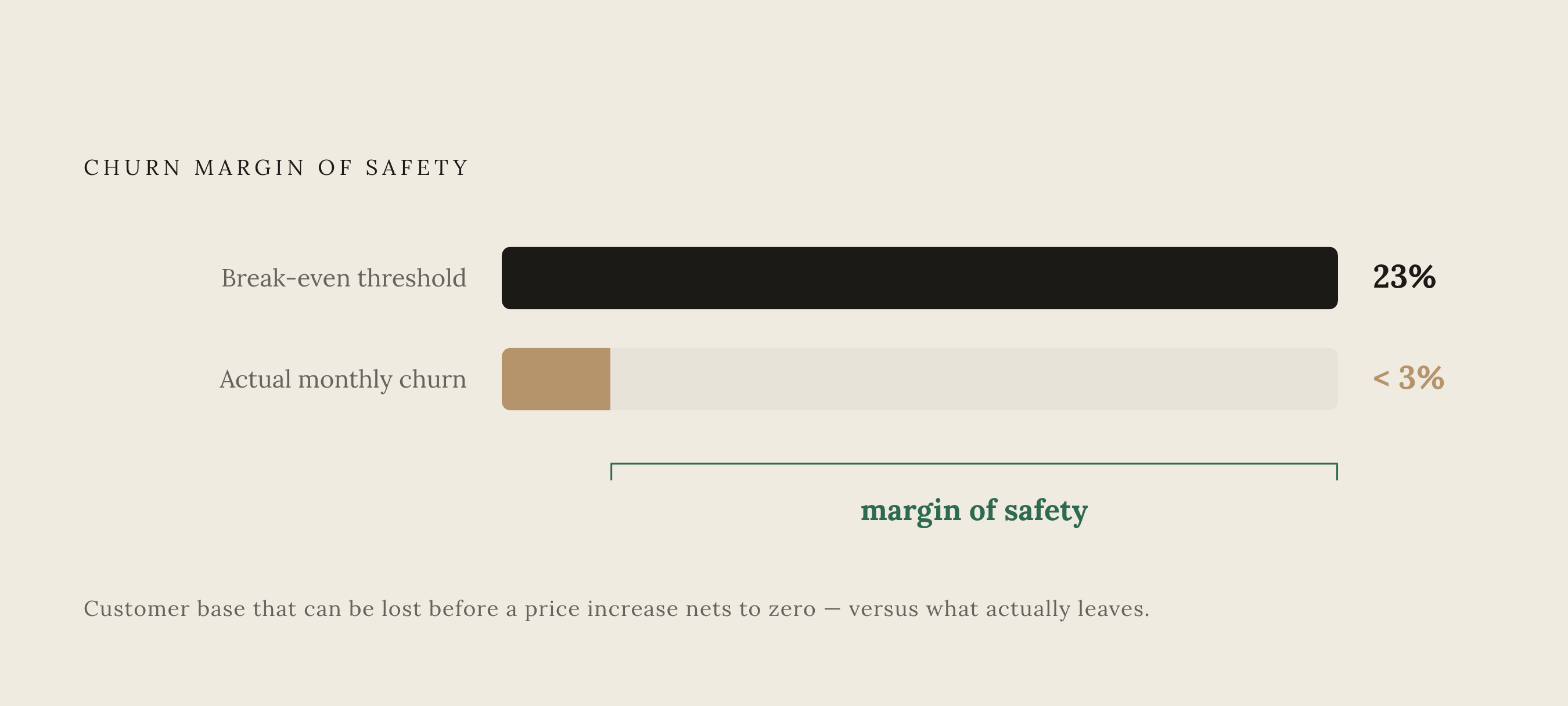
Every price increase carries the same fear: that people will leave. That fear is almost always bigger than the math supports. The question to ask is not whether some customers will churn, because some always do. The number of customers who would need to leave before the increase nets out to zero sits far higher than most founders expect. One founder ran the numbers and found he would need to lose roughly 23% of his existing base before a price increase stopped paying for itself. His actual monthly churn ran nowhere close to that figure, which meant the real downside was a small fraction of what he had been bracing for. The lesson generalizes: run this calculation before setting a new number, not after making the decision and hoping it holds up. Once a founder knows the break-even point, the founder can ask how much room there actually is before the math turns against the business instead of asking "is this safe," and that number is almost always more generous than instinct suggests.
Why sequence matters more than size
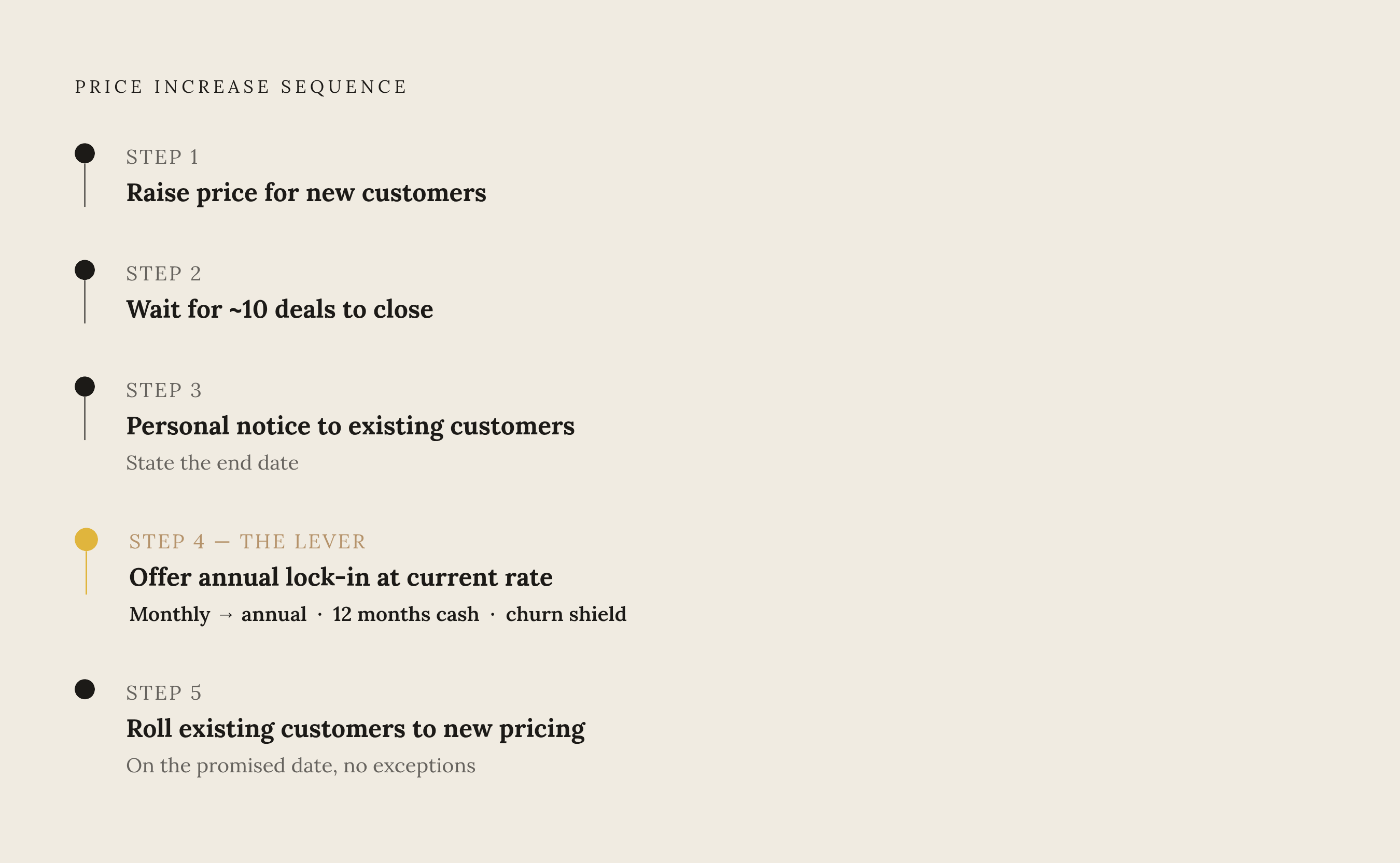
The founders who raised prices with the least churn were not the ones who raised them by the smallest amount. They were the ones who moved in the right order. The sequence that works starts with new customers: raise the price for anyone signing up going forward, before touching a single existing account. That first move does two things at once. It tells the founder whether the market will actually bear the new number, and it produces real conversion data, something concrete to point to if an existing customer pushes back later. Once the new price has held for roughly the next ten deals, it is time to turn to the existing base, and that step should always be personal communication delivered before the change takes effect, with a clear end date attached. Built into that notice period is a useful lever: offering an annual commitment at the current rate before the increase lands gives existing customers a reason to lock in now. That single offer does three things simultaneously. It converts monthly customers into annual ones, it secures twelve months of cash flow up front, and it reduces churn right at the moment the business is most exposed to it, since annual subscribers churn at a fraction of the rate monthly subscribers do. Timing the announcement matters almost as much as the sequence itself: give customers enough runway to make a decision, but not so much that the increase turns into a slow-burning source of anxiety. What the announcement leads with matters too. Open with what the product has become since the customer joined, state the new price, then give the date, in that order, rather than leading with the number and trying to justify it afterward. The communication step gets easier when a founder has concrete reasons to point to: real infrastructure improvements, new features shipped, or costs absorbed on the customer's behalf, each one a tangible reason the increase reads as fair. Grounding the conversation in actual product and infrastructure decisions, instead of vague references to market conditions, is what makes that personal conversation land well with customers who have been loyal for a while. Finally, keep a retention discount in reserve for the small number of customers who genuinely cannot absorb the change, but do not advertise it up front. Offering it proactively undercuts the whole increase, because it tells every customer the new price was negotiable all along.
Grandfathering existing customers
Grandfathering existing customers at their old price feels like a loyalty reward, and in the short term, it is one. Left indefinite, it becomes a liability that makes every future repricing harder. The common advice in founder circles, to always grandfather existing customers for a set period, is correct in structure but gets misapplied constantly. The part that matters is the word "set." A grace period needs a stated end date, not an open-ended promise that quietly becomes permanent because nobody wants to revisit it. Pricing strategists make a sharper argument than most founders want to hear: running multiple permanent pricing cohorts carries a real operational cost, and every additional year of indefinite grandfathering makes the next repricing decision more tangled than the last. Patrick Campbell, founder and CEO of ProfitWell, put it bluntly in an interview with Intercom: it is "extremely difficult to go from 10 million to 100 million without raising prices on your customers in some way." Indefinite grandfathering is the single biggest obstacle to ever doing that again. The workable position is to time-limit grandfathering for everyone, state the end date in the original announcement, and reserve individual attention only for the largest or most sensitive accounts worth a direct conversation. Everyone else rolls onto current pricing on the date that was promised from the start. When this gets communicated clearly, the churn at the transition point is small, well below what founders fear when they default to permanent grandfathering.
The objection worth taking seriously: does AI commoditization erode the premium?
The legitimate version of this worry goes like this: AI coding tools have lowered the floor for what a small team can ship, so there are more competing products built at lower cost, and any price premium has to survive against a field that can clone a feature set in weeks instead of months. That concern deserves a real answer. Founders already sitting on retained, paying customers tend to underestimate how rare that position has become. Technical execution has gotten cheap for everyone. The barriers that used to separate good products from bad ones have mostly fallen. Market attention and customer trust have gotten harder to earn at exactly the same time, and those two barriers are now the ones that actually separate winners from the field. A founder with paying, retained customers already holds something a brand-new AI-built competitor cannot replicate overnight, no matter how fast that competitor ships features. The real defense an incumbent has is switching cost and distribution, not feature parity. The window to set pricing that reflects the real value of that customer relationship is open right now, before more competitors arrive and the market gets noisier.
Building app infrastructure that makes repricing easy from day one
For a non-technical founder, the hidden cost of a poorly planned repricing usually has nothing to do with customer churn. It is the engineering work required just to change how the product bills, gates features, or manages a grandfathered tier. Every move described in this piece, from adding an annual tier to creating a time-limited grandfathered cohort to switching from flat pricing to usage-based pricing, touches backend logic, billing integrations, and sometimes the authentication system underneath the product. A founder without a developer on staff tends to hit that wall at the worst possible moment, right when a pricing decision needs to ship quickly to match an announcement already sent to customers. For founders relying on external infrastructure, the support-economics test from earlier carries an extra layer: if the underlying platform's per-request or per-token costs scale faster than revenue does, the pricing model is broken even when the support queue looks perfectly manageable. Founders building on all-in-one platforms with flat hosting, database, and backend costs baked in avoid that trap, because their unit economics stay predictable as the customer base grows, which makes raising prices with confidence a much simpler call. The practical fix is building on infrastructure that treats billing, backend logic, and user authentication as built-in parts of the product, so a repricing decision stays a business decision. Floot is built around exactly that position. It connects to the AI tools founders already use, including Claude and ChatGPT, and handles the technical stack behind the product, including backend logic, database storage, user authentication, and hosting with guided Stripe integration, so a founder can change how a product bills or gates features without writing code or managing a separate stack. A founder who decides today to add an annual commitment tier, grandfather a cohort for six months, and send email notifications at the transition point can do all of that from a single conversation, with no DevOps sprint and no external service stitching the pieces together. The founders this piece has been written for are not hobbyists testing an idea on a free tier. They are business owners who already have paying customers, who recognize that pricing is a lever to pull correctly, and who need infrastructure reliable enough to let them pull it again next year, and the year after that, without rebuilding the product each time.