Referral Programs a Solo Founder Can Run Without Custom Code
Build a referral program with no-code tools, one template, and an hour of setup time.
A solo founder does not need a developer, a custom-built dashboard, or months of runway to get a referral program working. What it takes is the right combination of existing tools, a reward structure that fits the product's stage, and about an hour of setup.
Referral programs and solo founders
Solo founding used to be the exception. Now it is close to standard practice: solo founders start over one-third of new companies, a jump of 53% since 2019 shippedsolo.com. That shift didn't happen in a vacuum. Gartner reported in 2025 that 70% of new applications get built on no-code or low-code technology, and the infrastructure to run a business, including a referral program, without writing a line of code has become standard practice for founders shippedsolo.com theanna.io. It's the mainstream path.
Referral programs fit this moment almost too well. They cost nothing in ad spend, they don't need a sales team, and they turn people who already like the product into the acquisition channel. Consumers back this up with their own behavior: 92% trust a peer recommendation over any other form of advertising shippedsolo.com journeybee.io. Paid ads have to work hard to earn that kind of trust. A referral just... has it, built in.
The tooling has caught up too. The global referral software market is on track to hit $4.18 billion by 2032, which says something specific: the kind of tracking, attribution, and reward logic that used to require an engineering team is now packaged and priced for a company of one shippedsolo.com journeybee.io. So the founder reading this probably already has early users, wants growth, and has neither a developer on staff nor a budget for one. That's the situation the rest of this piece picks up from. That's just where the rest of this piece picks up.
The one structural mistake that kills referral programs before they start
Most referral programs fail before a single link gets shared, and it's almost always the same mistake: rewarding only the person doing the referring. A program built that way turns every invite into a favor being asked, not a recommendation being made. The friend on the receiving end has zero reason to click through instead of just signing up on their own.
Fix that by making both sides win. The referrer needs a reason to bother sharing, and the new user needs a reason to use that specific link rather than finding the product some other way. Once that's in place, the next question is what the reward actually is. Without custom code, the realistic options are account credits, discount codes, an extended trial, a free tier unlock, or straight cash through PayPal or Stripe journeybee.io. Each carries its own friction. Cash converts best but needs a payout process. Credits are frictionless but only work if the product has recurring value worth crediting toward.
Size the reward to the product, not to some round number that sounds generous. A discount on a $25-a-month tool lands completely differently than the same discount on a $100-a-month plan flowbite.com 101aitools.com toolquestor.com solobuilder.ai journeybee.io. Get that proportion wrong and the offer either feels like an insult or costs more than the customer is worth. One non-negotiable requirement drives all of it: every referrer needs their own unique, trackable link. Without that, there's no program, just a request people forget by lunchtime.
Purpose-built referral platforms a solo founder can activate without a developer
Viral Loops is one of the clearer examples of what this category looks like now. It's built as an all-in-one referral platform, with templates modeled on growth programs that have already worked for established brands, so a founder isn't starting from a blank canvas. It supports straightforward referral programs, referral waitlists, newsletter refer-a-friend setups, invite-based giveaways, and an AI-powered campaign installer to get a template running faster. A newer addition lets participants share their referral link directly through Telegram, meeting people where they're already messaging instead of asking them to copy a link into a separate app. The client list gives a sense of scale: Product Hunt, Lime, Perplexity, Miro, Descript, Life360, Greenlight, Treecard, Opera, and Cloudways have all run programs on it. Pricing detail isn't published in a way that's worth guessing at here, so access comes through a free trial or a demo booking, and from there the founder picks a template and configures rewards rather than building logic from scratch.
That template-first approach is really the point of this whole category. Purpose-built referral tools exist to handle four things a custom build would otherwise force a founder to solve alone: generating a unique link per referrer, tracking actual conversions (not just clicks), running the reward fulfillment logic, and giving participants a dashboard to check their own status. When evaluating any platform here, run it through those four questions. Are unique links generated automatically? Does it track conversions past the click? Does it deliver rewards or just flag them for manual follow-up? Does it plug into the auth or email system already in use?
The audience for this is arguably more ready than founders assume. Nearly half of Gen Z (48%) and 44% of Millennials already run at least one side hustle, and a good chunk of that activity runs through referral networks as a way to generate passive income journeybee.io. It's a warm audience, already primed for exactly this kind of arrangement, not a cold one being asked to do something unfamiliar. It's a warm one, already primed for exactly this kind of arrangement.
Using automation tools to wire a lightweight referral loop without dedicated software
Not every founder wants a dedicated platform, and a lighter setup is available for anyone already living inside an automation tool. The classic version of this chain has a form firing a webhook, an automation tool catching it, a record getting created, and an email going out. Four products, several API calls, and a per-task meter ticking on every single step. For a referral loop specifically, that maps to sign-up form, record the new referral, send the unique link back to the referrer, track the eventual conversion, and trigger the reward.
Make runs $12 a month for Core, $21 for Pro, and $38 for Teams, with a free tier that includes 1,000 operations a month; because it prices by operation rather than by task, costs stay more predictable as referral volume grows, and its visual canvas handles loops and branching well, which suits a multi-step referral flow shippedsolo.com. Zapier runs $19.99 a month for Pro and $69 for Team, and its main advantage is reach: over 5,000 app integrations and the simplest setup of the three shippedsolo.com. Starter is €20 a month, Pro €50, Business €667, with a free self-hosted Community edition for anyone willing to climb a steeper learning curve shippedsolo.com. One founder running more than 20 workflows on self-hosted n8n reported saving around $140 a month compared to what the equivalent setup would cost on Zapier shippedsolo.com.
None of these three solve the link layer on their own. Automation handles the plumbing, not the unique-link generation, so this route still needs pairing with a form tool or even a spreadsheet-based link registry to make the links trackable. The stitched approach makes the most sense when a founder already pays for Make or Zapier, has fewer than a few hundred referrers, and would rather keep the referral flow inside a workflow they already manage than bring in a new platform. It starts to break down past that point: high referral volume turns per-task pricing into a real cost, and the whole thing gets fragile the moment any one integration changes its API. Automation tool comparison (pricing verified per shippedsolo.com).
Reward structures that work at each stage of a solo product's growth
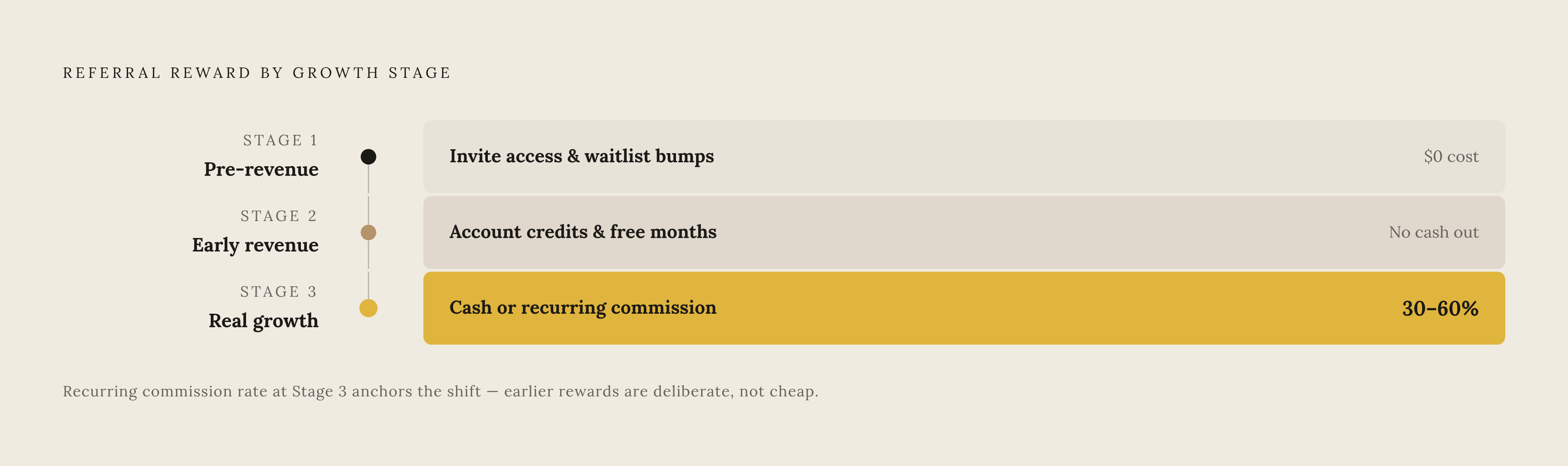
The right reward depends entirely on what stage the product is actually in, not on what sounds most generous. Pre-revenue, running a waitlist, the cheapest and most effective levers are invite-based giveaways and referral waitlists that bump position based on referrals. Neither costs anything to fulfill, and both create urgency out of nothing but social pressure. Viral Loops names both as supported campaign types, which says something about how standard this pattern has become at the waitlist stage.
Early revenue changes the math. Account credits and free-month extensions become the lowest-friction reward available: no cash changes hands, no payment processor gets involved, and the reward stays entirely inside the product's own ecosystem.
Once a product hits real growth, cash becomes the strongest motivator, paid through Stripe or PayPal, though it does require an actual fulfillment step someone has to manage journeybee.io. Established SaaS referral programs run commissions at 30%, 33%, and even 60%, and while that requires real tracking infrastructure behind it, it scales in a way flat rewards don't journeybee.io. Whichever direction gets picked, match it to the price point. A flat $30 cash reward on a $25-a-month product runs completely different unit economics than a 30% recurring commission, and both models are actually in use across established SaaS programs today 101aitools.com journeybee.io. Tiered rewards, where more referrals earn a bigger payout, do increase how many referrals each participant sends, but they add real complexity to tracking. Worth it only if the platform handles the tier math automatically, not by hand.
Building a referral commission tracker when you outgrow a spreadsheet
A spreadsheet handles the first few dozen referrers fine. Past that, it starts breaking in predictable ways: concurrent edits stepping on each other, reward math done by hand, disputes over what an affiliate is actually owed, and no way for an affiliate to check their own status without messaging the founder directly.
That last piece is the real gap. Plenty of referral platforms track conversions competently but never give the affiliate a live view of their own earnings and payout status. That silence is exactly where affiliate trust erodes, even when the tracking behind the scenes is accurate.
A tracker built to close that gap can exist without a developer. What it needs, functionally, is an affiliate login, a referral count, conversion status, a payout log, and the reward calculation, all visible in one place an affiliate can check on their own. Under the hood, that requires persistent data storage, real user authentication, and hosting that doesn't fall over, infrastructure that has to be built in from the start rather than bolted on after the fact. This matters most for founders treating referrals as a real growth channel, not a side experiment, where the program needs to feel like a professional system rather than something stitched together over a weekend.
Getting a referral loop live in a single session using an AI builder
A newer pattern, generally referred to as MCP, changes how the founder just describes what they want inside the AI chat they're already using. Instead of bouncing between a builder interface, a database admin panel, and a separate hosting dashboard, the founder just describes what they want inside the AI chat they're already using, and the infrastructure assembles itself behind that conversation.
Applied to a referral tracker specifically, that means describing the affiliate view, the payout log, and the referral count in plain language. The application provisions its own database and authentication, deploys to a live URL, and the founder hands that URL to affiliates directly. One reviewer of this kind of tooling put the shift bluntly: it's getting hard to justify buying certain SaaS products at all, when building the specific version needed is right there as an option. A referral tracker is close to the textbook case for that logic: narrow enough in scope, specific enough in requirements, that a generic off-the-shelf tool rarely fits as well as something built to spec.
Choosing the right approach for your program's stage
There are three real starting points here, not one universally correct answer. The fastest path to something live with zero configuration is a purpose-built platform like Viral Loops: pick a template, set the reward, embed or share it. That route makes sense when the founder wants the tracking and reward logic handled entirely by someone else. The most flexible path, for a founder who already has Make or Zapier running other parts of the business, is wiring the referral flow into that same automation stack alongside a form and an email tool. That fits best when referrals are just one more workflow among several already being managed the same way shippedsolo.com. And the path with the most control, plus the most professional face for affiliates, is a custom-built tracker through an AI builder, worth the effort once there are enough referrers that a live dashboard actually matters and the founder wants it to look and feel like their own brand.
The signal for moving from a platform to a custom tracker is usually a specific kind of question that appears in the inbox: affiliates asking about payout history, how a conversion got attributed, or what their earnings forecast looks like. When the platform's dashboard can't answer that, it's time to build something that can.
Across all three paths, the common thread holds: none of them require writing code, none require hiring anyone, and none should take longer than a single working session to get live and shareable. Worth keeping in mind, too, that the right amount of infrastructure to build depends on where the founder actually is. The referral setup should scale with that reality, not with some imagined future revenue number. So pick one of the three approaches, get one link live today, and send it to the ten most engaged users already using the product. The loop starts with a single referral. Realistic revenue context for calibrating effort shows 50% of active indie hackers make under $1K/month, 20% make $1K–$10K, and 10% make $10K–$100K (per betterlaunch.co), underscoring that the right referral infrastructure investment scales with where the founder actually is, not where they hope to be (betterlaunch.co, flowbite.com, toolquestor.com, solobuilder.ai, shippedsolo.com, journeybee.io).