SEO Content Strategy for a Solo SaaS Founder
Solo founders should build commercial pages first, then optimize for keywords they can actually win.

The number of publicly tracked indie SaaS products has roughly tripled between 2020 and 2026. That surge looks like momentum, but a ScrapingFish analysis of Stripe-verified Indie Hackers products found that most of them make exactly zero in revenue, showing the growth in tracked products has not translated into earnings. Zero. Not "struggling to grow," not "pre-revenue and early stage." Nothing.
Part of the problem is what founders are actually optimizing for. The Simply Business 2025 Solopreneur Report found that most solopreneurs list "being their own boss" as their top motivation, not money. That matters more than it sounds like it should, because most content advice out there is built for teams chasing revenue targets on a quarterly clock. A founder who picked up the business for autonomy, then blindly follows a content calendar written for a 12-person growth team, ends up burning the one resource that made the whole thing worth doing in the first place: their own time.
And the build side of the equation has changed fast. Solo founders now write around half their code with AI and can ship a working vertical SaaS product in about a month. That is a genuine shift. Now the bottleneck has moved. Building is no longer the hard part. Getting found is.
Which is exactly where most SEO advice falls apart for this audience. Standard SEO playbooks assume a team, a marketing budget, and room to experiment, fail, and try again. A solo founder has none of that slack. Every article that does not rank is a week of nights and weekends that did not go toward the product, toward a sales call, toward literally anything else that could have moved the needle. The opportunity cost appears immediately in the hours spent writing, hours that cannot be spent twice.
None of this is a burnout story or a plea for founders to slow down. It is a resource allocation problem, and it has a solvable answer. The constraint, treated correctly, becomes the advantage: a founder who only has three or four hours a week for content cannot afford to write what everyone else writes, so they end up building something sharper instead.
Why SEO compounds when paid acquisition does not
Paid acquisition behaves like rent. Pay it, and traffic appears as a result of that payment. Stop paying, and it disappears the same day. Content behaves differently: publish something that ranks, and it keeps producing value long after the work is done, without a recurring invoice attached to it.
The economics make the choice almost mechanical for a founder counting every dollar. Average cost per click on SaaS ads is around $8.50, while the cost per visit generated through content runs closer to $0.03. That gap is not a rounding error, it is close to three orders of magnitude, and it only widens the longer a piece of content stays live. A single post targeting the right low-competition keyword can pull in organic visits for years at close to no ongoing cost.
The 2026 wrinkle is that "ranking" no longer means one thing. SEO has gone multi-surface: showing up on Google alone leaves real pipeline sitting on the table, and Scalerrs' research found that the companies tying organic performance to pipeline across Google, AI tools, Reddit, and third-party mentions are outgrowing paid channels. The same Scalerrs research found that a large share of B2B buyers now use AI tools somewhere in their last purchase decision, which means a brand has to show up inside ChatGPT, Perplexity, and AI Overviews before a buyer ever lands on the site. That is a second compounding surface stacked on top of the first, not a replacement for it.
There's evidence this is already paying off at the earliest stage of company life. Among 2025 Stripe Atlas startups, 20% landed a first paying customer within 30 days of incorporation, more than double the 8% rate from 2020. Fast, capital-light distribution is not a theory anymore. It is happening at scale, and content is the channel doing most of that work.
Building commercial pages before writing a single blog post
Most solo founders open a blog with a "what is X" explainer post. It feels productive. It ranks for nothing that pays the bills, and it is the wrong first move.
These live in the site's main navigation as standalone pages, not buried in a blog feed.
The scale of the difference is stark. The SaaS Dir's 2026 research found that a SaaS company with five strong commercial pages and no blog at all will outperform a company sitting on 50 generic blog posts with no commercial pages. Beaten by five pages. That should reorder how a founder spends the first month of content work.
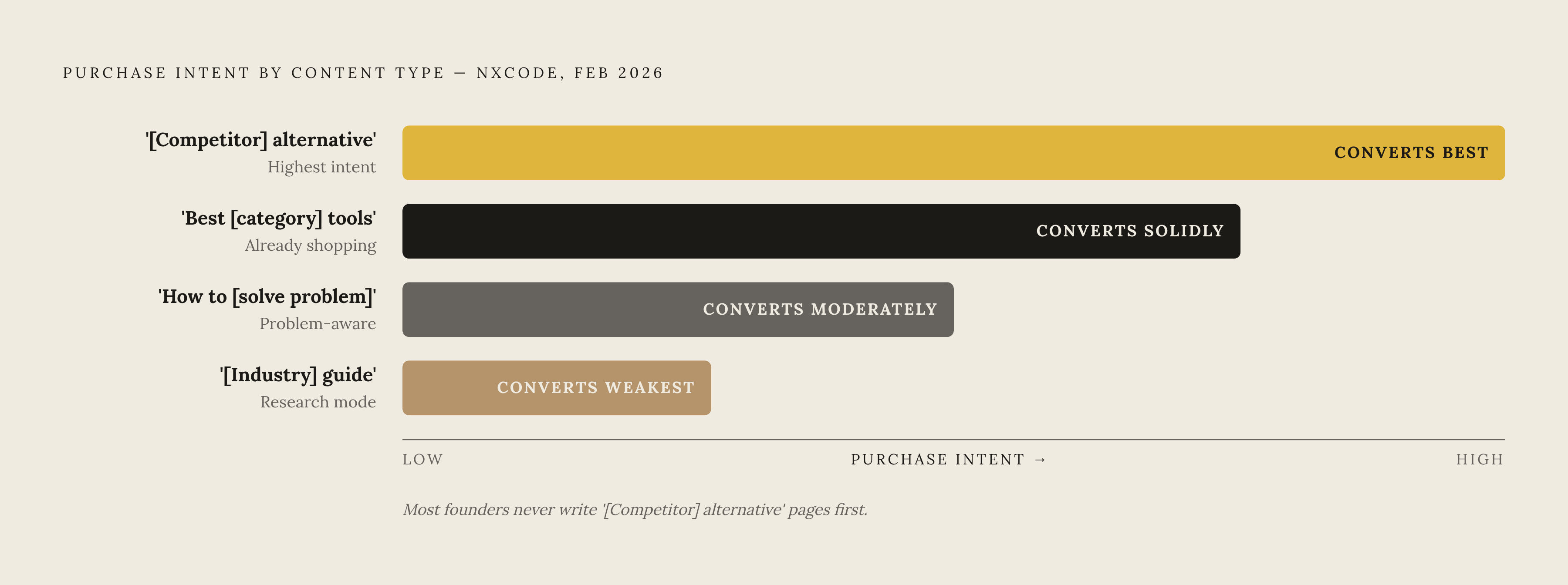
Conversion rates back this up directly. NxCode's February 2026 data shows that "[competitor] alternative" pages carry the highest purchase intent and convert best, "best [category] tools" comparison pages convert solidly because the reader is already shopping, "how to [solve problem]" posts convert moderately since the reader is problem-aware but not yet solution-aware, and "[industry] guide" content converts weakest because it targets someone still in research mode. The practical move is to start with the content closest to money and work backward toward awareness content, which is the reverse of what most content calendars tell founders to do.
Scalerrs' September 2026 findings make the funnel logic explicit: bottom-of-funnel content, meaning alternatives, comparisons, and pricing, drives demos, while top-of-funnel content mostly drives traffic that never converts. Early on, with a limited weekly budget, over-investing in top-of-funnel content is close to wasted motion.
Finding keywords a solo founder can win
Once the commercial pages are live, the keyword hunt for supporting content should start from the product itself, not from a keyword tool. List every problem the SaaS solves. Each one of those problems is its own keyword cluster: "how to [solve problem]," "best tool for [problem]," "[competitor] vs [your product]". This is a five-minute exercise that produces more usable topics than an hour spent scrolling through a keyword research dashboard.
The filter that actually matters is narrower than most guides suggest: low difficulty, modest search volume, and clear commercial or informational intent. Chasing a high-volume keyword that an established domain already dominates is a waste of the very time a solo founder does not have.
Volume numbers get too much weight in most keyword advice. What matters more is what is actually sitting on page one. If the top three results are massive, established domains, move on, it is not a winnable fight right now. But if the top results include Reddit threads, Quora answers, or thin content from small blogs, that is a real gap, and it is winnable with a genuinely good page. Skipping this step is the single most common mistake in solo founder keyword research: chasing a keyword because a tool says the difficulty score is low, without ever checking who currently owns the top spots.
The tools for this stage do not need to cost much. Google Keyword Planner is free. Moz Keyword Explorer gives ten free queries a month. Semrush's Keyword Magic Tool and Ahrefs' Keywords Explorer carry the most accurate difficulty scores and are reachable at entry-level paid tiers, worth the cost once the free options run out. Long-tail phrasing, something like "best [category] tool for [use case]," consistently pulls in buyers who are further along in the decision than someone typing a broad, generic term. And the best source of that exact phrasing is not a keyword tool at all, it is customer conversations and support tickets, where real buyers use the actual words they think in, not the polished language a founder defaults to when writing marketing copy.
How topic clusters turn individual posts into compounding authority
A single ranking post is useful. A cluster of them, linked together on purpose, is worth more than the sum of its parts.
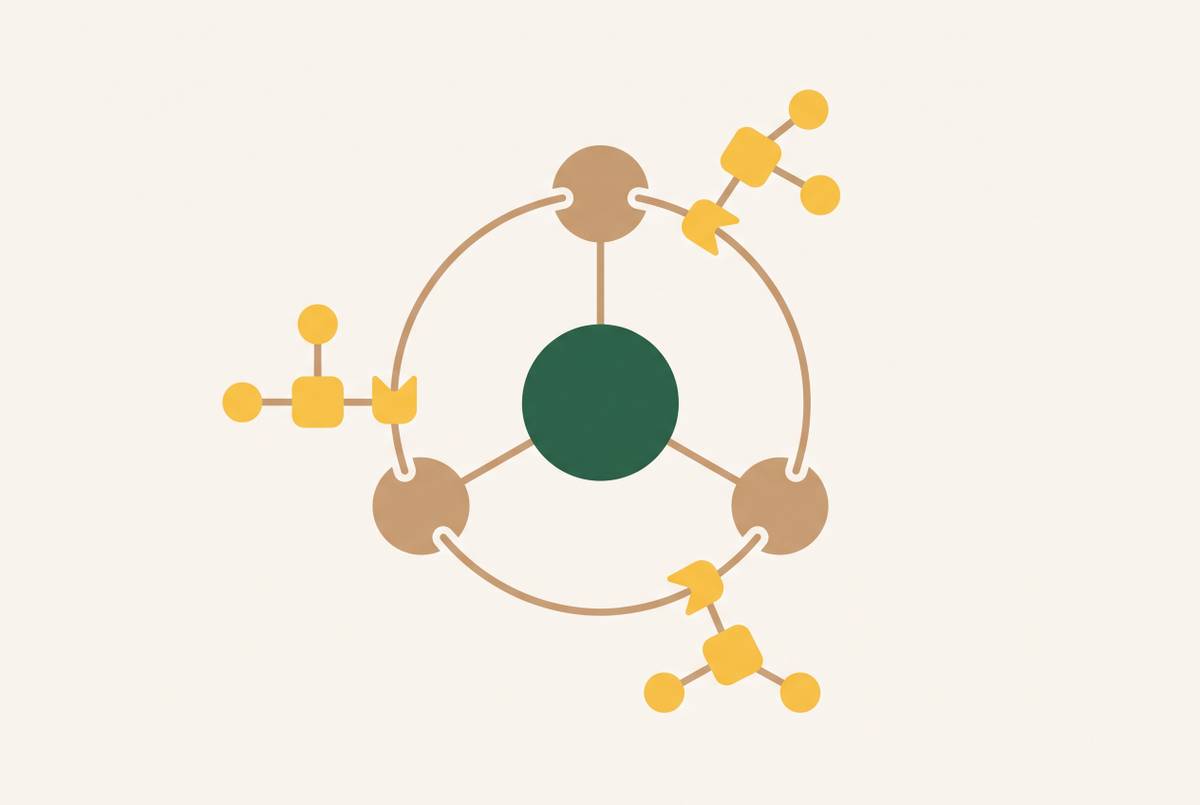
Picture a wheel. The pillar sits at the center, the spokes radiate outward, and every spoke points back to the hub. Averi Academy's April 2026 research shows a pillar on "SEO for startups" might have spokes covering "how to automate SEO audits," "affordable SEO tools for founders," and "SEO content brief templates", each one narrow enough to actually rank, each one feeding authority back to the center.
The internal links doing that connecting work have to run in both directions, pillar to spoke and spoke to pillar, because the links serve two jobs at once: they signal topical authority to search engines, and they keep a reader moving through related content instead of bouncing after one page.
The payoff appears in real numbers. Activity Messenger used exactly this structure in 2025, going after content gaps around queries like "how to send bulk SMS for small teams" and "[competitor] alternatives," and saw a dramatic jump in organic traffic as a result; Averi Academy's April 2026 findings document this. That is not a hub-and-spoke diagram working in theory. That is a small company applying the model to specific, winnable queries and watching the traffic curve move.
There is also a volume threshold behind all of this. Google's crawl budget and topical authority signals reward consistent, frequent publishing, and PekkerAI's April 2026 research found that 36 articles, which is 12 weeks at three articles a week, gives a site enough mass to start being recognized as a genuine authority in its niche. Below that, a site can look like it is trying. Above it, a site starts to look like it knows something.
The cluster model solves a second, quieter problem too: the blank page. Once the pillar topic is set, spoke ideas flow out of it almost automatically, which matters a lot to a solo founder who does not have a content strategist sitting across the desk feeding them next week's topic. Topic clusters follow a hub-and-spoke model, in which a central pillar page covers a broad topic at depth while 5–10 supporting articles link back to it, each targeting a narrower related keyword.
Publishing cadence a solo founder can sustain without burning out
One to two articles a week is a pace a solo founder can actually hold. Four a week is not, and the common failure pattern is committing to a high cadence and then stopping entirely after week three, because the pace was never realistic in the first place.
One well-researched, substantial post a week builds topical authority faster than several thin ones that say nothing worth reading; The SaaS Dir's 2026 findings support this. Depth beats frequency when frequency comes at the cost of quality, every time.
For founders who can manage three articles a week, PekkerAI's research lays out a split worth copying directly:
- Monday: bottom-of-funnel content, comparison posts, "[competitor] alternatives," "best [tool] for [use case]," aimed at readers close to buying
- Wednesday: middle-of-funnel content, how-to guides and strategy pieces that build authority and capture email signups
- Friday: top-of-funnel content, industry trends, opinion pieces, and data-driven posts built to earn backlinks and social shares
Founders who cannot sustain 3 articles per week should commit to 1 high-quality post weekly rather than sporadic bursts, since consistency builds topical authority signals over time while sporadic bursts do not.
Before any of this publishing starts, groundwork needs to be done first. NxCode's February 2026 research found that building a launch email list of 200 or more contacts before the blog even goes live, through a landing page with a waitlist, building-in-public posts on X and Reddit, and direct outreach (something like ten DMs a day asking for feedback, not signups), gives the first articles a built-in audience of early readers and validators instead of publishing into silence.
Using AI tools to handle the execution without producing generic content
The math here would not work at all without AI doing most of the heavy lifting.
The workflow that actually works, PekkerAI's April 2026 research shows, hands AI the bulk of the grind, research, drafting, optimization, and reserves the founder's limited hours for the one thing AI genuinely cannot fake: real product knowledge, real customer empathy, and a voice that sounds like an actual person built this thing.
The failure mode is easy to spot and even easier to fall into: pasting a keyword into a general-purpose chatbot with no real brief behind it. Throwing a keyword into a general-purpose chatbot without a data-driven brief produces content that looks like every other AI post out there, and it does not rank. The difference between a tool that helps and a tool that wastes an afternoon usually comes down to whether it actually looked at the search results before writing, versus generating something from training data alone with no idea what is already ranking.
The current landscape of tools built for this, as PekkerAI's April 2026 rundown shows, spans a wide range of price and purpose:
- Jasper, at $49 a month, is strong for marketing copy but weak on SEO
- Surfer SEO, at $89 a month, optimizes content well but does not write it for you
- Clearscope, at $129 a month, is built more for enterprise teams than solo operators
- Frase, at $15 a month, is strong on research but limited on finished output
- Koala Writer, at $9 a month, works well for affiliate-style content
- NeuronWriter, at $23 a month, mirrors what Surfer does at a lower price
None of these tools write the thing that actually gets a page ranked and read. That comes from the founder's own voice, product-specific examples pulled from real usage, and customer insight nobody else has access to, which is what separates AI-assisted content that ranks from AI-assisted content that gets filtered out and ignored. AI builds the scaffold. The founder is the signal sitting inside it.
Google is no longer the only surface that matters, and treating it as the only one leaves a company invisible to a growing share of its own buyers. Scalerrs' September 2026 research found that 45% of B2B buyers used AI somewhere in their last purchase decision, which means a brand absent from ChatGPT, Perplexity, and AI Overviews is invisible to nearly half its potential buyers before a single one of them ever lands on the actual website.
That is why Generative Engine Optimization and Answer Engine Optimization, GEO and AEO, are no longer optional extras. The same Scalerrs research shows they are now a required layer of any serious SaaS SEO strategy heading into 2026.
The mechanics differ from traditional keyword targeting in a real way. GEO is built around prompt-style queries, the actual natural-language questions people type into AI tools when researching a category, and those questions look nothing like a keyword string. A traditional keyword might be something clipped and search-bar shaped, like "SaaS SEO tool". A prompt-style query is a full sentence, something closer to "what's the best way to do SEO for a bootstrapped SaaS without a team?". Those two phrasings call for different content entirely: the keyword can point to a comparison page, but the prompt usually needs a direct, structured answer up front, not a long narrative buildup before the point arrives.
Both should be tracked side by side as separate content targets, not folded into the same keyword list and treated identically. Multi-surface visibility is the new moat, as brands that show up across Reddit, AI tools, and third-party sites gain an edge.