Winning the AI Answer Box for Bootstrapped SaaS Tools
Specific, extractable claims beat backlinks when AI engines decide what to quote.

The highest-leverage starting categories for bootstrapped SaaS are identified below. One is "what is [niche category]" (definitional queries where a crisp 40–60 word answer wins). Another is "[Tool A] vs [Tool B]" (comparison queries where specific, named feature differences and exact pricing are what AI engines can confidently cite).
Why zero-click search has made AI citation the metric that matters
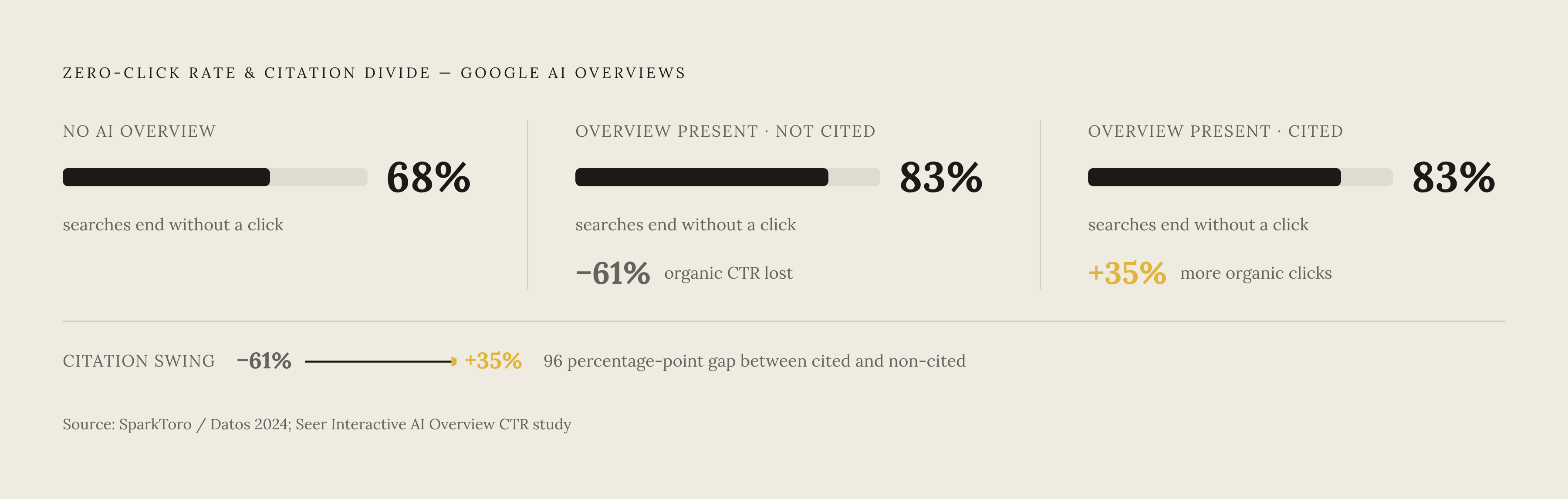
Most searches on Google no longer end in a click Similarweb. Between January and April 2026, 68.01% of U.S. browser searches on Google ended without a click Similarweb. Adding an AI Overview to the results page pushes that number to 83%. Ranking on page one used to be the finish line; now, since most searches resolve before a click, the only way to reach someone is to be the source the AI answer quotes.
The damage to click-through is not abstract. Seer Interactive measured a 61% drop in organic click-through and a 68% drop in paid click-through on queries that trigger an AI Overview. That guts the traffic model most SaaS marketing teams built their funnels around. For software buyers, the shift runs deeper still: more than half of B2B buyers now start vendor research in an AI chatbot, and AI chat shapes 54% of shortlists before anyone visits a pricing page.
The flip side matters just as much as the bad news. Brands that get cited inside the AI Overview earned 35% more organic clicks on average, according to Seer Interactive. Zero-click doesn't mean zero-return. It means the return only flows to whoever gets quoted.
That's the entire premise behind Generative Engine Optimization, or GEO: the deliberate practice of earning citation and inclusion inside AI-generated answers, whether that's Google's AI Overviews, Gemini, ChatGPT, Perplexity, or Claude. GEO is a different game with a different scoreboard from SEO, and the rest of this piece is about how to actually play it Zero-Click SEO in 2026: Winning AI Overviews and SERP Answers Without….
Why this is a structural opening for bootstrapped tools, not just a new SEO chore
Read that twice. Nearly a third of the pages AI engines trust enough to quote never ranked in Google at all Zero-Click SEO in 2026: Winning AI Overviews and SERP Answers Without….
Practically, AI engines reward the quality and extractability of individual passages over whoever has accumulated the most domain authority over the years. A single well-built paragraph can outcompete a decade of backlink accumulation, provided it says something specific enough to quote.
A second data point deserves attention here. Google's AI Overview shares only 35% of its sources with the organic results sitting directly beneath it. Ranking well doesn't guarantee a citation. But a page that's never ranked at all can still get picked up and cited, if it says the right thing in the right shape.
For a bootstrapped SaaS founder, that's the opening. A well-funded competitor with 200 backlinks on a thin comparison page is no more citable than an unranked founder page if neither contains a clear, extractable answer. Backlinks stop being the moat. Specificity becomes the moat.
Two cases make this concrete. REsimpli became the top ChatGPT recommendation for real estate investor CRM queries within 90 days, and domain authority had nothing to do with it Zero-Click SEO in 2026: Winning AI Overviews and SERP Answers Without…. Verito went from averaging position 40 on Google to becoming the top AI answer across its high-intent hosting prompts Zero-Click SEO in 2026: Winning AI Overviews and SERP Answers Without…. The mechanism wasn't backlinks or spend. It was specific, extractable, original claims that competitors simply hadn't bothered to publish Zero-Click SEO in 2026: Winning AI Overviews and SERP Answers Without….
Neither company won this with budget. They won by publishing passage-level content AI engines could confidently lift and reproduce as a standalone answer. That's a learnable format, not a lucky break, and the next section breaks down what it looks like.
Passage-level content and why the format is the strategy
Not a meta description or a title tag dressed up as a summary, but a complete paragraph that answers the question fully enough that nothing else on the page is needed.
This matches the query set a SaaS category generates on its own, regardless of whether anyone writes for it.
Confidence drives the logic of all of this. AI engines are hunting for passages they can cite without hedging their own credibility on it, and ambiguity kills that confidence fast. A specific claim with a named outcome beats a general description every time. It's a matter of confidence, not style. It's closer to a search algorithm's risk calculation: vague claims are unverifiable, and unverifiable claims don't get quoted.
There's a real payoff waiting on the other side of zero-click, too. OptimizeGEO's data shows that pages gaining AI Overview placement after structural cleanup see an average 35% lift in branded search volume. People don't click through from the AI answer, but remember the name and search for it directly later. Zero-click still drives awareness, just on a delay.
This isn't about stuffing keywords until a relevance score trips; it's about clearing the confidence threshold an AI model sets before quoting anyone. Form follows function: would a careful editor feel safe lifting this sentence and putting it in someone else's mouth? The target format is a 40–60 word complete answer placed first on the page, written to stand alone. This format wins for definitional content, comparison facts, and how-to queries, the exact types bootstrapped SaaS tools generate around their category. Practical content categories bootstrapped SaaS tools should target first are outlined below. One such category is product category definitions, such as "what is a [niche] CRM".
How bootstrapped SaaS tools can produce original, citable claims without a research budget
The REsimpli and Verito cases share a truth: the winning material wasn't peer-reviewed research or a funded study, but specific, extractable, original claims competitors never bothered to write down. The bar is committing something specific and extractable to a page before anyone else does.
Founders running lean SaaS tools already sit on more such material than they realize. Exact time-to-value numbers count (first app live in under an hour, first paying customer inside two weeks). Named workflow outcomes count too: what a user actually stopped doing after adopting the tool, not a vague claim about saved time. Support data (issues resolved automatically versus needing a human) and specific, quotable testimonials round out the list. Vague praise doesn't count; a number does.
Before publishing, run the citation-worthiness test: could this sentence be lifted whole into an AI answer with no surrounding page needed? If not, it still belongs on the page, further down, doing supporting rather than headline work.
A handful of claim types carry outsized value for SaaS tools specifically: time benchmarks like days to first paying user or hours to a working MVP, cost-per-outcome math grounded in real pricing, stack replacement counts (replacing five separate services is a citable fact), and named integration outcomes rather than a bare logo list.
What kills citability fast is the vague superlative: "the easiest," "the most powerful," "the best-in-class" all fail because an AI engine can't verify them and won't risk repeating them. Specificity and verifiability are, for this purpose, the same thing.
Writing the right sentence isn't sufficient alone: if a crawler can't find or parse the page, none of this content work matters. Real cost comparisons should use actual plan pricing, not estimates (the stitched-stack alternative costs $73–$205/month, versus a single plan for the all-in-one route).
Content must be reachable before it can be judged, which is where small SaaS tools quietly bleed their GEO potential unnoticed.
A short list of technical requirements decides whether AI crawlers ever see the page in the first place. Pre-rendering or server-side rendering matters most: content must sit in raw HTML, not load via JavaScript afterward, since a crawler that doesn't execute scripts like a browser will miss it. Canonical URLs consolidate authority around one definitive version of a page instead of splitting it across duplicates. Meta descriptions and social preview tags need to actually describe the page, since AI engines treat them as real content signals, not decoration. Structured data—FAQ, HowTo, and Product schema—helps an AI engine categorize a page without guessing, which matters greatly for comparison and feature pages. AI crawlers won't abandon a slow page like a human would, but a page that fails to render completely gets cited incompletely, or not at all.
Platform choice decides how much of this a founder has to manage by hand. Anyone stitching together Next.js, Supabase, Vercel, Resend, and Stripe owns every one of these configuration decisions individually, while all-in-one builder users must check item by item what's automatic versus manual.
For builders on an MCP-based infrastructure layer, pre-rendering, sitemaps, canonical URLs, and meta previews either ship as defaults or get bolted on later. Publishing citation-ready content in one step is faster than spending an afternoon wiring plumbing that should've come standard.
Once the content and infrastructure are sound, deciding what queries to target first becomes the priority—the point where GEO strategy diverges most sharply from traditional keyword SEO.
Why comparison and definition formats lead among the queries to target first
Definitional, comparison, and how-to queries are the highest-probability formats for AI citation.
"How to [specific workflow]" queries reward numbered steps tied to named outcomes, while "best [tool category] for [use case]" queries reward a tool that states explicitly why it fits that use case.
The comparison format deserves extra weight here. An AI engine answering a "vs" query needs specific differentiators to cite; a vague feature list always loses to exact pricing and named capability gaps. A bootstrapped tool can genuinely publish first here, if the well-funded competitor has only put out marketing copy instead of a real comparison.
Deprioritize broad informational queries with no decision intent, where citation might build awareness but won't drive a purchase, and where existing cited content is already dense with competitors. Time is finite. Spend it where citation converts.
The REsimpli and Verito pattern applies to hunting for query gaps: scan the top AI answers live in your category for claims asserted with confidence but never sourced. Those gaps are exactly where a specific, citable page can walk in and take the spot.
How the all-in-one vs. stitched-stack decision affects how fast you can execute GEO
GEO runs on a clock traditional SEO never had: speed to publish is now a competitive variable, not a nice-to-have Zero-Click SEO in 2026: Winning AI Overviews and SERP Answers Without….
That's where the platform decision starts to matter beyond convenience.
The cost isn't really the point: every hour debugging a Vercel deploy setting is an hour not spent writing the specific, extractable claim that gets quoted.
An MCP-based infrastructure layer handling backend, database, hosting, authentication, pre-rendering, sitemaps, canonical URLs, and meta previews as defaults changes that math: the founder's time returns to the content work GEO rewards. No platform writes the original claims; it just means infrastructure stops competing with writing for the same limited hours.
A second, quieter advantage follows from this. Comparison formats and honest pricing transparency are among the highest-value GEO content types, and a founder on a flat, predictable plan can publish a credible cost comparison in a way one on an opaque, token-metered bill can't. A trustworthy pricing structure needs to support any trustworthy pricing claims made on top of it. GEO is time-sensitive in a way SEO wasn't: REsimpli went from zero to top AI citation in 90 days, only because content was published and structured quickly enough to be crawled before competitors filled the gap. The stitched-stack tax means founders running Next.js, Supabase, Vercel, Resend, and Stripe at MVP stage spend $73–$205/month and own every configuration decision, including the SEO and crawlability requirements above. Individual component costs for context are given below, with all figures for 2026. Supabase costs $0–$25/month. Vercel costs $0–$20/month. Resend costs $0–$20/month. Stripe costs 2.9% + $0.30/transaction. ChatGPT Plus or Claude Pro costs $20/month. The all-in-one argument isn't just about cost—it's the operational drag of maintaining five separate configuration contexts while publishing citation-worthy content on a bootstrapper's time budget.
What to measure and adjust once GEO pages are live
Standard analytics dashboards weren't built for this. They track clicks, but GEO's premise is that the win often happens before a click occurs, so different instruments are needed.
Branded search volume is the most reliable leading indicator that AI citation is building awareness, with OptimizeGEO finding an average 35% lift in branded search after a page earns AI Overview placement. Someone who sees a brand cited in an AI answer and navigates directly, bypassing search results, never registers as a referral, so direct traffic and dark social referrals matter next. Manual checking, though unglamorous, works: run target queries through ChatGPT, Perplexity, Claude, and Google's AI Mode regularly, noting whether the tool gets cited, how it's described, and which claims are attributed to it. Organic click-through on pages earning AI Overview placement deserves tracking against the baseline drop, since non-cited pages lose roughly 61% of organic clicks once an Overview appears, showing whether a cited page recovers past that floor.
None of this is permanent: a page that earns a citation this quarter can lose it the moment a competitor publishes a sharper, more specific claim. Treat every cited page as a position to defend, not a task that's finished, and keep scanning for the next asserted-but-unsourced claim sitting in a competitor's answer, waiting for someone to actually write it down first.