Community-Led Distribution for Bootstrapped SaaS
How bootstrapped founders can use community to compound retention without paid ads.
A solo founder in 2026 can build a working SaaS product in a weekend. Getting strangers to care about it still takes months, sometimes years. Building stopped being the hard part.
That shift cuts both ways. A product one person can build in a few weeks, a competitor can copy in a few weeks too, so the durable advantage moves to whoever owns the attention and trust of the people who'd use it. Paddle's 2025 framing shows the money following the same shift: five years ago the split between product spend and go-to-market ran roughly opposite to where it sits now, and go-to-market has taken over as the dominant share. For a founder who can't outspend an incumbent on paid ads, that flip isn't a strategic wrinkle to note and move past. It decides whether the product gets customers.
How community-led distribution compounds
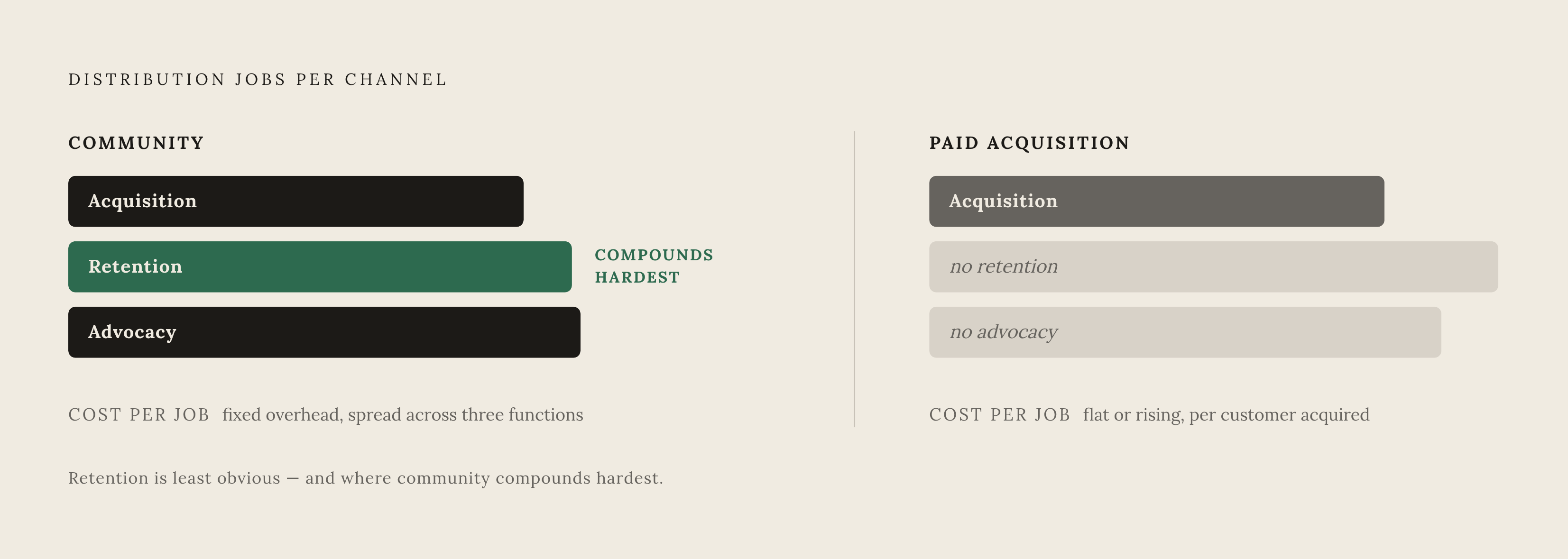
Community-led distribution earns its name because it turns the people already using a product into the mechanism that brings in the next ones, and it gets cheaper to run as it grows instead of more expensive. Paid acquisition runs on a simple, punishing rule: every new customer costs roughly what the last one cost, often more. A community runs on member goodwill instead: existing members answer questions, refer new users, and vouch for the product publicly. Existing members answer questions that would otherwise land in a support queue, current users bring in new ones through direct referral, and public advocacy shortens the distance between a stranger hearing about the product and trusting it enough to try it.
Three separate jobs run at once inside that structure. Acquisition happens when new people discover the product because they overheard someone in the community discussing it. Retention happens because a member who's built relationships inside that community has a reason to stay beyond the product's feature set, since leaving means losing those connections too. Advocacy happens when a satisfied member writes a post, answers a stranger's question, or makes a referral without being asked.
Retention is where this compounds hardest. A study cited by The Smarketers found that companies with active user communities report meaningfully higher retention than companies relying on traditional sales and marketing alone. That matters more for a bootstrapped SaaS product than almost any other metric, because a subscription business's economics are built on customers staying, not just arriving. A channel that improves retention is quietly improving every other number downstream of it, including the ones that show up on a cap table a founder will never have to raise.
Nobody paid those agencies to do that. Promoting the platform was in each agency's direct financial interest, since their own businesses depended on its success. That's a distribution engine with its incentives built into the structure itself, and it costs nothing in ad spend to run.
The measurement problem that community-led growth advocates understate
Community-led distribution works, but most programs that claim to run one can't prove it did. A SaaStr survey found that a majority of SaaS community programs can't attribute any revenue to community engagement at all. That's not a verdict on whether the programs failed. In most cases, nobody ever built the infrastructure to track whether community touchpoints preceded a signup, an upgrade, or a renewal, so the question of whether it worked was never answerable in the first place.
The success stories cited to justify community strategy carry a survivorship problem. A template ecosystem and an expert network get held up as proof that community builds companies. Both benefited from category-defining positioning, use cases that stretch in nearly infinite directions, and product flexibility that a narrow, focused tool will never have. A founder building a single-purpose SaaS product aimed at one job cannot replicate the conditions that made those two examples work, so borrowing their playbook wholesale sets up a comparison that was never fair to begin with.
Analysis of the broader 2024 to 2026 SaaS landscape backs up the more modest claim. True community-led growth rarely functions as a standalone channel that closes contracts on its own. It works best layered on top of other acquisition motions, amplifying what's already working rather than replacing it. SaaS Capital's 2025 benchmark, drawn from more than a thousand private B2B SaaS companies, puts median annual growth for bootstrapped companies in the low-to-mid double digits, and community-led companies don't dramatically outperform that median on raw growth rate. Selling community as a growth hack that will outrun the median is dishonest, and it sets founders up to abandon the strategy the moment it doesn't deliver a hockey stick.
What community actually does is optimize retention and word-of-mouth advocacy rather than raw acquisition velocity. It doesn't replace product-market fit or substitute for whatever acquisition motion is already working, paid or organic. It's a compounding layer sitting on top of those motions, making each one more efficient the longer it runs. For a bootstrapped founder with no marketing budget, that compounding effect on retention and referrals is worth building deliberately, even if it won't show up as a growth-rate miracle in a benchmark spreadsheet.
Building in public as the on-ramp to distribution
The cheapest way for a bootstrapped founder to seed a community is to build in public, and the founders who've made it work share one specific discipline: they teach what they're learning while they're still learning it, and the audience that follows that process becomes the first customer base once a product actually ships.
Pieter Levels built Nomad List, Remote OK, Photo AI, and Interior AI this way, all bootstrapped, all generating revenue without paid acquisition driving the growth. Tony Dinh founded TypingMind and grew it to meaningful monthly recurring revenue as a single developer while running DevUtils, having sold his earlier project BlackMagic.so in 2023. Dinh's distribution came from publicly documenting his own process as he built it. Marie Martens co-founded Tally Forms, a bootstrapped alternative to Typeform that reached significant annual recurring revenue, and the community that grew up around Tally became one of its earliest and most important marketing assets. Damon Chen took a mundane workflow, collecting video testimonials, and built the cleanest SaaS product available for that specific job, documenting the build publicly the entire way.
None of these founders built a community first and then built a product to sell it. They built the product in front of an audience, in public, in real time, and the audience that watched that process become the community itself. That ordering matters. A founder who tries to assemble an audience before having anything to show them is asking strangers to pay attention on faith. A founder who documents a real, specific problem being solved in public gives people something concrete to follow, and the people who stick around through that process already trust the founder by the time there's something to buy.
The acquisition loop in 2026: search, social, and community cross-pollination
Community doesn't replace search traffic or social reach in 2026. It amplifies both, and the founders growing fastest are the ones who design deliberately for the handoffs between all three.
Picture a founder who publishes a technical walkthrough solving one specific, narrow problem, the kind of post that ranks for a search query someone types when they're stuck on exactly that problem. The post ends with an invitation into a community discussion. Someone finds the post through search, joins the discussion, asks a follow-up question nobody had addressed yet, and that exchange turns into another piece of content that ranks for a slightly different query next month. The cycle repeats, each round adding another indexable page and another reason for a new visitor to land inside the community instead of just reading a static article and leaving.
Community cross-pollination runs alongside that loop. A member active in one Discord server or subreddit carries a mention of the product into a second community the founder never targeted directly, and that second audience arrives with a peer's recommendation already attached instead of a cold pitch.
Tutorial content is the connective tissue holding this whole loop together. A tutorial that shows a product solving a real problem works for search rankings and gives community members something concrete to share when they're recommending the product to a peer. For no-code and AI-builder tools specifically, this format carries a structural advantage: the distance between someone describing an idea out loud and a working app existing on screen is demonstrable in a short walkthrough. That's a gap a reader can watch close in real time, and it's far more shareable than a static list of features, because a feature list asks someone to imagine a benefit while a walkthrough shows them the benefit happening.
The infrastructure layer under a bootstrapped SaaS product and community viability
A community-led strategy falls apart if the product underneath it can't keep up with what the community generates: new users who need onboarding, feedback that needs a response, and a system that has to stay reliable while the number of people relying on it keeps climbing. That makes infrastructure a distribution decision as much as a technical one.
The feedback loop at the center of community trust runs on speed. When a member publicly requests a feature or flags a friction point, the founder who ships a fix within days earns far more trust and far more advocacy than the founder who queues the request for a quarterly release cycle. A founder juggling separate providers for hosting, database, authentication, email, and payments spends hours on maintenance and integration work that a community-led strategy demands go toward the product and the conversation happening around it instead.
Onboarding friction does direct damage to referral willingness. A new user who arrives because a community member vouched for the product, then hits a confusing setup flow or a deploy that breaks, reflects badly on the person who made that referral. That member is less likely to refer the next person, because their own credibility took the hit. The choice between an all-in-one infrastructure approach and stitching together separate services comes down to velocity more than cost. It's about velocity: the founder who ships, iterates, and answers community feedback faster than competitors builds community trust faster, and that speed compounds the same way retention does.
One approach to closing that gap is an MCP connector, where the infrastructure meets the founder inside the AI tools already being used to build and run the product. Introducing the MCP connector reduces the friction between community feedback and shipped response, letting a conversation that produces a new feature idea move toward publishing that feature without the founder switching context. The fewer steps between a community member's feedback and a shipped response, the faster trust builds and the faster that trust turns into the advocacy loop the entire strategy depends on.
The deliberate community architecture a bootstrapped founder should build from day one
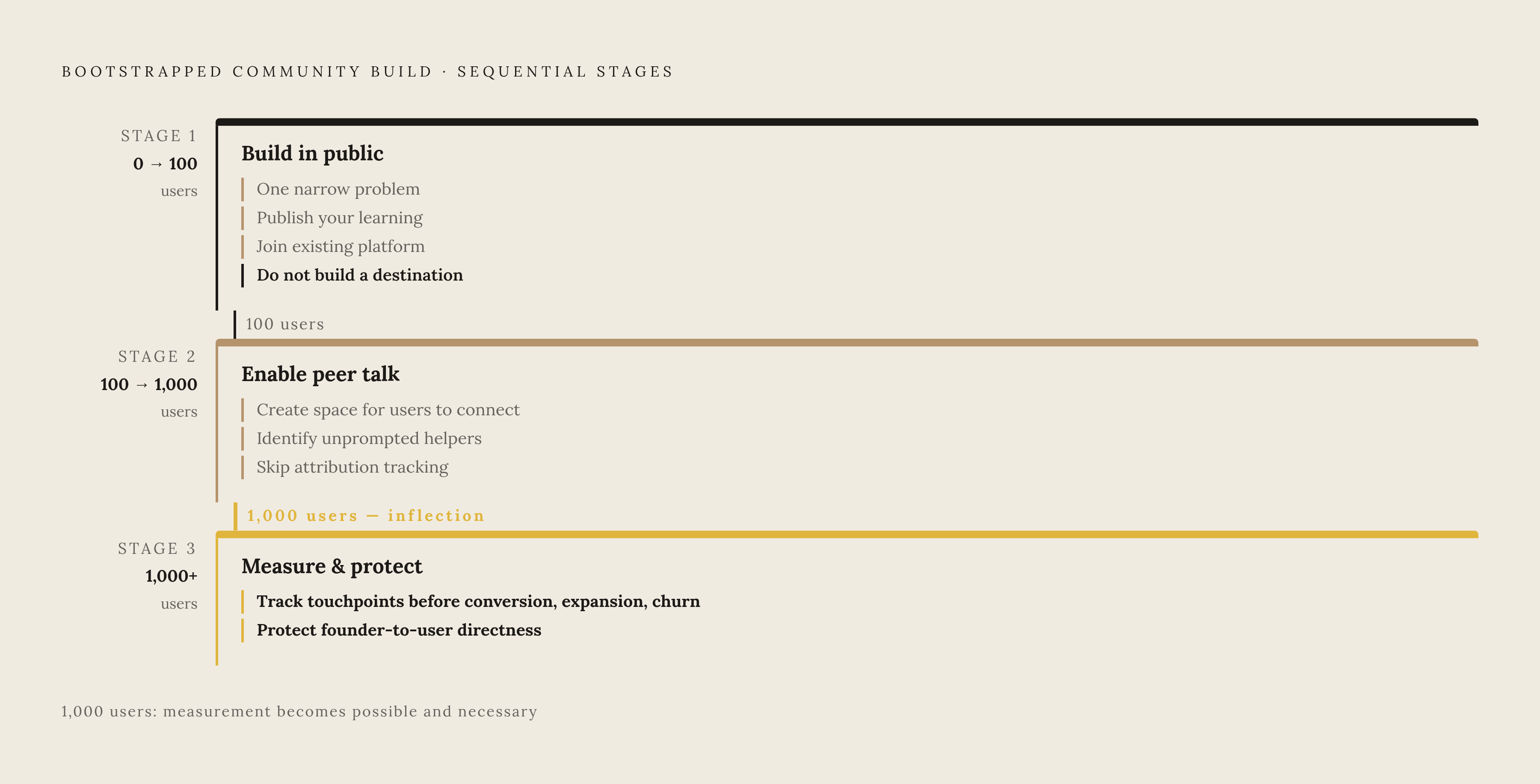
Community-led distribution doesn't happen by accident. It takes a deliberate structure built in stages, and a founder who builds that structure from day one holds a real advantage over one who tries to bolt it on after early traction has already stalled.
Stage one runs from before launch through the first hundred users. The job here is to build in public around one specific, narrow problem, publishing the learning process itself rather than just the finished product, and picking a single existing platform where the target audience already spends time instead of trying to build a destination from scratch. A Discord server with no members in it is a liability, not an asset. Skip building one until there are people who'd actually populate it.
Stage two runs from the first hundred users to the first thousand. The task shifts to creating a space where users talk to each other, not just to the founder, and to identifying the members who are already helping others unprompted. Those members are the community's distribution engine, so investing attention in them pays off more than investing attention in the founder's own visibility. Attribution infrastructure doesn't belong here yet. A community this size hasn't generated enough signal for that data to mean anything.
Stage three starts past the first thousand users, and this is where measurement finally becomes possible and necessary. Tracking which community touchpoints precede a conversion, an expansion, or a churn event turns guesswork into a measurable system. Without it, a founder is back to guessing whether any of this worked. The founder-to-user directness that built the community's trust in the first place is the one discipline to protect at this stage. Scaling the structure doesn't mean disappearing from it.
Structuring a program around practitioners who build their own livelihoods on top of the product creates a distribution layer that's motivated and self-sustaining in a way no paid channel can match at the same cost.
A founder who builds this deliberately from day one arrives at the point where paid acquisition finally becomes affordable holding three things a competitor can't simply buy: a retention advantage built over years of community relationships, a referral engine running on members who already have a stake in the product's success, and a content library built from real problems solved in public rather than generic marketing copy. That combination is what makes community-led distribution the one growth channel a capital-constrained founder can build without capital, and the one advantage that compounds for as long as the community keeps talking to itself.